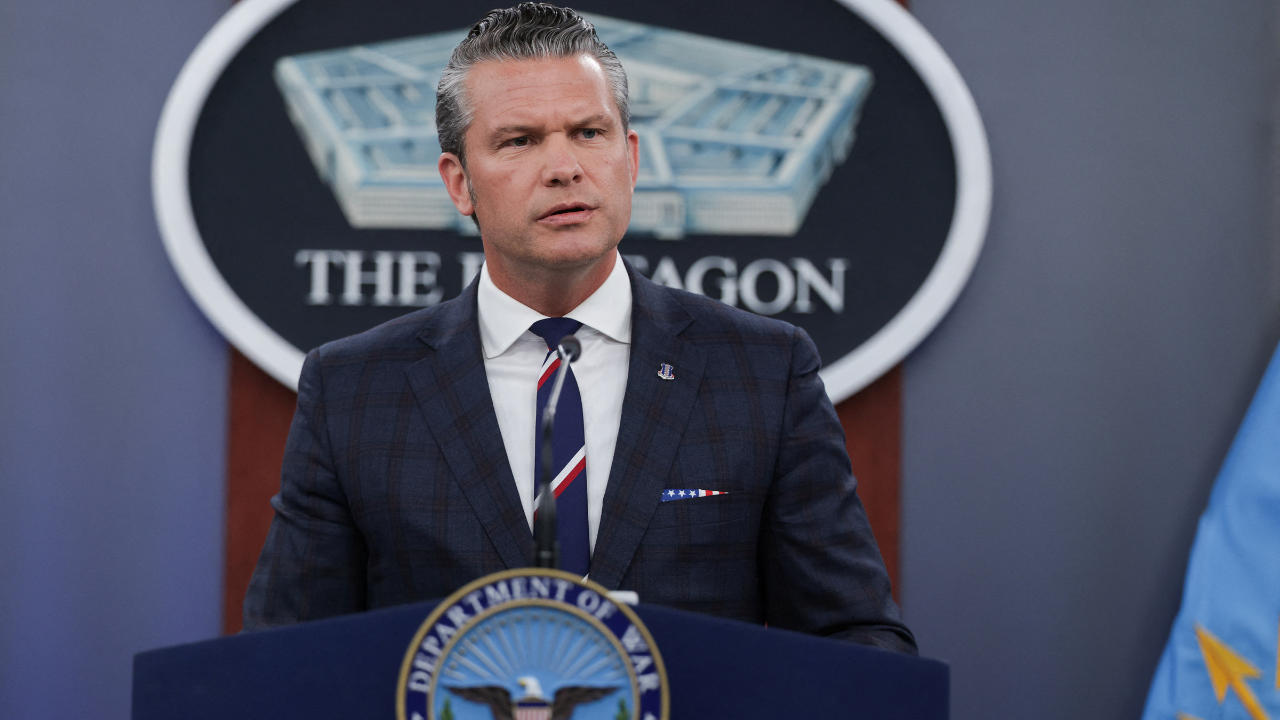
When political analysts and media outlets frame the recent friction between Vice President JD Vance and Defense Secretary Pete Hegseth as a simple finger-pointing exercise over midterm election results, they miss the structural reality of modern American foreign policy. According to reporting on the exchange—headlined by Hegseth’s statement that he "won’t point fingers" regarding Vance’s assertion that the conflict with Iran contributed to Republican midterm losses—the public narrative has quickly settled into a familiar Washington parlor game. Pundits treat the disagreement as a tactical dispute over campaign messaging or a routine blame-shifting maneuver after a disappointing election cycle.
That framing reduces a generational ideological divide to mere electoral post-mortem gossip.
To understand what is actually happening inside the administration and the broader conservative coalition, you have to look past the surface-level headlines about ballot boxes and swing districts. The exchange between Vance and Hegseth is not just about who lost which House seat or why independent voters stayed home. It is the visible fault line between two fundamentally incompatible theories of American power: Jacksonian restraint and traditional hawkish deterrence.
The Lazy Consensus of Electoral Blame
In Washington, every policy debate eventually gets flattened into a question of electoral math. When a party underperforms in a midterm election, commentators immediately reach for the most prominent news event of the cycle and declare it the culprit. In this case, Vance publicly linked U.S. military entanglement with Iran to Republican losses at the ballot box, arguing that voters rejected foreign interventions that felt disconnected from domestic economic priorities. Hegseth, responding to questions about Vance’s remarks, declined to engage in public recriminations, stating he would not point fingers while emphasizing operational focus and national security imperatives.
The mainstream coverage treats this moment as a standard intra-party squabble over optics. Political strategists argue over whether acknowledging voter fatigue with foreign conflicts helps or hurts future campaigns. Meanwhile, defense commentators debate whether talking about domestic politics undermines military credibility abroad.
Both sides of that commentary miss the point. Voters rarely punish an administration over a single foreign policy line item in isolation, and senior officials rarely make pointed public remarks just to vent frustration about poll numbers. When a Vice President and a Defense Secretary signal divergent interpretations of a major conflict, they are fighting over who controls the strategic doctrine of the executive branch for the remainder of the term—and who defines the party’s identity for the next decade.
Historical Precedent Beats Midterm Spin
Political history shows that the relationship between foreign conflict and midterm elections is far more complex than simple cause-and-effect narratives suggest. Consider the historical record of American midterms during periods of overseas military engagement:
- 1966 and 1970 (Vietnam): While the war in Vietnam certainly eroded public trust over time, the 1966 Democratic losses and 1970 mixed results were heavily driven by domestic inflation, civil unrest, and the standard historical penalty suffered by the party holding the White House in a second midterm.
- 2006 (Iraq): The 2006 wave election, in which Republicans lost control of both chambers of Congress, is often cited as the ultimate proof that unpopular wars sink midterm majorities. Yet even in 2006, structural factors—including sixth-year presidential fatigue, domestic political scandals, and economic anxieties—compounded the backlash against the conflict in Iraq.
- 2010 and 2014 (Afghanistan and the Middle East): During the Obama administration, major midterm losses in 2010 and 2014 occurred amid ongoing military operations in Afghanistan and rising instability in Iraq and Syria, yet exit polling consistently showed healthcare, job growth, and domestic economic recovery dominating voter decision-making.
In political science, the "midterm penalty"—the well-documented phenomenon in which the president’s party almost always loses seats in Congress regardless of specific policy events—remains one of the most reliable constants in American politics. Attributing midterm outcomes primarily to a single foreign policy front ignores decades of empirical data showing that domestic pocketbook issues and structural cycle dynamics usually carry greater weight with undecided voters.
Two Competing Doctrines Inside One Coalition
If the electoral math does not fully explain the tension, what does? The answer lies in the unresolved ideological merger that built the modern Republican coalition.
For nearly a decade, the GOP has housed two distinct worldviews under one roof without ever reconciling them:
- The Restraint and Realism Wing: Represented prominently by Vice President Vance, this faction views prolonged Middle Eastern engagements as strategic distractions that drain American blood, treasure, and industrial capacity. From this perspective, every dollar and munition committed to the Persian Gulf is a resource diverted from domestic revitalization and strategic competition in the Indo-Pacific. Pointing out the political cost of conflict with Iran is not merely an observation about the midterms; it is a deliberate argument that foreign intervention violates the core social contract with working-class voters.
- The Peace Through Strength Wing: Represented by figures like Defense Secretary Hegseth and traditional defense hawks, this school of thought holds that American credibility depends on decisive deterrence and unwavering support for regional allies. From this vantage point, refusing to confront adversaries like Iran invites greater instability, threatens global energy markets, and signals weakness that other rivals—from Beijing to Moscow—will inevitably exploit. Declining to "point fingers" over domestic electoral fallout is a way of insulating military strategy from short-term political swings.
When these two doctrines collide in real time during an active crisis, neither side is talking purely about last Tuesday’s election results. Vance is arguing that the political coalition cannot survive if it abandons its anti-interventionist promises. Hegseth is maintaining that national security decisions cannot be dictated by campaign post-mortems.
What People Actually Need to Know About Foreign Policy and Elections
Public discourse around this dispute frequently gets tangled in flawed assumptions about how governance works during a crisis. Addressing the underlying questions directly clarifies what is actually at stake:
Does a Vice President publicly criticizing the political cost of a war undermine military operations?
Not necessarily in a tactical sense, as operational command flows through the President and the Secretary of Defense to combatant commanders. However, public divergence at the highest levels of the executive branch does affect strategic signaling. Adversaries closely monitor Washington’s domestic political cohesion to gauge whether the United States has the political stamina for a protracted standoff.
Can an administration pursue "America First" restraint while simultaneously engaging in direct deterrence against Iran?
This is the central paradox facing the administration. Restraint advocates argue that deterrence can be achieved offshore without deep entanglement, while hawks contend that credible deterrence requires visible, forward-deployed force and a willingness to escalate when red lines are crossed. Attempting to satisfy both constituencies simultaneously often produces tactical ambiguity—doing enough to incur political criticism from non-interventionists, while stopping short of the decisive action demanded by hawks.
Why did Hegseth refuse to engage in a public back-and-forth?
In institutional terms, a Defense Secretary’s primary constituency is the chain of command, the armed forces, and allied defense ministries—not the political press corps. Entering a public debate with the Vice President over electoral blame would politicize the Pentagon’s leadership at a moment when operational discipline is the top priority.
The Real Stakes Going Forward
The media’s obsession with interpersonal drama—who slighted whom, who is up or down in the West Wing pecking order—obscures a much more consequential reality. Every presidential administration eventually confronts the gap between campaign rhetoric and the unforgiving constraints of global geopolitics.
During a campaign, it is easy to promise both ironclad deterrence against hostile regimes and total avoidance of foreign entanglements. Once in office, events in the Strait of Hormuz, missile launches, and alliance commitments force leaders to choose which priority takes precedence when the two collide.
The conversation sparked by Vance’s critique and Hegseth’s measured response is the first major test of how this administration resolves that contradiction. If the restraint wing wins the internal argument, future U.S. posture in the Middle East will likely shift toward rapid de-escalation, stricter limits on force posture, and a higher threshold for military intervention, regardless of regional pressure. If the traditional deterrence wing prevails, the administration will continue to prioritize countering Iranian capabilities and reassuring allies, accepting the domestic political friction as an unavoidable cost of global leadership.
Looking Beyond the Headlines
Voters and observers who want to understand where U.S. foreign policy is headed should stop counting mentions of midterm losses in press briefings and start watching concrete indicators: force posture deployments in the Central Command area of responsibility, supplemental defense spending requests, and the language used in upcoming National Security Strategy documents.
Rhetoric in Washington is often designed to reassure a specific political audience. Resource allocation and troop movements tell you who actually won the argument.
The debate over Iran and the midterms is not a post-mortem on an election that has already happened; it is an opening skirmish over the strategic direction of American power for the rest of the decade.