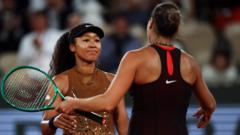
The scheduling of the fourth-round match between top seed Aryna Sabalenka and Naomi Osaka under the lights of Court Philippe-Chatrier was treated like a monumental breakthrough. It shouldn't have been. While the star-studded clash marked the first time in three years that a women’s singles match was granted the marquee night-session slot at the French Open, the decision was less a progressive leap forward and more an act of scheduling desperation.
Tournament organizers at Roland Garros have long shielded themselves behind broadcasting contracts and ticket-value arguments to justify an almost exclusive reliance on men's matches for their lucrative evening slot. By placing Sabalenka and Osaka in the 8:15 p.m. window only after the top half of the men's draw collapsed, the French Tennis Federation (FFT) exposed the cynical reality of Grand Slam economics. The move proved that the exclusion of women from primetime is a self-fulfilling prophecy manufactured by the tournament itself, and breaking this cycle requires a complete overhaul of how tennis handles its evening entertainment.
The Backup Option Privilege
To understand why the Sabalenka-Osaka match felt like a forced concession rather than an earned showcase, one only has to look at the numbers. Out of 64 total night sessions since the single-match evening ticket format was introduced in Paris in 2021, a women's match has been selected exactly five times.
That is not a statistical anomaly. It is a deliberate editorial choice.
For three years, a consecutive streak of 33 men's matches occupied the primetime slot on Chatrier. Tournament director Amélie Mauresmo has repeatedly defended this imbalance by arguing that women’s best-of-three matches risk ending too quickly, leaving fans who paid anywhere from $70 to over $320 feeling shortchanged.
Yet, when injuries and early upsets cleared out the expected male headliners in the top half of the 2026 draw, the tournament suddenly remembered it had two four-time Grand Slam champions on the roster. WTA Chair Valerie Camillo had to actively lobby Mauresmo in a meeting just days prior to get the matchup considered. Treating a blockbuster battle between two former World No. 1s as a contingency plan reveals a deep-seated institutional bias that refuses to see women's tennis as a primary draw.
The Flawed Logic of the Single Match Ticket
The structural core of the problem lies in the French Open’s rigid programming format. Unlike the Australian Open or the US Open, which pack their evening sessions with a double-header—typically one men's and one women's match—Roland Garros insists on selling a ticket for a solitary, standalone match.
This creates an immediate structural trap for the WTA Tour.
If a top-tier woman dominates her opponent and wins 6-2, 6-1, the match is over in 55 minutes. If a man wins a routine straight-sets match in the best-of-five format, it still consumes roughly two hours of television time. By measuring value purely through the ticking of a clock rather than the quality of the spectacle, the FFT has engineered a system where the shorter, sharper nature of women's tennis is viewed as a financial liability.
The irony was on full display during Monday night's showcase. Sabalenka and Osaka traded heavy baseline blows in a high-intensity slugfest, with Sabalenka ultimately winning 7-5, 6-3. The entire contest lasted exactly one hour and 27 minutes.
It was elite, breathless tennis.
The stadium was at near capacity, and the crowd was visibly enthralled by everything from Osaka’s custom Eiffel Tower-inspired dress to Sabalenka’s post-match celebration. No one left early demanding a partial refund. The match proved that fans want star power and compelling narratives, not just a marathon of attrition that drags past midnight.
The Myth of Broadcast Pressure
Television executives are routinely blamed for the lack of women in primetime. Amazon Prime, which holds the exclusive rights to the Roland Garros night session in France, naturally demands maximum viewership numbers to satisfy advertisers. The prevailing myth in tennis boardrooms is that men's matches inherently draw larger television audiences.
The data tells a more complicated story.
When television ratings spike during Grand Slams, they track individual star power and dramatic stakes, not the gender of the athletes. A routine three-set men's match involving a low-ranked qualifier will regularly draw fewer eyeballs than a high-stakes women's match featuring household names.
By starved television audiences of women’s matches in the premium time slots, networks and tournaments prevent the WTA from building the very primetime viewership metrics they claim to look for. You cannot prove a product lacks a market if you refuse to put it on the shelf.
How to Fix the Primetime Crisis
If the French Open genuinely wants to "open the door" to women’s night sessions, as Sabalenka urged after her victory, it must abandon the single-match format that forces gender equality into a direct conflict with ticket value. The solution is glaringly obvious, yet the FFT remains stubborn.
1. Adopt the Double-Header Format
The tournament must follow the blueprint established in Melbourne and New York. By starting the evening session an hour earlier, at 7:00 p.m., Chatrier could comfortably host one women's match and one men's match. This completely eliminates the fear of a short evening. If the women's match finishes quickly, the men's match provides the remaining value. If the men's match is a blowout, the women's match carries the night.
2. Rotate the Order of Play
To ensure fairness and manage the logistical nightmare of late-night finishes, the tournament must alternate which field takes the court first.
- Night 1: Women's singles followed by Men's singles.
- Night 2: Men's singles followed by Women's singles.
This rotation prevents one tour from consistently getting stuck playing at 2:00 a.m. in front of an empty stadium, a logistical hazard that has plagued other majors.
+------------------+-----------------------+-----------------------+
| Session Strategy | Match 1 (7:00 PM)     | Match 2 (Approx. 8:30)|
+------------------+-----------------------+-----------------------+
| Rotation A       | WTA Singles (Best of 3)| ATP Singles (Best of 5)|
| Rotation B       | ATP Singles (Best of 5)| WTA Singles (Best of 3)|
+------------------+-----------------------+-----------------------+
3. Reform the Ticketing Structure
If the tournament refuses to expand the night session to two matches due to local transport curfews in Paris, then the pricing of the night session ticket must be decoupled from the length of the match. Ground passes could be bundled with night session access, or the evening slot could be treated as a premium extension of the day session ticket rather than a separate, high-priced commodity.
The crowd reaction to Sabalenka and Osaka proved that the tennis public does not share the anxieties of the tournament's executives. The appetite for women’s tennis under the lights is there, but it is being choked by an administrative structure that treats equality as an administrative burden. Until Roland Garros changes the very architecture of its evening sessions, one-off matches like Monday’s will remain token gestures rather than real progress.