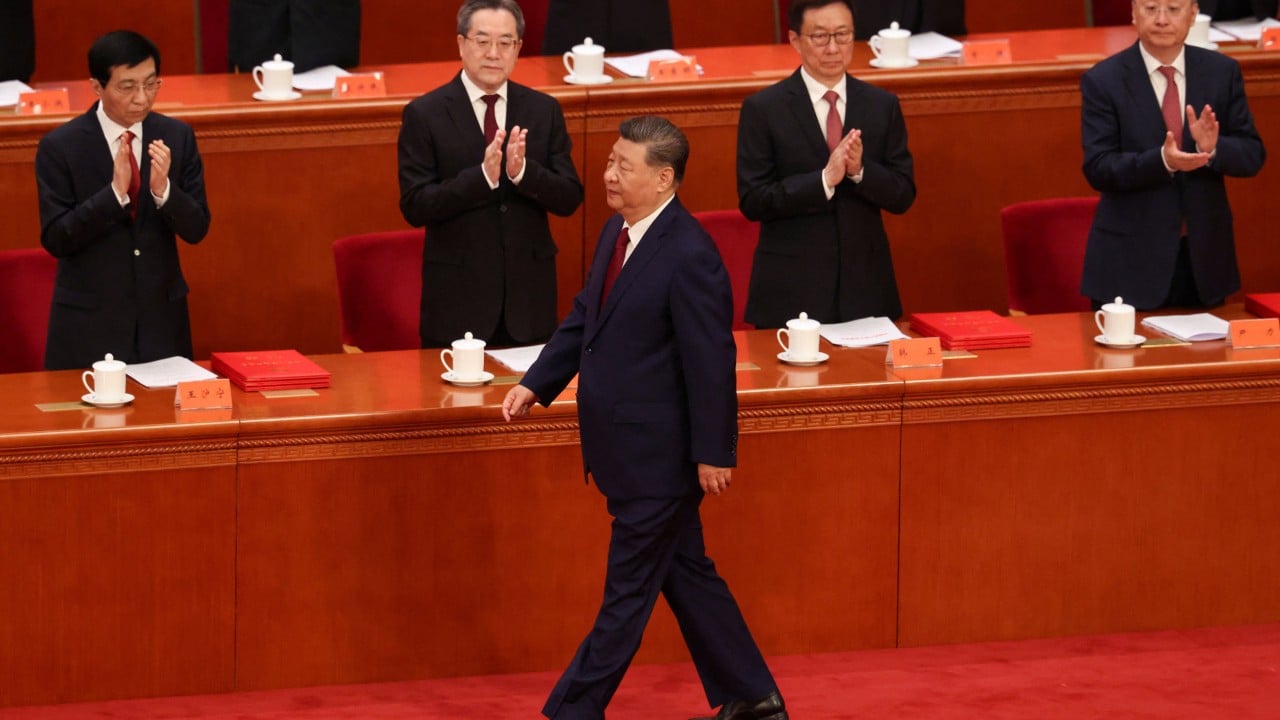
Chinese leader Xi Jinping stood before the massed ranks of the Communist Party faithful at the Great Hall of the People in Beijing to deliver a message of unyielding confidence. The occasion was the 105th anniversary of the founding of the ruling party. For forty minutes, the broadcast beamed a clear directive to the nation and the world that China offers a new blueprint for human advancement, backed by military might and ideological purity. Yet, this performance of absolute control masks a starkly different domestic reality. The carefully curated projection of global leadership is increasingly serving as an armor to shield a domestic architecture fracturing under the weight of historic economic slowdowns, real estate collapse, and deep systemic anxieties.
Beneath the rhetorical triumph lies an economy trying to self-correct without abandoning the central planning mechanisms that created its current vulnerabilities. For decades, the implicit contract between the citizens and the state relied on material advancement. That arrangement is fraying. By examining the structural friction points currently testing Beijing, from industrial overcapacity to internal party purges, it becomes clear that the display of external confidence is an urgent political necessity rather than a reflection of smooth sailing.
The Great Hall of Illusion
The imagery from July 1 was classic political theater, designed to convey continuity and strength. Xi warned of high winds and rough seas ahead. He exhorted over one hundred million party members to maintain confidence, insisting that no matter how treacherous the path, the organization would remain dauntless. The language was deliberately combative. It frame every internal obstacle as a challenge to be conquered through sheer ideological willpower and tighter discipline.
This focus on externalizing blame and magnifying foreign hostility helps maintain domestic cohesion. When the state media portrays the international arena as a hostile terrain of Western containment and unfair trade barriers, domestic sacrifices become matters of national security. The rhetoric seeks to elevate standard governance failures into epic struggles for civilizational survival. By positioning the party as the sole custodian of Chinese modernization, the leadership attempts to make any dissent look like a betrayal of the motherland itself.
The global audience was treated to an assertive declaration that Chinese wisdom and Chinese solutions represent a superior alternative to Western models of development. Beijing is actively using formats like the expanded BRICS bloc to position itself as the champion of the Global South. This strategy aims to build an alternative network of alliances that can bypass traditional financial and diplomatic institutions dominated by Washington and Europe. It is an ambitious plan. It relies on the assumption that developing nations will prioritize infrastructure capital and trade access over political liberalisation or adherence to established maritime rules.
The Iron Grip on an Empty Pocket
While the state projects international authority, the economic foundation supporting it is experiencing a profound transformation. The official growth target has cooled to between 4.5% and 5%. This target is the lowest statutory ambition the country has set for itself in decades, signaling an unspoken acknowledgment that the era of explosive, double-digit expansion has permanently ended. The state can no longer rely on building empty cities and expanding highway systems to inflate its balance sheets.
The most visible wound is the property sector, which has entered its fifth consecutive year of severe contraction. Most metrics tracking real estate activity, including new construction starts, total sales volume, and private investment, have dropped between 50% and 80% from their peaks at the start of the decade. This is not a cyclical dip that can be cured with a brief reduction in interest rates. It is a structural unwinding. For a generation of Chinese citizens, real estate was the primary vehicle for wealth accumulation, accounting for the vast majority of household assets. With property valuations in freefall, consumer confidence has evaporated.
This collapse has triggered a dangerous chain reaction through local government finances. Historically, municipal administrations funded their budgets and serviced their debt by leasing land to ambitious developers. That revenue stream has dried up completely. Local governments are now burdened with massive, hidden debt portfolios accumulated through off-balance-sheet investment vehicles. To avoid outright defaults, municipal authorities have begun cutting public services, reducing civil service salaries, and raising local fees. This extraction of capital from local communities further depresses the exact consumer spending that the central government claims it wants to encourage.
The state’s refusal to enact direct financial support for households reveals an ideological rigidity at the very top of the hierarchy. Western economists frequently argue that Beijing should implement cash transfers, expand the rural pension system, and boost public spending on health and education to unlock private consumption. Currently, household consumption in China stands at roughly 40% of gross domestic product. This figure is significantly lower than the global average of about 60%. Chinese citizens save nearly a third of their disposable income simply because the state social safety net is too thin to protect them from medical emergencies or old-age destitution. Rather than filling these structural gaps, the leadership views direct consumer welfare as an unearned entitlement that undermines the national work ethic.
The Export Mirage and the Threat of Involution
Instead of stimulating internal demand, the state has doubled down on its traditional strength by funneling credit into advanced manufacturing and heavy industry. This decision has caused a surge in exports, helping to offset the domestic real estate drag. This strategy allows headline production figures to look respectable. However, it creates severe imbalances both domestically and internationally.
Inside the domestic market, this hyper-focus on production has triggered a phenomenon known as involution, or intensive, self-defeating competition. When local governments across different provinces all use state subsidies to build factories for electric vehicles, solar panels, and lithium batteries, supply rapidly outstrips actual demand. The result is a brutal price war that destroys corporate profitability. Companies are forced to cut wages and lay off workers just to survive the domestic market pressure. This dynamic produces an economic paradox. Factories are operating at maximum capacity, using state-of-the-art automation, while the workers who staff them cannot afford to buy the products they assemble.
+--------------------------------------------------------------+
|               THE INVOLUTION CYCLE IN MANUFACTURING          |
+--------------------------------------------------------------+
|                                                              |
|   1. Massive State & Local Subsidies for Tech/Green Firms    |
|                              │                               |
|                              ▼                               |
|   2. Industrial Overcapacity Across Multiple Provinces       |
|                              │                               |
|                              ▼                               |
|   3. Aggressive Domestic Price Wars & Vanishing Profits      |
|                              │                               |
|                              ▼                               |
|   4. Wage Cuts, Layoffs, and Weak Consumer Confidence       |
|                              │                               |
|                              ▼                               |
|   5. Excess Inventories Dumped into Global Export Markets   |
|                                                              |
+--------------------------------------------------------------+
To relieve this internal pressure, the excess inventory is redirected into global markets at prices that foreign competitors cannot match. This approach has provoked a wave of trade protectionism. Advanced economies and developing countries alike are erecting high tariff walls to protect their own domestic manufacturing bases from being hollowed out by cheap imports. The central government assumes that its dominance over global supply chains and critical rare earth materials gives it enough leverage to weather these trade disputes. It is a risky calculation. As foreign governments implement anti-dumping duties, the export channel that currently keeps the economy afloat faces tightening restrictions.
Furthermore, high-tech manufacturing is inherently capital-intensive rather than labor-intensive. Automated assembly lines do not solve the employment crisis affecting young citizens. University graduates are entering a job market where the available positions are either low-paying service roles or grueling manufacturing shifts. The mismatch between expectations and economic reality has led to widespread disillusionment among younger generations, who increasingly choose to opt out of the intense professional competition entirely.
Purging the Ranks to Secure a Fourth Term
To manage these compounding tensions without triggering social instability, Xi has intensified his focus on internal security and organizational discipline. In his anniversary speech, he used medical vocabulary to describe his ongoing anti-corruption campaign, vowing to eliminate all viruses that erode the health of the party. This language indicates that the internal political cleansing, which has defined his tenure, will continue without interruption.
The anti-corruption drive serves a dual purpose. It removes genuinely corrupt officials who undermine local administration, and it systematically dismantles alternative power centers within the bureaucracy. In recent years, this purge has reached into the highest echelons of the defense establishment and civilian regulatory bodies. Top military officials and generals have been removed from their posts overnight, replaced by loyalists whose primary qualification is absolute adherence to the leader’s ideological line.
This environment of constant scrutiny has created an atmosphere of administrative paralysis across the country. Bureaucrats at the provincial and municipal levels are terrified of making mistakes that could be interpreted as political disloyalty. When local officials prioritize political survival over practical governance, they avoid taking any initiative. They wait for explicit, written instructions from the top before executing basic policy shifts. This dynamic slows down the government's ability to respond to rapidly evolving economic crises, as local leaders refuse to experiment with innovative solutions for fear of stepping outside the approved ideological framework.
The timing of this renewed push for discipline is highly strategic. The party is moving toward a crucial congress next year, where Xi is expected to formally secure a fourth five-year term as leader. This trajectory was enabled by the removal of presidential term limits years ago, effectively binding the destiny of the nation to the survival and absolute authority of one man. To ensure a seamless transition into this next phase of long-term rule, any potential pocket of institutional resistance must be neutralized well in advance.
The Dangerous Path of Ideological Suffocation
The core gamble of the current administration is that ideological uniformity can substitute for structural economic reform. The state has recently elevated a new branch of official doctrine to guide its long-term governance strategy. This step requires classrooms, research institutions, and corporate boardrooms to spend significant time studying official texts, ensuring that political alignment takes precedence over technical pragmatism.
This approach creates a fundamental tension with the country’s stated goal of achieving technological self-reliance. True innovation requires experimentation, the freedom to fail, and an open exchange of information. By placing strict ideological boundaries around intellectual life and tightening controls over internet data and academic research, the state risks suffocating the creative impulse needed to develop genuine breakthroughs in semiconductors, artificial intelligence, and biotechnology. The bureaucracy believes it can command innovation from the top down through state funding. History suggests that while state direction can effectively build infrastructure or replicate existing technologies, it struggles to generate the unpredictable leaps that define modern scientific advancement.
The foreign policy apparatus reflects this internal rigidity. Diplomatic missions operate under strict instructions to defend the state's positions with aggressive rhetoric, leaving little room for the compromise or nuance required to de-escalate complex international disputes. Tensions over the status of Taiwan and maritime borders in the South China Sea remain highly volatile. The central leadership continues to frame national reunification as an historical inevitability, a stance that forces the military to maintain a permanent state of high readiness despite the internal disruption caused by ongoing anti-corruption purges within its ranks.
The grand performance at the Great Hall of the People was intended to project a country moving confidently toward its destiny under an undisputed leader. The reality is far more fragile. The state is trapped in a structural bind of its own making, using export surges to hide domestic deflation, applying ideological discipline to mask administrative fear, and projecting international power to distract from growing domestic economic anxieties. As the gap between official rhetoric and daily economic experience continues to widen for ordinary citizens, maintaining this illusion of absolute confidence will require ever greater amounts of state resources and political coercion. The leadership has made its choice clear, opting to tighten its grip on the steering wheel even as the underlying engine begins to show signs of severe stress.