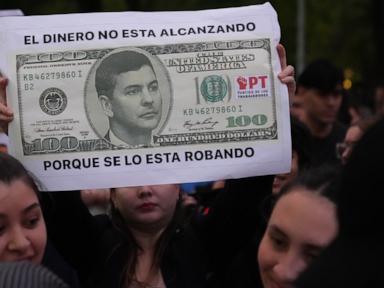
Imagine waking up to find your life savings locked behind a shuttered bank door while the government insists the financial system has never been healthier. That's the exact reality thousands of families are facing right now following the Paraguay bank collapse. When Banco Atlas and related financial entities hit the wall, or more specifically when Ueno Bank's rapid expansion collided with deep-seated political patronage and the fallout from Banco Atlas and Basa, the shockwaves didn't stay confined to Asunción's financial district. They went straight to the presidential palace.
Most international coverage treats this like a dry accounting failure. It isn't. It's a collision of concentrated political power, questionable regulatory oversight, and everyday people getting crushed by institutions they were told to trust. If you want to understand why President Santiago Peña is suddenly fighting for his political survival, you have to follow the money—and look closely at who owns the banks.
How the Paraguay Bank Collapse Actually Happened
Banks rarely fail overnight. They rot from the inside while glossy marketing campaigns tell depositors everything is fine.
In Paraguay, the financial sector has long operated like an exclusive club where political influence and banking licenses overlap. For years, retail depositors poured money into local institutions chasing yields that looked great on paper compared to traditional regional options. Meanwhile, regulators at the Banco Central del Paraguay (BCP) maintained a public posture of strict stability.
Then liquidity dried up. When confidence cracks in a smaller emerging market, bank runs don't happen politely. Institutional investors pull their capital first, quietly moving funds offshore or into dollar-denominated assets before retail customers even hear a rumor. By the time ordinary savers line up outside branches in Asunción or Ciudad del Este, the vaults are already functionally empty.
Here's what most people miss about how this unfolded:
- Over-concentration of risk: Too many loans were tied to a small circle of politically connected conglomerates and agricultural exporters vulnerable to weather shocks and commodity swings.
- Regulatory blind spots: Warning signs in balance sheets were either ignored or softened because the executives running these institutions had direct lines to top government officials.
- Aggressive digital expansion without adequate buffers: Rapid growth in customer acquisition outpaced actual capital reserves, leaving zero margin for error when interest rates shifted.
When the BCP finally stepped in to intervene and freeze operations, the official line was "preventative resolution." Try telling that to a retired teacher who can't pay for surgery because her pension payout is trapped in a frozen account.
Trapped Savings and the Illusion of Deposit Insurance
On paper, Paraguay has a deposit guarantee fund—the Fondo de Garantía de Depósitos (FGD). Government spokespeople rushed to television studios to remind panicked citizens that insured deposits are protected up to a statutory limit (75 minimum wages).
Sounds reassuring, right? In practice, it's a nightmare for anyone holding more than a modest checking balance.
First, the payout process is painfully slow. Verifying accounts, reconciling ledgers, and disbursing funds takes months, not days. Small business owners who rely on weekly cash flow to pay suppliers and staff don't have months. Several local importers and mid-sized retailers in Asunción have already defaulted on commercial leases simply because their operating capital is stuck in regulatory limbo.
Second, anyone with savings above the coverage cap—whether it's a family that just sold a piece of land or a company holding payroll reserves—faces massive haircuts. They become unsecured creditors in a liquidation process that can drag on for years in Paraguayan courts.
I've watched similar banking crises play out across Latin America over the past two decades, and the pattern never changes. Politicians protect institutional bondholders and connected insiders first. Regular savers get told to be patient while inflation eats away whatever fraction of their money they eventually recover.
Why Dollar Accounts Hit Hardest
Paraguay has a heavily dollarized economy. Roughly half of all deposits and loans in the country are denominated in U.S. dollars. When a local bank runs into trouble, the central bank can print guaraníes to provide emergency liquidity, though doing so risks inflation. It cannot print U.S. dollars.
Once a bank's dollar reserves are depleted, there is no magic lever for the BCP to pull. Depositors holding dollar accounts suddenly realized that the "dollars" on their banking app were just an IOU from an institution that didn't actually have the greenbacks on hand. That realization triggered panic across the entire financial system, forcing even healthy banks to hoard cash and freeze new credit lines.
Why President Santiago Peña Is in the Crosshairs
If this were purely a private-sector failure, Santiago Peña could play the tough reformer, fire a few regulators, and promise justice. He can't do that here. Why? Because his own financial history and political alliances are tangled directly into Paraguay's banking elite.
Before taking office in August 2023, Peña wasn't just a technocrat—he worked at Banco Basa, a bank owned by the family of Horacio Cartes, the former president who still controls the ruling Colorado Party and serves as Peña's political mentor. Cartes himself has been sanctioned by the U.S. government over corruption allegations, which already put Paraguay's financial sector under intense international scrutiny.
When the current banking crisis erupted, opposition lawmakers and street protesters immediately connected the dots. Critics pointed out that government agencies and state-owned enterprises—most notably the Instituto de Previsión Social (IPS), Paraguay's massive social security fund—had moved hundreds of millions of dollars into specific favored banks right before the turmoil escalated.
Think about how bad that looks. While private institutions were struggling behind the scenes, public pension funds were being used to prop up liquidity in banks linked to the administration's inner circle.
The Political Fallout Is Just Starting
Peña built his entire presidency on a single pitch: he is a modern, U.S.-educated economist who would bring foreign investment, investment-grade credit ratings, and institutional maturity to Paraguay. Moody's even upgraded Paraguay to investment grade in 2024, a milestone Peña touted constantly.
Now that narrative is crumbling. Foreign investors aren't stupid. They see a president whose administration is accused of steering state funds to politically friendly banks while regular citizens lose access to their money. Street protests in Asunción have grown louder, bringing together angry depositors, labor unions, and opposition factions that normally can't agree on anything.
Even within the Colorado Party, fractures are showing. Traditional party bosses who never fully trusted Peña's technocratic circle are using the banking mess to extract concessions and weaken his grip on cabinet appointments. Impeachment talk, once dismissed as fringe noise, is now being whispered openly in congressional hallways.
What Most Analysts Get Wrong About Paraguay's Economy
If you read standard macroeconomic reports from Wall Street or multilateral lenders, Paraguay looks like a South American success story. Low taxes, cheap hydroelectric power from Itaipú, steady GDP growth around 3.5% to 4%, and manageable public debt.
Those numbers hide a massive structural flaw. Paraguay's economy is small, informal, and overwhelmingly controlled by a handful of families who own the media, the agricultural export firms, the construction companies, and the banks.
When you have that level of concentration, there is no real firewall between business failure and state crisis. A bank doesn't just fail on its own; it threatens to pull down the political party that enabled it. Standard risk models miss this because they look at debt-to-GDP ratios rather than political ownership networks.
Honestly, the warning signs were flashing red for at least two years. Rapid credit growth in consumer lending, opaque related-party transactions, and aggressive bidding for state deposits are textbook indicators of an impending crunch. Regulators chose to look the other way because challenging the wrong bank owner in Asunción is a fast way to end your career.
Practical Steps If You Hold Assets or Do Business in Paraguay
If you have personal savings, business operations, or investments tied to Paraguay right now, hoping the government stabilizes things isn't a strategy. You need to protect your exposure immediately.
- Audit your counterparty risk today. Don't keep all your cash in a single domestic Paraguayan bank, regardless of how shiny its mobile app is or how high its CD rates look. Spread operating capital across multiple institutions, prioritizing regional or international banks with strong foreign parent backing.
- Respect the deposit insurance ceiling. Check the exact current limit of the Fondo de Garantía de Depósitos (75 minimum wages, calculated per depositor per institution) and ensure no single account exceeds that threshold. Anything above that line is at risk if another mid-tier lender freezes withdrawals.
- Separate currency exposure. Understand that local dollar accounts carry convertibility and liquidity risk during systemic stress. If you hold significant U.S. dollar reserves for business or retirement, consider holding a portion in jurisdictions where the central bank actually backs the currency or in short-term U.S. Treasury instruments.
- Watch IPS and state deposit movements. In Paraguay, where public pension funds move, political risk follows. Pay close attention to investigative reporting from independent outlets like ABC Color and Última Hora regarding which banks are receiving sudden injections of public funds—that's often a sign of behind-the-scenes liquidity stress rather than strength.
Paraguay's banking crisis isn't over, and the political reckoning for Santiago Peña has barely begun. Until Asunción separates political patronage from financial regulation, every deposit slip in the country comes with hidden fine print.