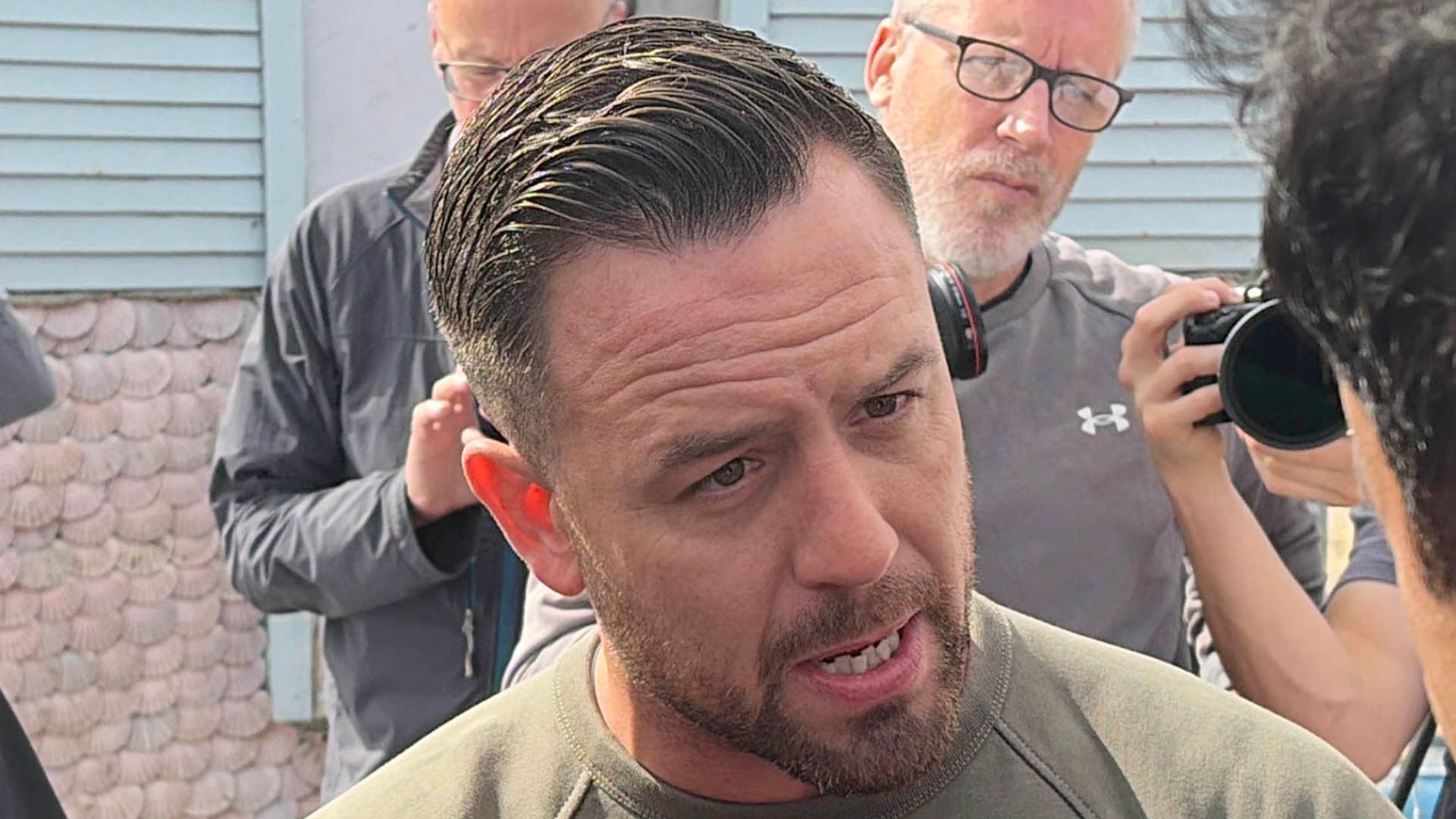
Far-right activist Daniel Thomas, known online as Danny Tommo, has been sentenced to prison after slashing an inflatable migrant dinghy on a beach in northern France while broadcasting the act to his followers. The conviction marks a sharp legal boundary for cross-Channel anti-migrant agitators who have increasingly traveled from the United Kingdom to French coastal towns to film confrontations, disrupt small-boat launches, and monetize outrage for domestic audiences. What began as a livestreamed stunt intended to project strength and defiance ended in a French courtroom, exposing the legal vulnerabilities of foreign vigilantes operating outside their own jurisdiction.
For years, the stretch of coastline between Calais and Dunkirk has served as both a humanitarian flashpoint and a political stage. While British political rhetoric has focused heavily on stopping small boats in the English Channel, a subset of online activists decided that parliamentary debate was moving too slowly. They crossed the Channel with cameras, tripods, and social media accounts hungry for engagement. Their stated goal was deterrence. Their actual business model was attention.
The Anatomy of a Livestreamed Stunt
Daniel Thomas built his online profile within the ecosystem of British street-level nationalist activism. Like many figures in that space, his influence depended on constant visibility, confrontational livestreams, and the framing of political grievances as immediate physical emergencies. Traveling to northern France offered high-stakes visuals that domestic protests could no longer match.
On the beaches near Calais and Gravelines, inflatable dinghies staged by smuggling networks represent the physical threshold of the Channel crisis. For activists seeking viral footage, puncturing a boat on camera delivers an unmistakable visual payoff. It requires no policy nuance, no sustained organizing, and no engagement with the complex logistics of cross-border policing. A knife, a camera, and an internet connection are enough to generate thousands of shares within minutes.
That simplicity is precisely what made the tactic attractive—and what made prosecution almost inevitable. Unlike vague political speeches or noisy demonstrations outside hotels in Britain, destroying property on foreign soil leaves behind unambiguous physical evidence. Worse still for the perpetrator, livestreaming the act hands prosecutors a timestamped, high-definition confession.
French authorities have long dealt with the operational burden of policing dozens of miles of shifting dunes, estuaries, and industrial ports. Local police units, gendarmes, and maritime patrols already operate under intense pressure to intercept launches before overcrowded boats enter busy shipping lanes. Introducing foreign nationals into that environment to carry out vigilante property damage does not assist law enforcement. It complicates active operations, escalates the risk of violent clashes on isolated beaches, and forces French officers to divert resources toward policing political tourists.
Why French Courts Treat Vigilantism Differently
A common miscalculation among British activists operating in France is assuming that political framing will soften criminal liability. In the United Kingdom, debates over protest rights, public order offenses, and free speech often dominate media coverage of far-right arrests, giving defendants a ready-made narrative of political persecution. Inside a French criminal court, that framing carries little weight.
French criminal procedure treats intentional destruction of property and unauthorized vigilante intervention as straightforward public-order offenses. Whether a dinghy belongs to a smuggling network, an unidentified owner, or sits staged near the water awaiting use, a private citizen has zero legal authority to destroy it. Under French law, the right to seize, disable, or destroy equipment linked to criminal activity belongs exclusively to state authorities acting under judicial and administrative rules.
There is a practical reason for this strict monopoly on enforcement. Northern France is not an empty stage set. Smuggling networks operating along the coast are organized, profit-driven criminal enterprises that guard their equipment and routes aggressively. When untrained outsiders approach staging areas with knives to slash boats, they risk triggering immediate retaliation—not necessarily against themselves once they retreat to a parked car, but against migrants waiting on the beach or local residents caught nearby.
French prosecutors also recognize the contagious nature of performative vigilantism. If one activist livestreams himself slashing a boat and walks away with a fine or a suspended sentence, dozens more will book ferry tickets the following weekend. Custodial sentences serve a clear deterrent function. They signal that northern France will not become an unregulated hunting ground for foreign content creators chasing algorithmic rewards.
The Economics of Border Outrage
To understand why someone would film themselves committing a crime in another country, you have to look at the incentives driving fringe political media. Traditional political organizing is slow, expensive, and unglamorous. Building a local constituency or influencing legislation takes years. Livestreaming direct action collapses that timeline into a single afternoon.
Within the right-wing digital ecosystem, escalation is currency. Moderate commentary rarely breaks through crowded social feeds. Viewers conditioned by years of increasingly dramatic clips expect each broadcast to raise the stakes. If last month’s video showed an activist shouting outside an asylum hotel, next month’s video needs higher drama to hold the audience. Crossing into France to physically intervene in the Channel crisis satisfied that demand for escalation.
The financial mechanics behind these broadcasts are straightforward even when platforms restrict direct ad revenue. High-engagement livestreams funnel viewers toward secondary donation links, subscription channels, merchandise pages, and crowdfunding appeals—especially legal defense funds once arrests occur. Paradoxically, getting arrested can temporarily boost an activist’s standing within their core audience, reinforcing a narrative of sacrifice and state repression.
Yet prison changes the equation. Online bravado translates poorly to a cell in a foreign penal system, away from sympathetic media ecosystems and familiar surroundings. A jail sentence interrupts content production, severs regular access to audiences, and imposes real personal cost where previously there was only digital applause.
What Vigilante Disruption Actually Does to Channel Policing
Supporters of direct-action stunts frequently argue that slashing a dinghy saves lives by preventing a dangerous sea crossing. On the surface, the claim sounds intuitive. If a flimsy inflatable boat cannot launch, nobody drowns in the Channel that night.
In reality, smuggling networks do not operate on a single-boat model. They operate as resilient supply chains.
How Smuggling Logistics Absorb Small-Scale Sabotage
Criminal facilitators along the northern French coast procure inflatable craft, outboard motors, and life jackets in bulk, often sourcing hulls from manufacturers outside Europe and moving them through fragmented transit routes across Belgium, Germany, and France. Boats are cached in dunes, wooded areas, and temporary storage sites well away from the shoreline until the final window before departure.
When a single dinghy is damaged on a beach, the network rarely cancels an operation permanently. Instead, facilitators pass the cost down to migrants who have already paid thousands of pounds for passage, delay the launch until a replacement hull is brought forward, or shift departures to less monitored stretches of coast further west toward Boulogne-sur-Mer and the Somme estuary.
The Operational Damage to Law Enforcement
Unannounced vigilante activity creates serious blind spots for legitimate enforcement agencies. French intelligence and policing units rely on surveillance, coordinated patrols, and tracking equipment to map smuggling movements and arrest organizers rather than merely puncturing rubber hulls. When activists storm onto a beach with cameras rolling:
- Surveillance operations are blown: Undercover observation of high-level facilitators collapses the moment a commotion draws attention to the area.
- Departures become more dangerous: Panicked launches triggered by unexpected confrontations increase the likelihood that boats are pushed into the water prematurely, overloaded, or poorly balanced.
- Police bandwidth is consumed: Officers who could be intercepting vehicles carrying engines and fuel must instead detain, process, and interview foreign vigilantes.
The irony is hard to miss. Actions marketed online as "doing the job the authorities refuse to do" actively undermine the coordinated intelligence work required to dismantle smuggling rings at the source.
The Cross-Channel Friction Nobody Wants to Own
The conviction of Daniel Thomas also highlights an uncomfortable diplomatic reality between London and Paris. For years, successive British governments have poured hundreds of millions of pounds into bilateral agreements funding French coastal patrols, drones, detection technology, and detention capacity. Despite those investments, small-boat crossings have remained a persistent political liability in Westminster.
That frustration has created fertile ground for populist narratives suggesting that France is either unwilling or unable to control its coastline. When British activists travel to Calais to film themselves taking matters into their own hands, they tap directly into that domestic skepticism. To their followers, the footage serves as visual proof that ordinary citizens are stepping into a vacuum left by governments.
For Paris, however, the optics are intolerable. France guards its territorial sovereignty fiercely, and the spectacle of British political agitators conducting self-styled enforcement operations on French soil strikes at the heart of state authority. French officials already face domestic criticism in coastal communities like Calais and Dunkirk, where mayors and residents complain that their towns have been turned into a permanent buffer zone for Britain’s border politics.
Allowing foreign vigilantes to operate unchecked would inflame local resentment and strain bilateral cooperation at a time when both governments depend on joint intelligence sharing to target smuggling networks. In that context, a firm judicial response was not merely predictable—it was diplomatically necessary.
The Illusion of the Lone Enforcer
There is a deep cultural appeal to the myth of the lone citizen stepping forward when institutions appear paralyzed. Social media algorithms amplify that myth relentlessly, turning impulsive acts into cinematic clips stripped of context, consequence, or complexity.
In practice, border enforcement is an intricate legal and logistical discipline governed by maritime law, international treaties, criminal intelligence, and chain-of-custody rules. A pocketknife and a smartphone cannot substitute for cross-border policing, nor can vigilante theater solve a migration crisis driven by global instability, clandestine logistics, and economic demand.
By broadcasting the destruction of a dinghy on a French beach, Danny Tommo delivered the exact spectacle his online audience wanted. He also handed French prosecutors everything they needed to put him behind bars, proving once again that when performative activism collides with sovereign criminal law, the livestream ends long before the sentence does.


