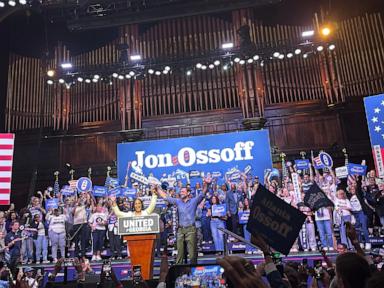
The asphalt on the campaign trail never really cools down in Georgia. It just waits. On a humid Tuesday afternoon, the kind where the air feels like a wet wool blanket, a local volunteer shifts from one foot to the other outside a community center near Atlanta. She has three separate clipboards balanced on her forearm. Her sneakers are worn down at the heels from marching through suburban subdivisions. She isn’t waiting for an election happening next week, or even next month. She is working a machinery that began running the moment the last ballots were counted two years ago.
While she hands out literature, fifty miles away, a bitter, exhausting family feud is paralyzing the opposing political tribe.
This is the invisible reality of modern political warfare. We are trained to look at elections as sudden, explosive clashes—two forces colliding on a single Tuesday in November. But victories are rarely manufactured in the heat of a general election. They are built during the quiet, agonizing stretches of time when the public is barely paying attention. Right now, Georgia is witnessing a stark experiment in political physics: one side is moving with the synchronized precision of an atomic clock, while the other is trapped in a spinning wheel of internal friction.
To understand why this matters, look past the generic cable news chyrons and focus on the concept of political velocity. When a party enters a crucial election cycle united, with its champions already selected and its infrastructure greased, it possesses the ultimate luxury. Time. When a party is forced into a brutal runoff, it bleeds time, money, and sanity.
The contrast in Georgia is no longer just a difference in philosophy. It is a difference in math.
The Luxury of an Empty Track
Consider the position of Jon Ossoff and Keisha Lance Bottoms. They do not have to spend their mornings crafting attack ads against fellow Democrats. They do not have to look at polling data to see if their base is going to desert them for an insurgent candidate from their own flank. Because their path to the nomination is clear, their campaign apparatus operates like a massive corporate rollout rather than a chaotic backyard brawl.
Imagine a runner who gets to start the sprint fifty meters ahead of everyone else, while the other contestants are still at the starting line arguing over who gets to wear which jersey.
This head start manifests in ways that never make the evening news but dictate the final tally. It means booking the best television advertising slots six months in advance at a fraction of the cost. It means locking down the most talented field directors before they accept jobs in other states. It means Ossoff can spend an afternoon talking to manufacturing workers in Savannah about federal infrastructure funding without having to look over his shoulder. It allows Bottoms to build deep, quiet alliances with civic leaders in rural counties who are weary of partisan noise.
Unity creates a specific kind of gravity. It attracts donors who want predictability. It comforts volunteers who are terrified of internal party drama. When the top of the ticket displays a seamless front, the message to the rank-and-file is simple: We know exactly where we are going. Get in.
The Meatgrinder of the Runoff
Now turn your eyes to the Republican side of the ledger. The scene is entirely different. It is loud. It is expensive. It is deeply personal.
A primary runoff is a political meatgrinder. When no single candidate secures a clean majority in the initial vote, the top two finishers are thrown back into the arena for a localized, high-stakes duel. On paper, it sounds like a healthy exercise in democracy—a way to ensure the ultimate nominee has the backing of a true majority. In practice, it is a grueling exercise in mutual destruction.
Think of it as a custody battle where both parents are trying to convince the kids that the other side is unfit to live with.
To win a runoff, a candidate cannot simply talk about their vision for the state or criticize the opposing party. They have to convince their own most passionate voters that their fellow Republican is a fraud, a closet liberal, or a weak-kneed institutionalist. The rhetoric sharpens. The television ads become toxic.
"He isn't conservative enough," one ad screams.
"She betrayed the movement," another barks back.
The tragedy for the party is that every dollar spent on these intra-party broadsides is a dollar that cannot be used against the Democrats in November. Millions of dollars raised from passionate conservative donors are effectively vaporized, burning up in a civil war while Ossoff and Bottoms sit on an untouched mountain of cash.
Worse than the financial drain is the emotional exhaustion of the electorate. Voters do not have infinite energy. When they are bombarded for weeks with messages detailing why every Republican running is deeply flawed, a dangerous cynicism sets in. By the time the runoff concludes and a nominee finally emerges, bruised and bleeding from a thousand small cuts, the party leadership faces a monumental task. They have to somehow convince the supporters of the losing candidate to forget everything they heard over the last month, shake hands, and march together.
Sometimes they do. Often, the resentment lingers long enough to keep people home on the day it matters most.
The Human Infrastructure of the Precinct
The true cost of this delay is felt at the neighborhood level. Political power is not just about multi-million-dollar ad buys in the Atlanta television market; it is about the mundane human infrastructure of the precinct.
Let’s look at a hypothetical precinct leader—we will call him Marcus. Marcus lives in a fast-growing suburb in Gwinnett County. His job is to know which doors to knock on, which neighbors need a ride to the polls, and who is leaning toward changing their vote.
In the unified Democratic model, Marcus receives his marching orders, his voter lists, and his script in the spring. He has months to build a relationship with his neighborhood. He can drop by a backyard barbecue, chat with a registered independent at a school function, and slowly, methodically dismantle their objections over a series of months. His approach is patient. It feels human.
Now look at his Republican counterpart in the same neighborhood. This volunteer cannot start building that relationship yet. Why? Because he doesn't know who the candidate is. If he knocks on an independent voter’s door today, he cannot give a coherent pitch. He is stuck in limbo, waiting for the runoff dust to settle. By the time he finally gets his candidate, it is late summer. The calendar is working against him. His interactions must be rushed, transactional, and aggressive.
"Vote for our candidate because the other side is evil," becomes the default pitch when you run out of time to make a nuanced argument.
This discrepancy in pacing changes the entire texture of a campaign. One side is playing a game of chess with a clock that has hours left; the other side is playing speed chess, franticly slapping the timer as the seconds tick down to zero.
The Ghost of Georgia’s Political Past
This dynamic is not happening in a vacuum. Georgia has become the premier laboratory for American political realignment, a place where old assumptions go to die. For decades, the state was a predictable piece of real estate on the electoral map. The formula was simple: rural turnout would reliably overwhelm the urban core, and the suburbs would act as a conservative firewall.
That firewall has dissolved. The suburbs are no longer homogenous; they are transient, highly educated, racially diverse, and politically volatile. In this new Georgia, elections are decided on the razor’s edge of a percentage point.
Because the margins are so thin, the structural advantage of an early start becomes magnified. When an election is decided by ten points, a party can afford a messy primary, a public scandal, and a couple of weeks of bad press. When an election is decided by twelve thousand votes across an entire state, every single day of lost momentum is an existential threat.
The Republicans locked in this runoff are fighting yesterday’s war with yesterday’s tactics. They are operating under the assumption that the base will always unify out of sheer animosity toward the opposition. But that assumption overlooks the profound weariness of the modern voter. People are tired of the noise. If one party offers a calm, organized, forward-looking operation while the other offers a chaotic screaming match that stretches into the summer, the undecided voter makes a judgment not just on policy, but on competence.
The Quiet Room and the Loud Arena
On election night, when the television networks bring out their flashing graphics and their pundits analyze the exit polls, they will talk about ideology. They will debate whether Georgia is shifting left or right, and they will point to specific policy positions to explain the outcome.
They will miss the real story.
The real story is being written right now, in the contrast between a quiet room and a loud arena. In one room, a campaign staff sits around a table, calmly mapping out a digital mobilization strategy for October, their funding secure, their candidates focused, their internal polling steady. Outside the other arena, candidates are sweating through their suits, trading insults in a desperate bid to survive until next Tuesday, while their donors sigh and write checks they know are being wasted on friendly fire.
The candidate who wins the runoff will eventually step onto the stage, raise their arms in victory, and try to project strength. But as the confetti falls, they will look at the calendar, then at their bank account, and realize the terrible truth.
The race didn't start today. It started months ago, and the people they are trying to catch are already miles down the road.