A Cold Morning on the Route
Rain slicked the asphalt outside, turning the London streetlights into smeared streaks of amber and crimson. It was an ordinary morning on the city transit lines, the kind of damp, weary start to a day where passengers stare blankly into their phones or out at the blurred skyline, caught in the hypnotic hum of the diesel engine. The bus lurked through traffic, stopping, starting, opening its doors to let in wet umbrellas and heavy boots.
Nobody paid much attention to the fabric laundry bag slung under one of the plastic seats toward the rear.
London buses are graveyards for forgotten items. On any given Tuesday, drivers find damp umbrellas, single gloves, half-eaten sandwiches, cheap reading glasses, and cheap earphones left behind by absentminded commuters. A heavy, zippered laundry bag resting near the floorboards barely warranted a second glance. People carry laundry on the bus all the time.
Then, the bag moved.
It did not slide as the driver took a sharp corner. It twitched. A faint, high-pitched rustle came from beneath the heavy woven plastic fabric.
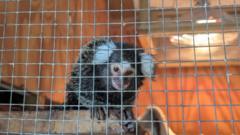
When a curious passenger leaned down and carefully pulled back the metal zipper, they did not find dirty clothes or forgotten groceries. Staring back at them from the darkness, wide-eyed and shivering violently, was a living creature that belonged thousands of miles away in a tropical canopy, not on the floor of a public transit vehicle in South London.
It was a small monkey.
The Invisible Trade Behind the Bus Seat
To understand how an exotic primate ends up sitting in a laundry bag on a wet double-decker bus, you have to look past the surreal nature of the moment and peek into the shadowy world of illegal and irresponsible exotic pet ownership.
Exotic animals do not appear out of thin air on city streets. Every wild creature kept in an apartment represents a long chain of bad decisions, legal loopholes, and human impulse.
Consider the marmoset or the squirrel monkey. In their natural habitats across Central and South America, these creatures live in complex, highly social family structures. They leap through canopy leaves, communicate using a intricate language of chirps and squeaks, and spend their days foraging and grooming one another. They are wild beings, wired by millions of years of evolution to exist in sunlight and endless greenery.
Yet, a quick search on unregulated online classifieds or social media trading groups reveals a very different reality. For a few hundred or a few thousand pounds, anyone with an internet connection can buy a baby primate. The sellers often market them as adorable, perpetual human infants—dressing them in tiny doll clothes, feeding them soft fruit, and promising potential buyers that these animals make affectionate, low-maintenance companions.
It is a fantasy built on ignorance and greed.
The reality hits hard and fast. A baby monkey might seem docile for the first few months of its life, but as it matures, its wild instincts take over. Primates are not domesticated. They do not possess the tens of thousands of years of evolutionary adaptation that allow dogs and cats to thrive alongside human beings.
As they grow, primates become territorial, unpredictable, and aggressive. They bite with terrifying force relative to their size. They mark their territory constantly, leaving behind a pungent scent that no household cleaning product can eliminate. They require specialized diets, precise ultraviolet lighting to prevent bone diseases, and immense space to move.
When the novelty wears off and the destruction begins, owners realize they are completely out of their depth.
The Moments Before Abandonment
Picture the human being carrying that laundry bag onto the bus.
They did not start their day planning to commit a crime of profound negligence. Perhaps months earlier, the idea had felt exciting. A monkey. A conversation starter. A sweet, unusual companion to fill a quiet room.
Then came the reality. The endless screeching at dusk. The damaged furniture. The medical bills from a specialist veterinarian who warned that the animal was suffering from metabolic bone disease due to a lack of proper sunlight. The sudden, sharp bite that drew blood when someone tried to clean the makeshift cage.
Panicking and desperate, the owner faced a crisis of their own making. Sanctuaries were full or required legal proof of origin. Local authorities might charge them with animal cruelty or illegal possession. Dumping the creature in a park in midwinter meant instant death for a tropical animal.
So, they chose the cowardly middle ground.
They packed the small creature into a dark, suffocating laundry bag. They walked through the chill city air, paid their bus fare, and slipped into a row of seats. As the bus rattled down the road, they quietly slid the bag under the seat, waited for the next stop, and walked off into the crowd, leaving their responsibility behind on the vinyl floorboards.
It is a specific kind of cruelty born of convenience—a refusal to face the consequences of one's own impulses.
The Rescue and the Reality of Recovery
When animal welfare officers arrived to collect the bag, the scene was equal parts tragic and terrifying for the tiny occupant.
Imagine being a miniature primate, weighing less than a loaf of bread. Your world has been a series of strange, cold rooms, followed by total darkness inside a zip-up container, accompanied by the roaring rumble of a giant mechanical engine and the terrifying smell of strangers.
Rescuers wrapped the bag in warm towels and carefully transferred the shivering animal to a secure carrier. The immediate goal was survival: combatting hypothermia, shock, and severe dehydration.
Work like this falls on specialized wildlife sanctuaries and organizations like the RSPCA. When these animals are recovered, the physical rescue is only the first step in a long, complicated path toward rehabilitation.
- Medical Evaluation: Vets must immediately test for metabolic deficiencies, malnutrition, and infectious diseases that thrive in improper captivity.
- Behavioral Assessment: Primates raised in isolation often exhibit severe psychological distress, such as self-clipping, pacing, or extreme fear of other animals.
- Social Integration: The hardest part is teaching a hand-reared, traumatized monkey how to be a monkey again—introducing them gradually to others of their species in an environment that simulates a natural habitat.
Even in the best sanctuaries, the damage done by months or years in a cramped human apartment can never be fully undone. An animal raised on white bread and soft drinks in a residential room will carry the physical and psychological scars for the rest of its life.
Why Legislation Alone Isn't Enough
Cases like the monkey on the bus trigger predictable calls for stricter laws. People demand total bans, harsher fines, and heavier jail time for those who trade or abandon exotic pets.
While legal frameworks are vital, legislation alone rarely solves a problem rooted in human psychology.
The desire to possess something exotic or wild is as old as civilization itself. It stems from a misguided longing to touch the natural world, corrupted by consumer culture that tells us anything can be bought, kept, and discarded when it becomes inconvenient.
When we view a wild animal as a status symbol or a novelty, we strip away its intrinsic value. We reduce a complex, feeling biological organism to an object of human entertainment.
When that object breaks or becomes burdensome, it ends up in a laundry bag on a public bus.
The Echo in the Silence
The bus eventually completed its route, washed down by depot workers and prepped for the evening commute. Passengers boarded that night, shaking off the rain, grabbing the overhead handrails, completely unaware of what had rested beneath seat fourteen earlier that morning.
The tiny monkey found on that bus survived its ordeal, rescued by people who dedicated their lives to fixing the messes left behind by thoughtless human impulse.
Its story serves as a sharp, undeniable mirror.
Every time we choose convenience over responsibility, or novelty over respect for the natural world, something suffers in the dark. The creature in the laundry bag was lucky enough to be found before the cold claimed it. Millions of other wild animals trapped in improper homes around the world never make the news at all.
Somewhere in the city, an empty cage sits in a corner, dust gathering on its wire bars.