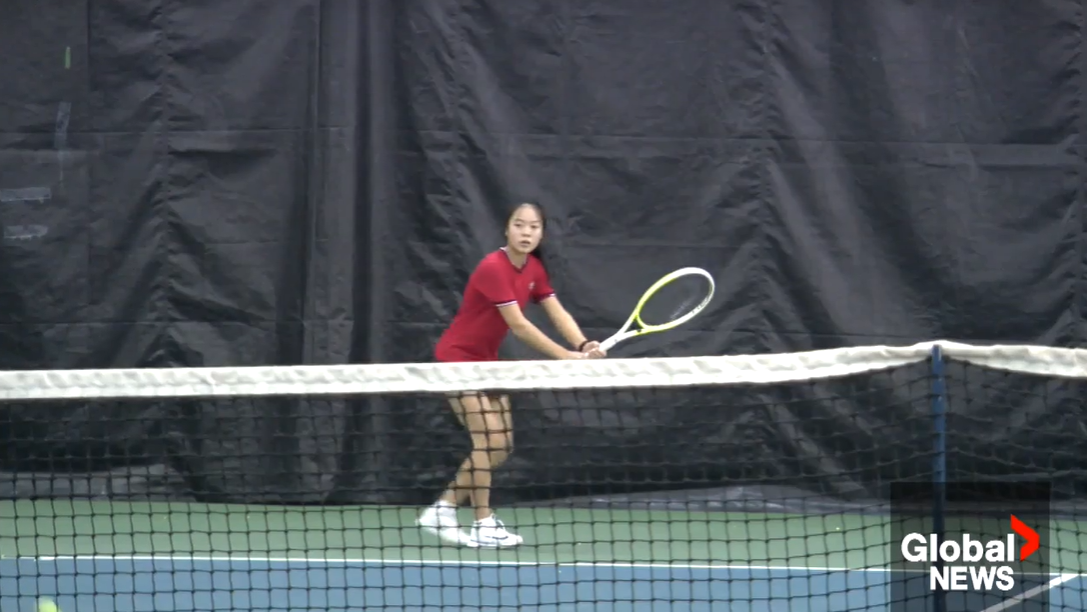
The air inside the North Vancouver tennis center doesn’t smell like glory. It smells like felt dust, industrial cooling fans, and the sharp, metallic tang of recycled sweat. On court four, a fourteen-year-old girl from Montreal is sliding into a backhand. Her shoes make a screeching sound against the hard surface—a sound that, if you close your eyes, sounds remarkably like a bird trapped in a high-voltage wire.
She isn't just hitting a yellow ball. She is fighting for a plane ticket to Prostejov, Czech Republic. She is fighting for the right to wear a tracksuit that says Canada across the shoulders in bold, unyielding letters.
Most people see junior tennis as a hobby for the affluent or a weekend distraction for high-energy kids. They see the scores on a website and move on. They see "Canada qualifies for World Junior Team Finals" and think it’s a natural progression of talent. They are wrong. What is happening right now in the qualifying rounds for the ITF World Junior Tennis competition is a high-stakes psychological war disguised as a game.
The Invisible Weight of the Jersey
Tennis is a lonely sport. Usually, if you miss a volley, you are the only one who pays the price. Your ranking drops, your parents might look a little disappointed in the car ride home, and you move on. But the World Junior Team competition changes the math.
Suddenly, you aren't playing for yourself. You are playing for the person sitting on the bench next to you. You are playing for a national program that has invested thousands of dollars in your footwork. When a thirteen-year-old realizes that their double fault might cost three other people their dream, the racket starts to feel like it’s made of lead.
Consider a hypothetical player named Leo. Leo is the top-ranked U14 boy in his province. He has won dozens of trophies. But here, in the qualifying stages against teams from Mexico and the United States, Leo realizes that his opponent isn't just a kid across the net—it’s the expectation of a country that has recently tasted Grand Slam success through the likes of Bianca Andreescu and Felix Auger-Aliassime.
The pressure isn't a metaphor. It is physiological. Cortisol floods the system. The grip tightens. The fluid motion that Leo has practiced ten thousand times suddenly becomes choppy and frantic. This is the "Red Clay Crucible," even if they are playing on North American hard courts to get there.
The Geography of Ambition
Canada is not a natural tennis superpower. We are a nation of ice and long shadows. For a Canadian junior to reach the world stage, they have to overcome a geographical disadvantage that players in Florida or Spain never have to contemplate.
Our players spend six months of the year indoors, playing in bubbles where the air is dry and the bounces are predictable. The World Junior Team Finals, however, are often held on European red clay—a surface that behaves like a living, breathing organism. It slows the ball down. It demands a level of slide and stamina that can't be taught in a suburban gymnasium.
To get to the finals, the Canadian teams—both the boys and the girls—must first navigate the North/Central American and Caribbean qualifying zone. They face athletes who have grown up playing outdoors under a relentless sun.
The Mathematics of the Match
The format of these competitions is brutal in its simplicity. Two singles matches, followed by a doubles match. If you split the singles, the doubles match becomes a sudden-death sprint for survival.
Imagine the scene: The score is tied 1-1. The sun is dipping low, casting long, distorted shadows across the court. The Canadian pair is down a break in the second set. This is where the technical stats matter less than the "invisible stakes."
- The First Serve Percentage: It usually hovers around 60% for these juniors, but under the pressure of a deciding rubber, it often plummet to 40%.
- The Unforced Error Count: In a standard tournament, a junior might spray thirty errors. In a team qualifying event, the fear of making a mistake often leads to "pushing"—hitting the ball softly and safely—which is a slow-motion form of competitive suicide.
The kids who make it to the finals aren't necessarily the ones with the fastest serves. They are the ones who can look at their teammate during a changeover and smile when their heart is hammering against their ribs like a frantic drum.
The Ghost of the Future
Why does this matter? Why do we care if a group of teenagers makes it to a tournament in the Czech Republic?
Because the World Junior Team Finals are a crystal ball. If you look at the rosters of this tournament from fifteen years ago, you will see names like Nadal, Djokovic, and Swiatek. This isn't just a "junior" event; it is the laboratory where the next decade of professional sports is being engineered.
When Canada’s U14 and U16 teams step onto the court, they are auditioning for a life they haven't lived yet. They are testing whether they have the stomach for the professional tour—a world of lonely hotel rooms, constant jet lag, and the relentless requirement to perform when you are exhausted.
There is a specific kind of silence that happens when a player realizes they’ve just won the deciding point to qualify their country for the finals. It’s not a cheer. It’s a collective exhale. It’s the sound of a burden being lifted, if only for a moment.
The Grit Beneath the Glamour
We see the highlights of the pros under the lights of Arthur Ashe Stadium, but the reality for these juniors is far grittier. It’s early morning warm-ups in humid gyms. It’s eating lukewarm pasta out of a plastic container between matches. It’s the stinging sensation of new blisters forming over old ones.
In the most recent qualifying rounds, the Canadian girls' team showed a brand of resilience that bordered on the stubborn. They didn't just win; they outlasted. They turned matches that should have been two-hour losses into four-hour wars of attrition. They used the "moonball" when necessary. They chased down "lost" causes. They played with a desperation that suggested they knew exactly how far the flight to Prostejov actually is.
Tennis Canada has built a system designed to catch these players before they fall. They provide the coaches, the travel logistics, and the tactical analysis. But once the chair umpire calls "Play," all the institutional support in the world vanishes. It is just a kid, a racket, and the terrifying realization that they are currently the most important tennis player in their country.
The red dust of the European clay courts is waiting. It doesn't care about your national ranking or how many followers you have on social media. It only cares about who can slide, who can suffer, and who can carry the weight of a maple leaf without let it crushing their spirit.
The kids in the qualifying rounds aren't just playing for a spot in a tournament. They are learning how to be the people we will all be cheering for in five years. They are turning felt and strings into a destiny.
The girl from Montreal hits one more backhand. It clips the line. She doesn't pump her fist. She just breathes, wipes the sweat from her forehead, and gets ready for the next point. The world is watching, even if the stands are mostly empty.