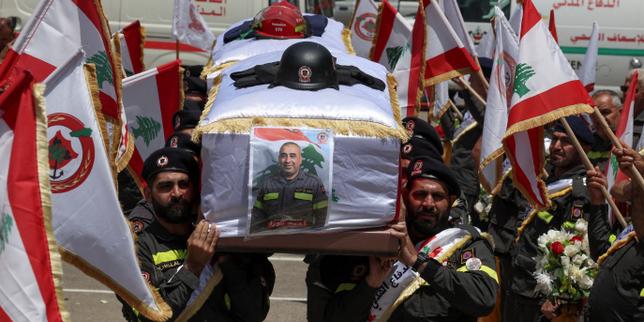
The white vest and the red emblem used to be a shield. In the brutal geography of South Lebanon, that shield has shattered. Despite the diplomatic fanfare surrounding a shaky ceasefire agreement, Lebanese paramedics are finding that their GPS coordinates—meticulously shared with international intermediaries—are increasingly serving as target data rather than safeguards. This isn't just about "collateral damage." It is a systemic breakdown of the Geneva Conventions where the very people tasked with pulling bodies from the rubble have become the primary targets.
To understand the current crisis, one must look past the headlines of "exchanged fire" and into the mechanics of the rescue missions. Every time an ambulance leaves its station in Tyre, Nabatieh, or the border villages, a complex dance of "deconfliction" occurs. The Lebanese Red Cross (LRC) or the Civil Defense sends their precise route and timing to UNIFIL, which passes it to the Israeli military. The goal is to ensure that a rescue mission isn't mistaken for a combat maneuver. Yet, the frequency of strikes on these cleared missions suggests that the process is no longer functioning, or worse, is being disregarded entirely.
The Mirage of Deconfliction
The term "deconfliction" sounds like a cold, bureaucratic necessity. In reality, it is the difference between life and death for a twenty-year-old volunteer driving a van through a smoke-filled valley. For decades, this system allowed medical teams to operate in active war zones with a reasonable expectation of safety.
That expectation is gone.
What we are seeing now is a shift in operational doctrine. When an ambulance is struck while performing a coordinated retrieval, it sends a clear message to the entire humanitarian sector: your neutrality is no longer recognized. This creates a paralysis. If the Red Cross cannot guarantee the safety of its own crews, they cannot reach the wounded. When the wounded are left in the rubble, the mortality rate of a conflict doesn't just climb; it spikes. We are witnessing the intentional creation of "no-go zones" where even the dying are left to fend for themselves because the cost of rescue is the certain death of the rescuers.
This isn't a theory. It is the lived reality for teams who now wait hours, sometimes days, for a "green light" that may never come, or may be rescinded by a drone strike while they are midway through a recovery.
The Cost of the Broken Cross
When a paramedic is killed, the loss is more than a single life. It is the loss of a multiplier. One trained responder can save dozens of lives in a single afternoon. By removing that responder, the kinetic impact of a strike is amplified across the entire community.
In Lebanon, the rescue infrastructure is divided among several groups. You have the Lebanese Red Cross, the government-run Civil Defense, and several NGO-affiliated groups like the Risala Scout Association and the Islamic Health Authority. While the latter have political affiliations, under International Humanitarian Law, their medical personnel are still supposed to be protected if they are engaged exclusively in medical duties.
The blurring of these lines has provided a convenient pretext for a policy of "total friction." By labeling all rescue organizations in certain regions as extensions of a political enemy, the protective status of the medical mission is stripped away. It is a dangerous precedent that won't stay confined to the Middle East. If the world accepts that a medic can be targeted because of the neighborhood they work in or the organization that signs their paycheck, the very concept of the "neutral medic" dies.
The Logistics of a Target
- Tracking and Signal Intelligence: Modern warfare relies on the electronic signature of vehicles. Even with the red emblem painted on the roof, an ambulance emits signals that are tracked by high-altitude drones.
- The Wait-and-Strike Tactic: Often, a primary strike is followed by a secondary strike once rescue teams arrive on the scene. This "double tap" is specifically designed to target first responders.
- The Psychological Toll: The trauma isn't just physical. Paramedics in Lebanon describe a unique form of terror—the sound of a drone overhead while they are trying to cut a child out of a crushed car. They know the drone sees them. They know their coordinates were shared. And they still don't know if they will be alive in thirty seconds.
Why Diplomacy is Failing the First Responders
The international community loves to talk about "rules-based order" from the safety of New York or Geneva. But on the ground in South Lebanon, those rules are being rewritten in real-time. The ceasefire agreements that make it to the front pages often lack the granular enforcement mechanisms needed to protect humanitarian corridors.
A ceasefire that doesn't include a hard, enforceable ban on targeting medical personnel is just a lull in the fighting, not a return to law. The problem lies in the lack of accountability. When a medical convoy is hit, there is an "investigation" that lasts months and usually ends in a vague statement about "operational errors." There are no sanctions. There are no expelled diplomats. There is only a new set of martyrs and a more terrified group of survivors.
The failure here is twofold. First, the warring parties have decided that the tactical advantage of stopping a rescue outweighs the international blowback. Second, the international community has signaled that the blowback will be minimal. It is a classic case of a moral hazard.
The Erosion of International Law
We are entering an era of "post-legal" warfare. For the last century, the one constant in global conflict was the sanctity of the medical mission. Even in the height of the Cold War or the most brutal colonial struggles, the Red Cross was generally seen as off-limits.
What is happening in Lebanon is the "normalization" of the strike on the medic. By repeatedly hitting ambulances and rescue centers with little to no consequence, the threshold for what is considered an acceptable target is being lowered. This has a ripple effect. If it is okay to hit an ambulance in Nabatieh, why not in any other future conflict?
The technical excuse often used is that ambulances are being used to transport weapons or fighters. If that were the case, the burden of proof lies with the attacker to provide clear, immediate evidence. Instead, what we see are "blanket justifications" applied to entire regions. It is a strategy of collective punishment disguised as tactical necessity.
Beyond the Statistics
The numbers are grim—dozens of rescuers killed, hundreds of centers damaged. But the statistics don't capture the silence of a village where the local ambulance has been burnt out and no one else is coming. They don't capture the choice a father has to make: does he try to drive his bleeding daughter to a hospital himself, knowing he might be targeted as a "suspicious vehicle," or does he stay and watch her die in his arms?
This is the "humanitarian vacuum." It is a deliberate tactical choice to strip a population of its support systems until life becomes untenable. It is the weaponization of healthcare.
The rescue workers who continue to go out are not doing so because they feel protected. They are doing so out of a sense of duty that the rest of the world has seemingly abandoned. They are the last line of defense against a total descent into barbarism, operating in a landscape where the rules of war have been replaced by the whims of an operator in a remote container miles away.
The Infrastructure of Survival
Most of the rescue vehicles in Lebanon are aging. They are not armored. They are thin-skinned vans filled with oxygen tanks—which, when hit, become secondary explosives. The irony is that the very equipment meant to save lives makes the vehicles even more dangerous under fire.
The global community has a choice. It can continue to issue "concerns" and "calls for restraint," or it can demand a transparent, third-party monitoring of deconfliction. This would involve UNIFIL or another neutral body having real-time access to the targeting data and the ability to verify, on the ground, the nature of every struck medical vehicle. Without that level of intrusive transparency, the "mistake" will continue to be the standard operating procedure.
The current trajectory suggests that the red emblem is being relegated to a historical curiosity. If the world allows the rescue workers of Lebanon to be hunted with impunity, it is effectively signing the death warrant for humanitarianism in every conflict to follow. The shield is broken, and unless there is a massive, coordinated effort to forge it anew through genuine accountability, the next time the sirens wail, there may be no one left to answer the call.
The silence that follows the strike is the most dangerous thing of all. It is the sound of a society losing its most basic safety net, and the sound of international law being buried under the rubble of a Nabatieh health center. Stop looking for the "next steps" in a peace process that doesn't protect the people pulling survivors from the flames. The priority isn't a new treaty; it's the immediate, enforced recognition that a medic is never a target, regardless of the flag flying over the territory where they bleed.