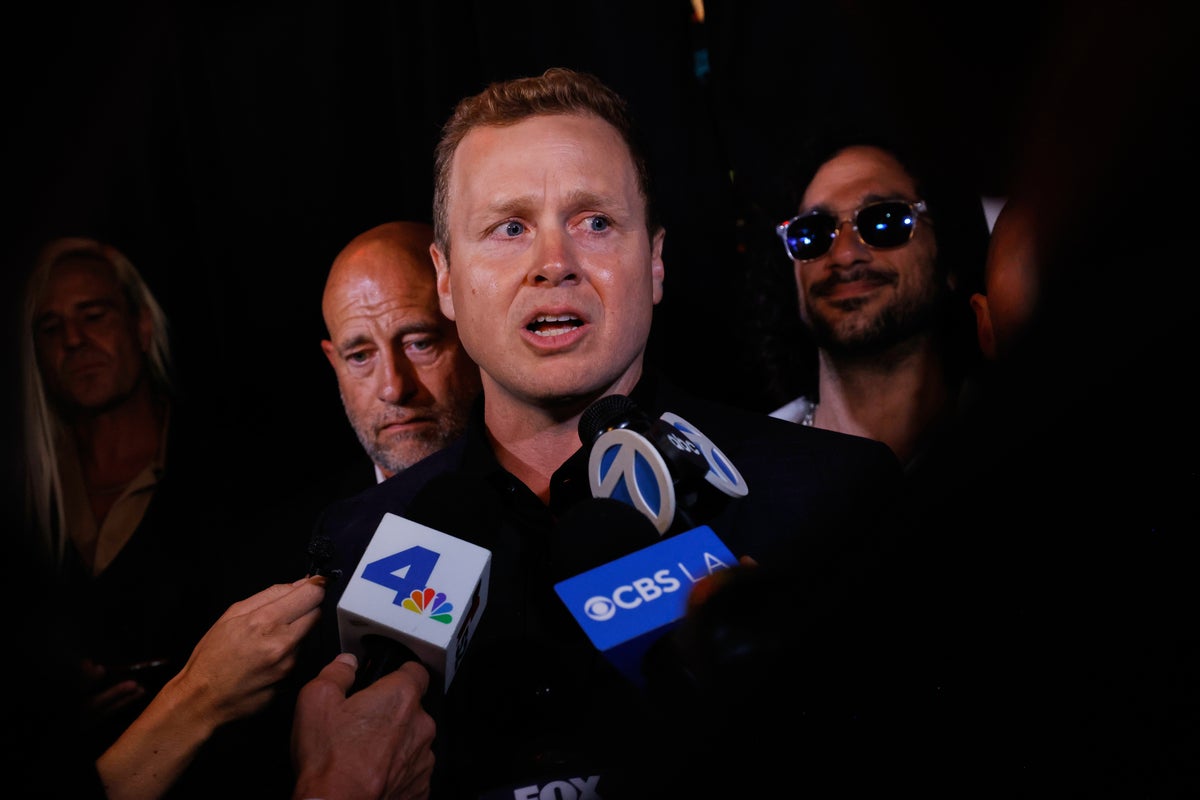
The air inside Don Antonio’s Mexican restaurant on Pico Boulevard smelled of charred carne asada and cheap tequila. It was Tuesday night, election night, and Spencer Pratt was winning.
He stood in the center of the room, flanked by his wife, Heidi Montag, under the low amber glow of hanging lamps. For an hour or two, the universe seemed to align with the script he had spent months writing. The early returns from the June 2 Los Angeles mayoral primary showed him up by seven percentage points over City Councilwoman Nithya Raman. He was in second place, right behind incumbent Karen Bass. If the numbers held, the former king of 2000s tabloid villainy would advance to the November runoff.
Outside, a crush of reporters jostled against the glass, locked out by a campaign that treated the press like an uninvited paparazzi swarm. When Pratt finally stepped into the cool night air, he didn’t talk about policy. He smiled his familiar, asymmetrical smile and whispered about "God's plan."
He looked like a man who believed his own hype. He had out-raised the sitting mayor, raking in millions from Hollywood power players like Jeanie Buss and David Foster. He had captured the city’s collective anxiety with a viral, AI-generated campaign video that painted Los Angeles as a dystopian Gotham City, positioning himself as a crystal-clutching Batman ready to purge the streets of crime and homelessness.
But elections in California do not end when the bar closes on Tuesday night.
By Friday, the silence from the ballot processing center in the City of Industry began to warp the reality inside Don Antonio's. The seven-point lead was gone. As the slow, methodical gears of the state’s election machinery turned, Raman began to chip away at the margin. Ten thousand votes. Five thousand votes. Then, a few hundred.
By Sunday, the prediction markets plummeted. Pratt was slipping into third place. Defeat was no longer a mathematical abstraction; it was breathing down his neck.
Three thousand miles away, a voice boomed from a tarmac at Joint Base Andrews, weaponizing the silence. Donald Trump, watching his hand-picked "Big MAGA" candidate lose ground in a state he has long viewed as a personal antagonist, did what he always does when the numbers turn against him. He called the system crooked. He called it rigged.
"They send out 38 million votes," Trump told a huddle of reporters, his voice cutting through the whine of jet engines. "Nobody knows where they’re going. It's a rigged system."
Later, on national television, he went further. He pointed to the shifting totals as proof of a crime. "All I have to do is look," he said.
But what Trump was looking at wasn't a conspiracy. It was a postal schedule.
To understand why Los Angeles elections take days—sometimes weeks—to settle, you have to look past the political theater and into the actual living rooms of California voters. Consider a hypothetical voter named Maria. She lives in Echo Park, works two jobs, and handles her mail over breakfast. In California, every registered voter receives a ballot in the mail. Maria doesn't have to brave a two-hour line on a Tuesday afternoon. She can sign her envelope, drop it in a mailbox on election day, and go to work.
Under state law, as long as that ballot is postmarked by June 2, it counts, even if it arrives seven days later.
When the initial returns flash on screen at 8:01 PM on election night, they represent two things: early mail-in ballots that arrived days before, and the people who voted in person. In recent years, an undeniable behavioral pattern has emerged. Registered Republicans and older voters tend to vote early or show up at physical polling places. They want the sticker. They trust the box.
Progressives, younger voters, and working-class citizens lean heavily on the mail, often dropping their ballots off at the very last minute.
This creates a psychological phenomenon known to political scientists as the "red mirage" or the "blue shift." It is a statistical illusion. The early vote favors the right; the late vote favors the left. It isn't because anyone is stuffing ballot boxes in the dead of night. It is because it takes human beings time to open millions of envelopes, verify signatures against state databases, and feed paper into scanners.
Yet, that natural delay has become a breeding ground for a deeper, more dangerous kind of cynicism.
The suspicion wasn't just coming from Washington. On Friday morning, Bill Essayli—the Trump-appointed U.S. Attorney in Los Angeles—announced on social media that his office had opened "multiple election fraud investigations" and dispatched a federal prosecutor to monitor the county’s vote-counting center. The move felt less like a standard legal procedure and more like a tactical deployment, a synchronized escalation designed to match the rhetoric coming from the president.
Even Pratt’s fellow Trump-endorsed ally, gubernatorial candidate Chuck Hilton, found himself caught between the narrative and the reality. Hilton publicly llamó the California system a "national and international laughingstock" for its sluggishness, demanding an emergency detachment of state workers to speed up the count. But when pressed by his own legal team, Hilton had to admit the truth: they hadn't seen a single shred of actual fraud.
The tragedy of the rhetoric is that it obscures the very real human pain that drove this bizarre political chapter in the first place.
Spencer Pratt’s candidacy was easy to mock. He was, after all, the man who once spent thousands of dollars on healing crystals and became famous for picking fights on MTV's The Hills. But his run for mayor didn't start in a television studio. It started in the ashes.
In January 2025, the catastrophic Palisades wildfire ripped through the canyons of western Los Angeles. It destroyed thousands of homes, leaving hillsides black and smoking. One of those homes belonged to Pratt and Montag. They lost everything they owned. For a year, the family bounced through temporary housing, from the high-end suites of the Hotel Bel-Air to rentals in Carpinteria, grappling with the realization that they might never be able to afford to rebuild in the city they loved.
When Pratt announced his campaign on the one-year anniversary of the fire, he spoke with the raw fury of a displaced resident. He blamed Karen Bass for mismanaging the aftermath. He spoke for a segment of Los Angeles that felt abandoned by the progressive establishment—people terrified of the tents lining the sidewalks, the open-air drug markets, the street takeovers that transformed neighborhoods into drag strips overnight.
"Standing here one year later," Pratt said at his launch, "the most heartbreaking part wasn't losing everything I own. It was the realization that all of this was preventable."
That is the invisible stake of the election. It isn't about whether a reality star can run a city; it’s about a population so desperate for safety and order that they are willing to look at a caricature of a villain and see a savior. Pratt tapped into a vein of genuine urban exhaustion. His hardline proposals—calling in ICE, expanding incarceration for repeat offenders, forcing unhoused people into mandatory treatment—resonated with an electorate that felt the current system was broken.
But by relying on the language of grievance and fraud to explain his impending loss, Pratt and his backers did something far more damaging than losing an election. They eroded the only thing keeping the city together: trust in the process.
The Brookings Institution examined millions of mail-in ballots over several election cycles. They found that the rate of actual mail-in voting fraud sits at roughly 0.000043 percent. That is four out of every ten million ballots. You are statistically more likely to be struck by lightning while holding a winning lottery ticket than to find a fraudulent mail-in ballot in Los Angeles County.
But statistics don't make for good television. Suspicion does.
As the counting continues into the second week of June, the gap between Raman and Pratt will likely widen, cementing a November showdown between the progressive councilwoman and the establishment mayor. Pratt has already threatened to leave Los Angeles entirely if he loses, a dramatic exit fitting for a man who lived his life in front of a lens.
The tragedy isn't that Spencer Pratt lost his bid for power. The tragedy is that long after the reality star packs his bags and leaves the state, the millions of voters who believed in him will look at the slow, quiet, honest work of the ballot counters in the City of Industry and see a crime.
The count goes on, one paper ballot at a time, in a fluorescent-lit room where the only sound is the rhythmic, mechanical click of scanners proving that the system isn't rigged—it's just patient.