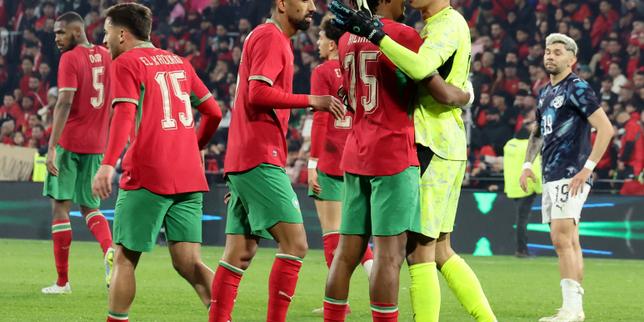
The wind in northern France doesn’t just blow. It bites. In Lens, a town built on the grit of coal dust and the ghosts of miners, the sky usually wears a permanent shade of bruised grey. But on a Tuesday evening at the Stade Bollaert-Delelis, the grey was obliterated. It was drowned out by a tidal wave of crimson.
Thousands of people didn’t just travel to see a football match between Morocco and Paraguay. They staged a migration. They came from the banlieues of Paris, the canals of Brussels, and the tiny industrial hubs of the Rhine. They brought with them the scent of orange blossom water and the frantic, rhythmic heartbeat of the Maghreb, transplanting it into the cold soil of the Pas-de-Calais. In related updates, we also covered: Jasmine Paolini and the Myth of Momentum in Professional Tennis.
This wasn’t about a friendly fixture. Friendly is a word for diplomats and polite neighbors. This was about gravity. It was about the invisible thread that pulls a person back to a place they might not have seen in years, or perhaps, a place they have only ever known through the stories of their grandfathers.
The Geography of the Heart
Consider a man named Youssef. He is a hypothetical composite of the dozens of fathers I stood next to in the drenching rain outside the stadium gates. He is forty-four. He lives in a suburb of Lille. He hasn’t lived in Casablanca since he was seven years old. He pays his taxes in euros, he speaks French with the clipped precision of a local, and his children argue about TikTok in the backseat of a Peugeot. Sky Sports has analyzed this important issue in great detail.
But when the Atlas Lions—the Moroccan national team—arrive within a hundred-mile radius, Youssef undergoes a molecular change. He isn't a suburban accountant anymore. He is a guardian of a legacy. He drapes a flag over his shoulders like a priest donning a vestment.
The stadium in Lens became a sovereign territory for ninety minutes. To the casual observer, it’s just a crowd. To the people inside, it’s a census of the diaspora. They are the millions who live "in-between." They are too Moroccan for the cafes of Paris and too European for the markets of Marrakech. In the stands of Bollaert, that duality stops being a burden. It becomes a superpower.
Why a Scoreboard is a Liar
The match ended in a 0-0 draw. In the cold language of statistics, that suggests a stalemate—a lack of progress, a night where nothing happened.
The statistics are lying.
In the 70th minute, the rain turned into a stinging horizontal sheet. In a standard match, this is when the energy dips. This is when people start eyeing the exits, thinking about the heater in their car and the traffic on the A21 motorway. Instead, the stadium erupted. The "ole" chants didn't just ring out; they vibrated in the concrete of the stands.
The stakes weren't the three points or a trophy. The stakes were the validation of an identity. For the diaspora, the national team is the only institution that consistently speaks their name on a global stage. When Achraf Hakimi sprints down the wing, he isn't just a world-class athlete. He is the physical manifestation of the dream every immigrant parent carries: that you can go anywhere, face any weather, and still be the best in the room.
The players feel this. You could see it in the way they lingered on the pitch after the final whistle. They didn't retreat to the warmth of the dressing room. They stood in the downpour, clapping back at the fans. It was a silent pact. We see you here, in the cold, and we know why you came.
The Architecture of Belonging
Lens is a football city to its marrow. The local club, RC Lens, is famous for its "Sang et Or" (Blood and Gold) colors and a fanbase that treats every Saturday like a religious holiday. There is a shared DNA between the working-class supporters of northern France and the Moroccan diaspora. Both groups know what it means to be overlooked. Both groups know that community is the only thing that keeps the cold out.
Hypothetically, imagine the stadium as a giant battery. For most of the year, it powers the local pride of the Pas-de-Calais. But on nights like this, it is plugged into a different grid. The chants are in Darija. The drums are different. The energy is more desperate, more joyful, more frantic.
It is a reminder that borders are lines on a map, but culture is a pulse. The diaspora doesn't live in Morocco, but Morocco lives in them. It's in the way they share bread in the parking lot. It's in the way three generations of a family—the grandfather in a djellaba, the father in a tracksuit, the daughter in a Hakimi jersey—walked hand-in-hand through the puddles.
The Burden of the Atlas
There is a specific kind of pressure that comes with being a "Lion." When the team plays in Rabat, they are playing for their country. When they play in Lens, or Barcelona, or Cincinnati, they are playing for a scattered tribe. They are carrying the emotional weight of millions of people who use the team as a bridge to a home they miss.
The 0-0 draw against Paraguay wasn't a masterpiece of footballing tactics. It was a messy, slippery, physical battle. But for the people who filled the stands, the quality of the cross-field passes was secondary to the fact of the gathering.
They stood in the rain because the rain was better than the silence of being ignored. They screamed until their throats were raw because, for a few hours, they weren't "immigrants" or "second-generation residents" or "demographics." They were simply the owners of the space.
As the lights of the Stade Bollaert-Delelis eventually dimmed, the red smoke from the flares lingered in the air, mixing with the fog of the northern night. The fans headed back to their cars, their flags soaked and heavy, their shoes caked in mud. They were heading back to lives where they are often the "other."
But as they drove away, the car windows fogging up from the heat of five or six bodies packed inside, they weren't thinking about the score. They were humming the songs they had just sung. They were carrying the warmth of twenty-five thousand people who all knew the same secret.
The rain in Lens is cold, but the fire of the diaspora is unquenchable.