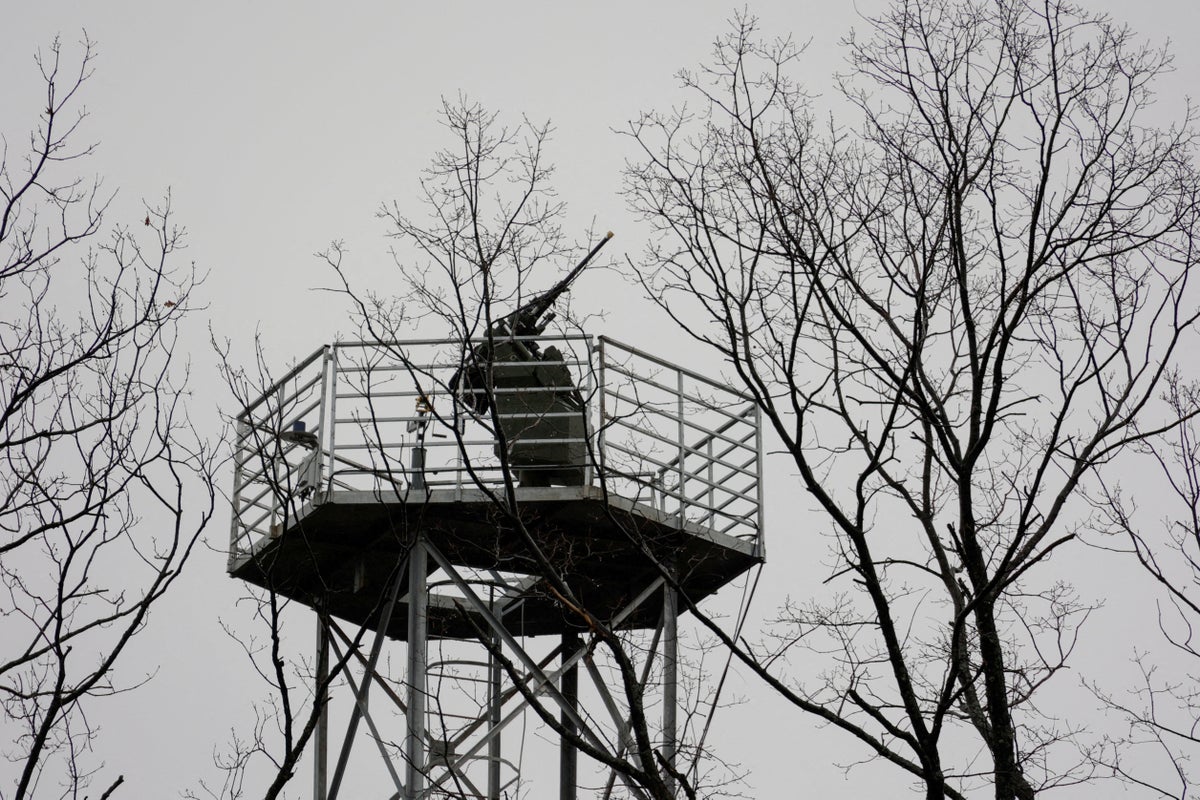
The sky over Ukraine has become a marketplace of necessity. For years, the protection of critical infrastructure was a burden borne exclusively by the state, a centralized shield that often wore thin under the weight of thousands of Russian-launched Shahed drones. That monopoly on violence has officially shifted. Since the start of 2026, Ukraine has moved beyond experimental pilots to fully integrate private air defense units into its national command structure. This is not a mercenary venture or a loose collection of guards with rifles; it is a high-tech, regulated industry where private firms now operate heavy machine guns, electronic warfare arrays, and interceptor drones under the direct tactical control of the Ukrainian Air Force.
Business owners are no longer waiting for a government battery to arrive. They are buying their own. Expanding on this idea, you can also read: Why Trump is gambling on a long blockade to force Iran's hand.
The Privatization of the Shield
The logistics of this shift are rooted in a brutal mathematical reality. Russia can produce or procure "kamikaze" drones far faster than any nation can manufacture million-dollar surface-to-air missiles. When a $30,000 drone threatens a $500 million power plant, using a Patriot missile is a financial defeat even if the target is destroyed. Ukraine’s answer is a distributed network of "corporate" air defense groups that target the low-end threats, freeing up the military’s strategic assets for ballistic missiles and jets.
As of April 2026, over 20 companies have registered to form their own operational units. These groups are composed of vetted employees who undergo rigorous training and quarterly polygraph tests to ensure no Russian infiltration. The Ministry of Defense (MoD) provides the legal framework and, in some cases, the weaponry, while the companies provide the personnel and the localized infrastructure. Analysts at Al Jazeera have also weighed in on this matter.
The Onion Strategy
Private operators like Carmine Sky and Gvardiia describe their approach as a "layered onion." The defense of a factory or a grain terminal starts kilometers away with acoustic sensors and ends at the facility perimeter with automated kinetic systems.
- Acoustic and Thermal Detection: Cheap, distributed sensors that listen for the distinct "moped" sound of a Shahed engine.
- Electronic Warfare (EW): Systems like those developed by Piranha Tech that jam GPS and radio frequencies, forcing drones to drift off course or crash.
- Kinetic Interceptors: High-speed FPV drones, such as the General Cherry Bullet or the Sting, designed to ram or explode near incoming targets.
- Hard Kill Systems: Truck-mounted M2 Browning machine guns or automated turrets that serve as the final line of defense.
This isn't a "wild west" scenario. Every trigger pull is authorized through a unified digital command-and-control system. When a private operator sees a target on their screen, the decision to fire comes from the Air Force command. This prevents friendly fire incidents and ensures that the private units are an extension of the national army, not a substitute for it.
The Business Case for Survival
From a purely commercial perspective, the investment makes sense. In 2025, the Ukrainian defense tech sector saw investment jump from roughly $1 million to over $100 million. Firms are finding that the cost of standing up an air defense unit—wages for a dozen operators, procurement of EW gear, and maintenance—is a fraction of the cost of rebuilding a bombed-out warehouse or losing three months of production due to a grid failure.
There is also a burgeoning export market. Ukrainian specialists are already being deployed to Middle Eastern countries, including Qatar and Saudi Arabia, to advise on how to counter the same Iranian-designed drones that plague Kyiv. What started as a survival mechanism is maturing into a globally unique expertise: the ability to build and manage low-cost, high-volume air defense networks in a high-intensity environment.
The Risks of Decentralization
Entrusting lethal weaponry and sophisticated electronic warfare to private entities is not without friction. Critics point to the long-term implications of "home guard" units that could, in theory, become private militias if the central government’s grip ever wavered. To mitigate this, the Ukrainian government has instituted strict inventory controls. The Air Force can "loan" equipment to these firms, but it remains state property.
Furthermore, the technology is in a constant state of evolution. The effectiveness of electronic warfare is diminishing as drones become more autonomous, utilizing machine vision to navigate without GPS. This has forced private firms to pivot toward "interceptor drones"—unmanned aircraft that hunt other unmanned aircraft. These systems, like the British-partnered Octopus, represent the next stage of the arms race: robots fighting robots in the airspace above civilian factories.
The Blueprint for Modern Civil Defense
The Ukrainian model suggests that the future of national security is not just about the size of a standing army, but the resilience of its private sector. By allowing businesses to protect themselves, the state has effectively increased its sensor and shooter density tenfold without spending a dime of the central budget on personnel.
The training pipeline is equally streamlined. A drone interceptor pilot can be trained in three weeks. Civilian employees work their regular shifts and then rotate into the air defense control room, swapping spreadsheets for gamepads. It is a total mobilization of society, but one that is managed with the efficiency of a tech startup rather than the bureaucracy of a legacy military.
The result is a landscape where the "front line" is everywhere and nowhere. A grain silo in the west is now as much a part of the air defense network as a missile battery in the east. This distributed architecture is much harder to dismantle than a centralized one. You can take out a radar station, but it is nearly impossible to take out a thousand independent companies all watching the sky simultaneously.
Ukraine has turned its sky into a collaborative, corporate-led fortress. The era of relying solely on the state for protection is over; the era of the industrial-military partnership has arrived, and it is being written in the smoke of intercepted drones.