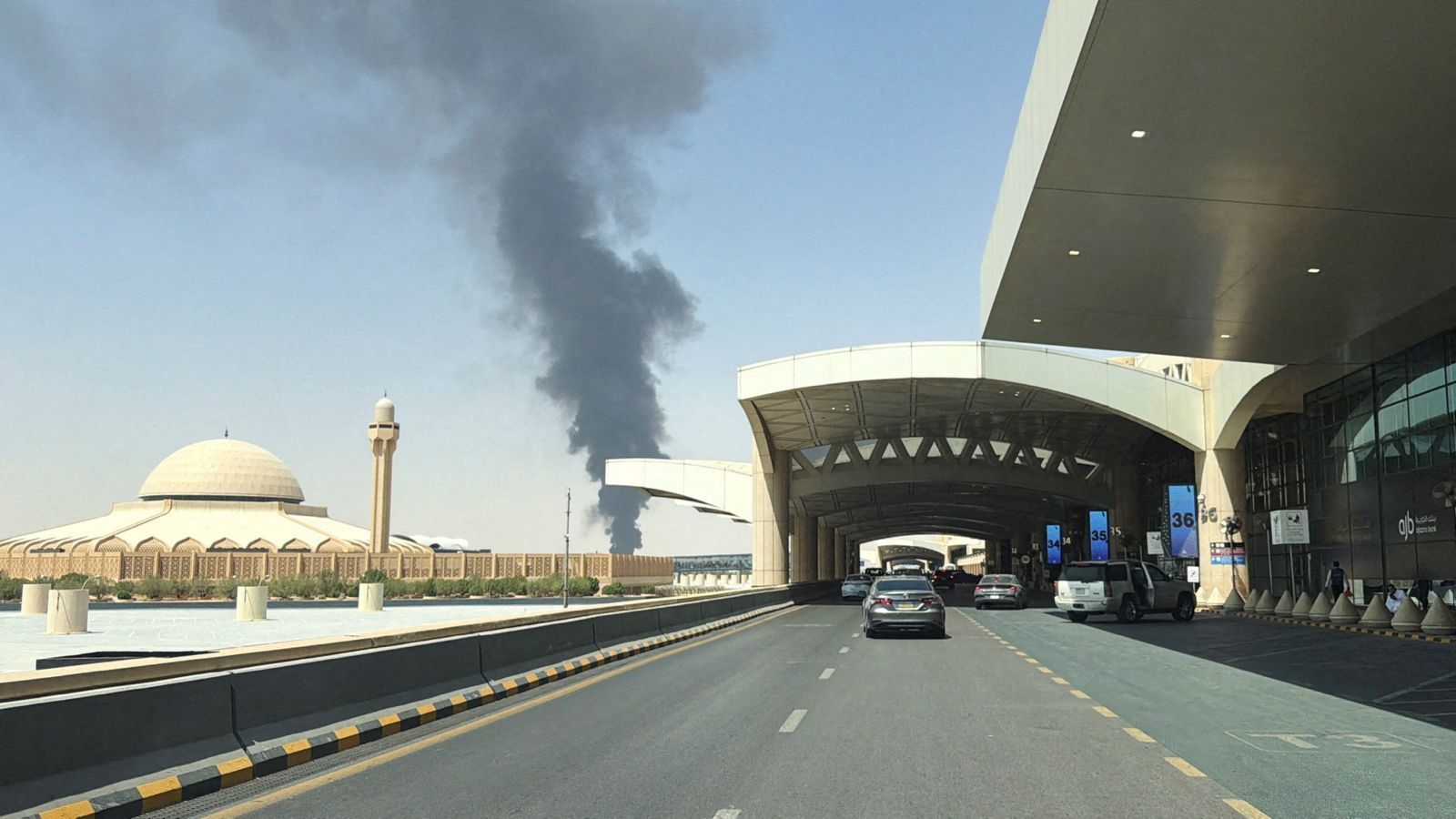
Thick black smoke rising near a major international transport hub changes the conversation instantly. When emergency alerts lit up phones across Riyadh and Al-Kharj, residents knew this was different. Loud booms echoed through the capital's upscale districts, followed by striking visuals of flames near King Khalid International Airport's fuel storage depots.
For years, the physical distance between Yemen's active conflict zones and Saudi Arabia's gleaming financial center offered a psychological buffer. That buffer is gone. The escalation involving Yemen's Iran-backed Houthi movement brings the reality of modern drone and missile warfare directly to the doorstep of the Gulf's economic powerhouse.
Understanding the New Threat Dynamic
The sequence of events on that Saturday morning exposed the vulnerability of high-value infrastructure. Hours after Saudi civil defence systems triggered emergency mobile warnings for potential aerial threats, the Houthis claimed responsibility for coordinated drone and missile strikes targeting sensitive sites in Riyadh.
While Saudi air defenses routinely intercept incoming projectiles, the physical presence of smoke near civilian and commercial transport sectors alters how airlines, foreign investors, and residents calculate risk. This isn't just about localized military friction anymore. It is a direct challenge to the economic stability of the region.
The Houthis explicitly tied these deep-strike operations to retaliatory cycles, citing recent military exchanges and airstrikes inside Yemen. When blockades meet cross-border ballistic capabilities, the margin for error shrinks to zero. Critical arteries like the capital's international airport and surrounding energy nodes become primary leverage points in a war that refuses to stay contained.
The Broader Impact on Energy and Aviation
You cannot separate these security incidents from the wider economic chessboard. Saudi Arabia's energy infrastructure has faced persistent pressure, from drone strikes hitting critical pumping stations along the East-West Pipeline to threats directed at facilities in Abqaiq.
When oil logistics and major aviation hubs face direct threats, global markets react immediately. Insurance premiums for cargo moving through the region skyrocket. Foreign carriers reassess flight paths and overnight crew schedules.
The strategy behind these long-range strikes relies as much on psychological impact as physical damage. Disrupting the daily operations of a capital city forces authorities to divert massive defense resources inward, testing the resilience of counter-air capabilities against swarming, low-cost drone technology.
What Comes Next for the Region
Riyadh faces a complex balancing act. Military deterrence alone hasn't stopped cross-border projectile launches, and diplomatic channels remain strained as regional actors weigh their next moves.
The security architecture protecting the Gulf requires constant adaptation. As long as the underlying political deadlock in Yemen persists, the capital will remain vulnerable to sudden, high-stakes escalations. Residents and international observers are left watching the skies, knowing that a single alert can turn a routine morning into an emergency response.