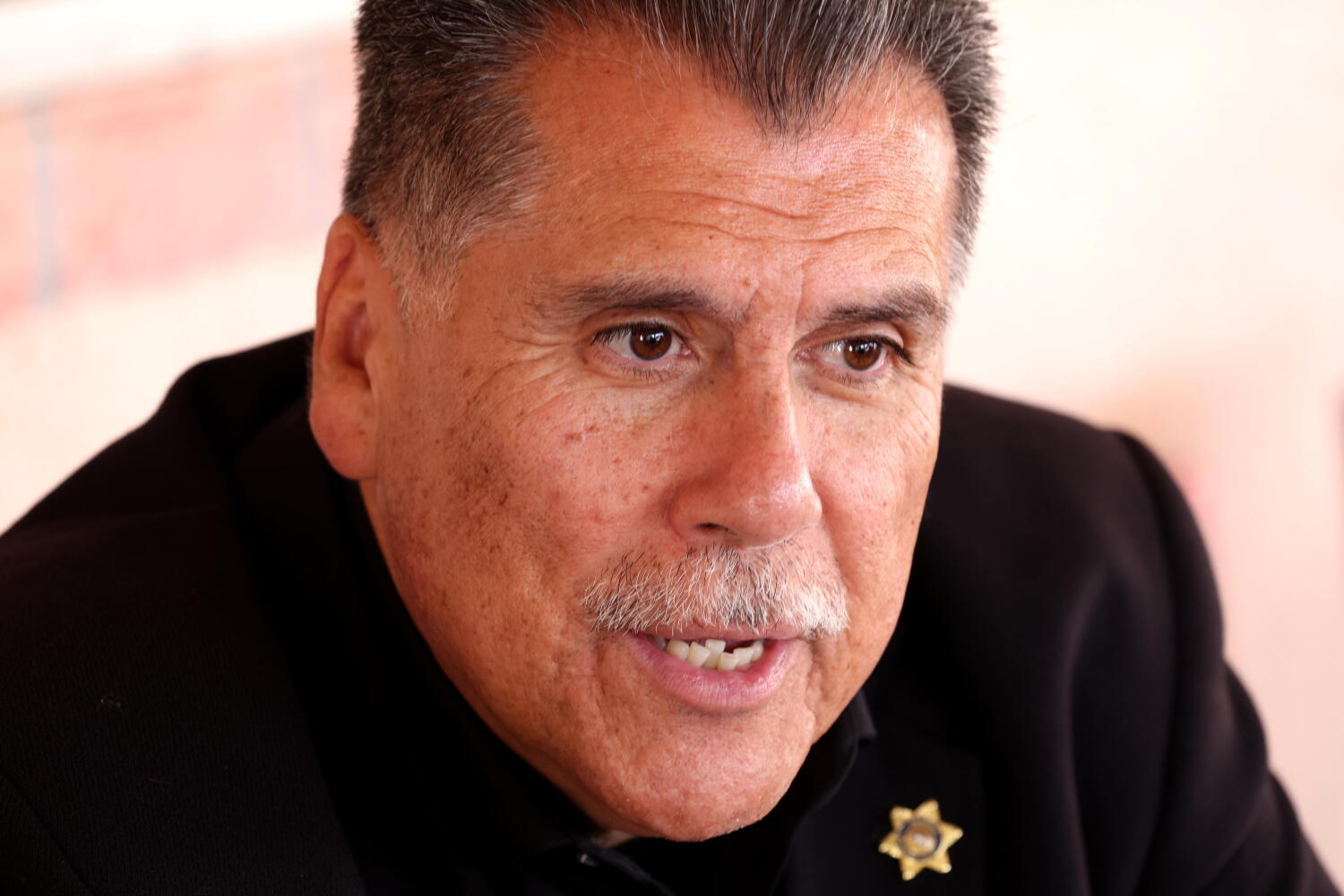
Robert Luna ended Alex Villanueva’s turbulent tenure in November 2022 by uniting Los Angeles County’s fractured political establishment, labor unions, and exhausted voters around a promise of institutional stability, before securing a second term in 2026 by surviving the brutal realities of jail oversight and deputy accountability. Luna did not win because he ran a flashy populist campaign. He won because Villanueva burned every bridge in county government until an outsider from Long Beach became the only viable lifeboat for the nation’s largest sheriff’s department.
To understand how a former Long Beach police chief took over a 18,000-employee agency he had never worked for, you have to look at the structural collapse that preceded him. The Los Angeles County Sheriff’s Department (LASD) is not just another police force. It is a sprawling, multi-billion-dollar apparatus that patrols unincorporated communities, contracts with dozens of cities, secures the county courts, and operates the largest municipal jail system in the United States. When the person running that machine goes to war with every oversight body in the region, the gears eventually grind to a halt. Also making waves lately: Why Western Media Completely Misunderstands Hong Kong National Security Trials.
The Self-Inflicted Collapse of Alex Villanueva
Alex Villanueva entered office in 2018 as a political miracle. Running as a progressive reformer from within the ranks, he unseated incumbent Jim McDonnell—the first time in over a century an L.A. County sheriff had been voted out. Villanueva promised to clean up the jails, remove federal immigration agents from custody facilities, and rein in deputy misconduct.
Then he took the oath of office. Almost immediately, the progressive rhetoric vanished, replaced by a combative, bunker-mentality leadership style that alienated his earliest allies. More information into this topic are explored by The New York Times.
Villanueva reinstated deputies fired for misconduct, most notably Caren Carl Mandoyan, a former campaign aide terminated over allegations of domestic abuse and dishonesty. That single decision triggered a multi-year legal and political war with the Los Angeles County Board of Supervisors. Instead of backing down, Villanueva escalated. He fought subpoenas from the Civilian Oversight Commission, clashed publicly with Inspector General Max Huntsman, and refused to cooperate with probes into deputy cliques—often referred to as deputy gangs—operating out of stations in East Los Angeles and Compton.
By 2022, the sheriff was running a department defined by constant crisis. He launched criminal investigations into county officials, journalists, and political critics. During the height of the COVID-19 pandemic, he refused to enforce county vaccine mandates among his ranks, framing public health directives as political overreach.
Voters were exhausted. In a county where Democrats hold an overwhelming registration advantage, Villanueva had alienated the Democratic Party establishment, the major labor unions, and the editorial boards that had backed him four years earlier. He still commanded a fierce, loyal base of conservative voters and rank-and-file deputies who viewed him as a warrior against woke politicians. That base was enough to get him through the primary. It was nowhere near enough to survive a general election runoff.
The Long Beach Outsider Strategy
Enter Robert Luna.
Born in East Los Angeles and raised in a working-class family, Luna spent 36 years rising through the ranks of the Long Beach Police Department, starting as a reserve officer in 1985 and retiring as chief in late 2021. Long Beach is California’s seventh-largest city, and its police department faces complex urban challenges, from port security to gang violence and homelessness. Yet to many inside the LASD, Long Beach was still viewed as a smaller pond.
Luna turned that perceived weakness into his primary selling point. He wasn't part of the LASD’s insular culture. He had no ties to the factions, cliques, or internal rivalries that had poisoned the department for decades.
His 2022 campaign was a masterclass in coalition building and disciplined messaging. While Villanueva spent his time on conservative talk radio and picking fights on social media, Luna quietly locked down endorsements from the Los Angeles County Federation of Labor, the Los Angeles Times, U.S. Senators, and key members of the Board of Supervisors.
Money followed the endorsements. Independent expenditure committees poured millions into the race to oust Villanueva, framing the election not as a choice between two law enforcement philosophies, but as a referendum on basic competence and constitutional governance. Luna’s pitch was deliberately unglamorous. He promised to show up to work, respect the rule of law, cooperate with oversight bodies, and focus on reducing violent crime and homelessness rather than staging press conferences to attack county supervisors.
When the ballots were counted in November 2022, the result wasn't even close. Luna defeated Villanueva by more than 20 percentage points, capturing over 61 percent of the vote.
Inheriting a Broken Machine
Winning the election was the easy part. Running the department proved to be a grueling test of administrative endurance.
When Luna took command in December 2022, he inherited an agency bleeding personnel. Mandatory overtime in the jails had reached unsustainable levels, driven by staffing shortages and lingering pandemic disruptions. Deputies were working double and triple shifts, leading to burnout, rising sick leave, and deteriorating conditions inside Men’s Central Jail and the Twin Towers Correctional Facility.
The federal scrutiny was relentless. The LASD remained under a long-standing U.S. Department of Justice consent decree governing the treatment of mentally ill inmates and use-of-force policies in the jails. At the same time, the California Department of Justice was conducting its own civil rights investigation into the department’s policing practices, particularly regarding deputy gangs and unconstitutional stops.
Luna had to modernize a management structure that had grown deeply distrustful of civilian oversight. Within months of taking office, he created the Office of Constitutional Policing, hiring outside experts to overhaul internal affairs investigations and compliance tracking. He issued new policies explicitly prohibiting deputies from participating in or promoting law enforcement gangs, signaling a sharp break from Villanueva’s denial that such groups existed.
The Union Friction
Reform inside a massive police agency never happens without pushback. The Association for Los Angeles Deputy Sheriffs (ALADS), the powerful union representing rank-and-file deputies, had fiercely backed Villanueva in 2022. When Luna took over, the relationship between the new sheriff and the union started on ice.
Deputies resented the perception that an outsider had been brought in to discipline them. Staffing shortages meant Luna couldn't immediately end forced overtime, leaving morale fragile. Meanwhile, the union fought back against strict new disciplinary matrices and transparency rules, arguing that management was hanging street deputies out to dry to appease county politicians.
Luna navigated this minefield by avoiding the theatrical warfare that defined his predecessor. He met privately with union leaders, negotiated pay increases and retention bonuses with the Board of Supervisors to stem the exodus of deputies, and focused on upgrading aging equipment and patrol vehicles. He didn't win over every skeptic in the locker rooms, but he lowered the temperature enough to keep the department functioning.
The Path to a Second Term
In Los Angeles County, elections for sheriff follow the gubernatorial cycle. Because Villanueva’s single term ended in 2022, Luna’s first term ran through 2026, setting up a rapid-fire reelection test after less than four years on the job.
Running as an incumbent is fundamentally different from running as a challenger. In 2022, Luna could blame every failure of the department on Villanueva. By 2026, Luna owned the jails, the response times, and every controversial use-of-force incident captured on body-worn cameras.
Critics attacked him from both sides of the political spectrum. Progressive criminal justice advocates argued that reform was moving too slowly, pointing to persistent deaths in county jails and delays in disciplining deputies linked to secret cliques. Conservatives and traditional law-and-order voices accused him of being too compliant with the Board of Supervisors and failing to aggressively prosecute retail theft and quality-of-life crimes.
Alex Villanueva, unwilling to fade quietly into retirement, attempted a political comeback, alongside other challengers from within the department's command staff. The pitch from Luna’s opponents was predictable: the outsider hadn't fixed the problems, so it was time to bring back someone who knew the agency from the inside.
That argument failed to gain traction with the broader electorate for three concrete reasons:
- Institutional Peace: For the first time in years, the sheriff was actually talking to the Board of Supervisors, the District Attorney, and the Inspector General. Subpoenas were being answered. Budgets were being passed without courtroom drama. Voters remembered the chaos of the previous administration and had zero appetite for returning to it.
- Measurable Incrementalism: Luna couldn't wave a wand and fix a decaying jail system overnight, nor could he hire 1,000 deputies out of thin air. What he could do was point to steady, verifiable progress. Academy class sizes began creeping back up, reducing mandatory jail overtime. Body-worn camera compliance improved, and internal investigations moved faster through the pipeline.
- Absence of Scandal: In a department historically plagued by corruption scandals—from Lee Baca and Paul Tanaka’s federal convictions to Villanueva’s retaliatory probes—four years without a major self-inflicted ethical crisis looked like a triumph. Luna stayed out of the tabloids.
What Luna’s Reign Means for American Policing
The rise of Robert Luna offers a stark case study in modern urban governance. For decades, conventional wisdom held that the Los Angeles County Sheriff’s Department was too massive, too insular, and too politically entrenched to ever be led by someone who didn't come up through its own academy. The internal culture was treated as an immovable object.
Luna proved that when an institution’s internal culture becomes toxic enough, voters will deliberately choose an outsider to break the cycle. His two victories demonstrate that in major metropolitan areas, the electorate's tolerance for rogue, unaccountable law enforcement leadership has evaporated. Sheriffs are constitutional officers elected directly by the people, a structure that has historically insulated them from the checks and balances that restrain appointed police chiefs. When a sheriff abuses that independence, the ballot box becomes the ultimate oversight mechanism.
Yet Luna’s tenure also exposes the hard limits of what one executive can achieve inside a broken system. Replacing the person at the top stops the bleeding, restores basic institutional decorum, and opens the door to federal compliance. It does not magically rebuild crumbling concrete jails, solve the street-level mental health crisis that turns deputies into de facto psychiatric nurses, or erase decades of ingrained subculture across dozens of patrol stations.
Robert Luna toppled Alex Villanueva by offering competence over chaos, and he kept the job by proving that boring, methodical administration is infinitely preferable to constant political war—even if the underlying structural rot of the nation's largest sheriff's department remains far from cured.