The air in Queens during late summer does not move. It hangs. It clings to your skin like a wet wool blanket, heavy with the scent of melted asphalt, hot pretzels, and the collective anxiety of thousands of people screaming for a yellow ball to land two inches to the left.
On the blue hardcourts of Flushing Meadows, the noise is a constant, ambient roar. It is an arena designed to swallow athletes whole. If you are seventeen years old, standing on the baseline with the weight of a country thousands of miles away resting entirely on your shoulders, that roar can sound less like applause and more like a warning. Recently making news in related news: The Weight of Ghosts on the Turf of Lyon.
Alex Eala stood in that heat.
She adjusted her grip. The grip tape on her racket was already damp with sweat. Across the net stood Lucie Havlickova, the reigning French Open junior champion, a towering presence whose serves regularly dismantled defense strategies before they could even begin. The scoreboard didn't care about nerves. It only registered the cold, hard geometry of the sport. More details on this are explored by FOX Sports.
To understand what happened next, you have to look past the trophy. You have to look past the standard highlight reels that sports networks broadcast to fill airtime. You have to look at the ankles of countless little girls playing on cracked concrete courts under the blistering tropical sun of Manila.
The Geography of an Unlikely Dream
Tennis has an image problem. For generations, the sport has been defined by a specific aesthetic. Crisp white polo shirts. manicured grass lawns in pristine country clubs. An unspoken requirement of old-money heritage. When we think of tennis prodigies, our minds naturally drift to European academies or sun-drenched Florida compounds where toddlers are handed graphite rackets before they learn to read.
The Philippines is known for many things. Passionate community spirit. Legendary boxers who can stop national traffic during a bout. Basketball courts improvised out of rusted rims nailed to coconut trees in rural villages.
Tennis? Not so much.
When a young athlete from an archipelago with limited tennis infrastructure tries to climb the global rankings, they aren't just playing against an opponent. They are fighting history. They are swimming upstream against a system designed to favor resources they simply do not have access to. Every plane ticket to an international tournament is a financial gamble. Every match is a high-stakes audition for sponsors who look at a Southeast Asian passport with skepticism.
Consider the reality of training in a tropical climate where typhoon season can wipe out weeks of outdoor practice. Imagine the mental fortitude required to sit in a locker room surrounded by competitors who have known each other since the under-twelve European circuits, speaking languages you only hear in movies, looking at you like an anomaly.
Eala was that anomaly.
But she did not play like a guest who was happy just to be invited to the party. She played like she owned the house.
The Anatomy of the Final Point
The match itself was a masterclass in controlled aggression. Havlickova brought the power, throwing heavy, deep groundstrokes that forced Eala behind the baseline. It was a classic tactical trap. If Eala retreated too far, she would be picked apart by angles. If she stepped up too early, she risked being overpowered.
Survival in tennis requires a strange mix of amnesia and hyper-focus. You have to forget the double fault you hit thirty seconds ago, yet you must remember exactly how your opponent moves their hips when they are about to hit a cross-court forehand.
Eala chose to step forward.
Her movement on the court was rhythmic, almost musical. She neutralized the Czech player’s power with precise timing, using her left-handed spin to create awkward bounces that disrupted her opponent's rhythm. The crowd began to shift. The casual spectators who had wandered over to Court 11 just to catch some junior tennis found themselves transfixed by the sheer intensity of the rally.
Then came the match point.
Silence descended on the court, the kind of sudden, suffocating quiet that only happens right before a major sporting moment. Eala tossed the ball into the hazy New York sky. Her racket met the felt. A sharp crack echoed off the stands. A few chaotic seconds of baseline baseline trading followed, until Havlickova's final return sailed wide, kissing the alley tramline before bouncing away into the backdrop.
History.
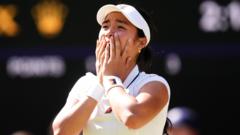
Six-two, six-four. The numbers on the board looked clean, almost simple, completely betraying the years of grueling sacrifice required to produce them. Eala dropped her racket. She covered her face with her hands, sinking to her knees on the blue surface. She had just become the first Filipino ever to win a Grand Slam singles title.
A Language of Home
The real magic of that afternoon did not happen during the final rally. It happened when someone handed Eala a microphone.
Standard post-match speeches are predictable exercises in corporate gratitude. Athletes thank their coaches, their clothing sponsors, the crowd, and their families. They use safe, sanitized phrases designed to slide through the media cycle without causing a ripple.
Eala looked at the crowd. She saw the blue, red, and yellow flags waving in the stands. She saw people who had driven hours from New Jersey, from Queens, from the far reaches of New York just to see someone who looked like them stand on a podium.
She stopped speaking English.
Instead, tears streaming down her face, she spoke in Tagalog. Her voice echoed through the American tennis stadium, carrying a dialect that had never before claimed center stage at a Grand Slam ceremony.
"Buong puso ko 'tong ipinaglalaban hindi lang para sa sarili ko kundi para makatulong din ako sa kinabukasan ng Philippine tennis," she said, her voice trembling but clear. She was fighting with all her heart, not just for herself, but to help the future of tennis in her homeland.
Then she delivered the line that transformed a standard sports victory into a cultural touchstone. She dedicated the historic win to "all the girls with ruffled socks and chubby cheeks" who dreamed of doing something big.
The Ghosts in the Mirror
Think about that phrase for a moment. It is an image stripped entirely of athletic vanity.
When we talk about sports heroes, we talk about chiseled jawlines, steely glares, and intimidating physical statures. We talk about machines. We rarely talk about the little girls who look in the mirror and see nothing but awkwardness. The ones whose socks bunch up around their ankles while they run. The ones who do not fit the sleek, idealized mold of a billboard model.
By choosing those words, Eala reached backward through time. She was talking to the seven-year-old version of herself, practicing under the midday heat in Manila, wondering if her dreams were too loud for her reality.
She was also talking to every kid sitting in a cramped living room in Cebu, Davao, or the suburbs of Manila, watching a grainy live stream on a smartphone screen. She gave them a roadmap. She proved that greatness does not require a country club membership or a pedigree recognized by European scouts. It requires an iron will and the willingness to sweat through the doubts.
The tennis world moves incredibly fast. Tournaments blur together, trophies gather dust in display cases, and new prodigies arrive every season to claim their share of the spotlight. The record books will always show that Alex Eala won the 2022 US Open junior singles championship. That is a matter of administrative fact.
But facts alone are cold comfort to a child trying to break out of poverty or isolation through sport. They need something they can feel.
They need to know that someone went before them, carrying the same heavy heritage, speaking the same language, and wearing the same ruffled socks, all the way to the top of the world.