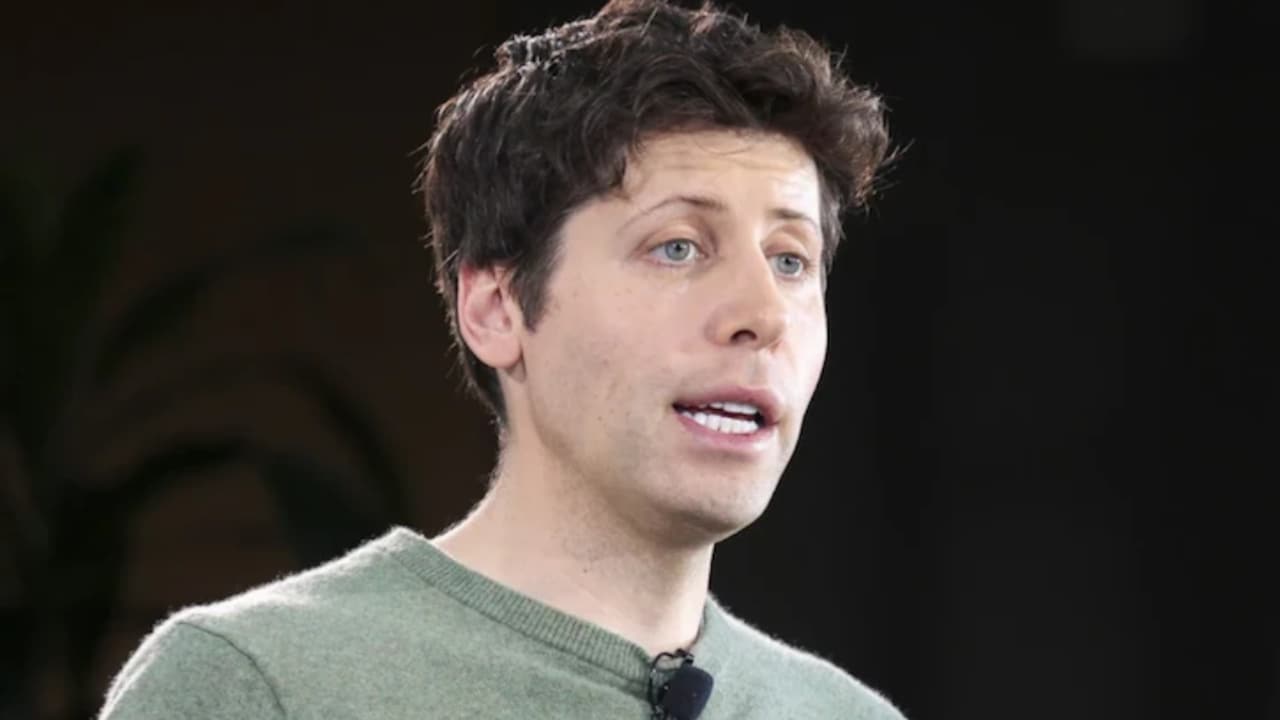
Sam Altman is a villain. That is the story. Everyone loves a villain.
Open-source purists hate him. Copyright hawks hate him. Capitol Hill hawks eye him like a hawk eyes a field mouse. Silicon Valley founders who once treated him like an oracle now pick apart every pivot, every boardroom drama, every billion-dollar compute deal.
Standard media coverage treats this backlash like a tragedy of fallen PR. The usual story goes like this: Sam Altman showed up in Washington in 2023 wearing a suit, sounding reasonable, asking Congress to regulate AI, and then somehow lost the plot. Critics say he pulled the ladder up behind him. Supporters say he is just misunderstood while trying to build artificial general intelligence for humanity.
Both sides are lazy. Both sides are asking the wrong question.
People keep asking why Sam Altman became a "bad guy" in the US, as if reputation in American tech were a popularity contest or a moral scorecard. It is neither. Backlash is the toll fee for touching real power, real money, and real structural friction. If nobody hates your company yet, your company probably does not matter.
The Lazy Consensus Around Sam Altman's Reputation
Conventional coverage reduces Sam Altman's reputation problem to three neat boxes: corporate greed, regulatory capture, or open-source betrayal. You see this everywhere. A founder gives a contrarian quote, a pundit writes a hot take about "hypocrisy," and the whole debate stops at personality.
That misses how power works in capital-intensive technology.
I have watched startups and scale-ups burn tens of millions of dollars chasing applause from developer forums and Twitter threads while ignoring the hard bottlenecks that actually decide survival—data centers, power grids, enterprise distribution, and regulatory compliance. Applause does not pay for gigawatts of power or high-bandwidth memory chips.
When a company moves from neat research demos to massive commercial infrastructure, early fans almost always turn on it. Early adopters love scrappy experiments and open weights. Once a lab starts signing multi-billion-dollar cloud contracts, negotiating with publishers, and building products for Fortune 500 procurement teams, the romantic phase ends. Friction begins.
Critics call that selling out. Operators call it growing up—or overreaching.
Why Asking "Why Is Sam Altman a Bad Guy?" Misses the Real Story
Asking why Sam Altman became a bad guy treats a structural collision like a character flaw.
The real story is not one man's PR strategy. The real story is that frontier artificial intelligence sits right on top of four unsolved clashes in American life:
- Speed vs. Law: Training large models on public web data moves at software speed. Copyright statutes, licensing markets, and court dockets move at legal speed.
- Openness vs. Risk: Open-weight models democratize capability fast, while also lowering barriers for misuse, espionage, and unregulated deployment.
- Capital Concentration vs. Antitrust Instincts: Frontier training runs require immense capital and specialized hardware, which naturally concentrates power in a few well-funded players and triggers deep suspicion in a country allergic to monopolies.
- Hype vs. Utility: Executives want magic; CFOs want return on investment; workers worry about displacement.
Sam Altman happens to stand at the center of those collisions because OpenAI kicked open the door for mainstream generative AI. Blaming his persona for all four collisions is like blaming a traffic cop for rush hour.
"People Also Ask" — Dismantled and Answered Straight
Did Sam Altman try to pull the ladder up with AI regulation?
That accusation assumes a neat conspiracy where one executive writes the laws. In reality, congressional hearings on AI have been full of lawmakers wrestling with questions they barely understand, lobbyists from every direction pushing competing interests, and competing factions inside the tech industry itself. Calling for safety guardrails while competing in a cutthroat market creates genuine tension—and critics are right to watch for self-serving rules. Still, pretending one founder controls Capitol Hill gives him far too much credit and Washington far too little agency.
Why do open-source advocates dislike OpenAI's direction?
Because their incentives clash head-on. Open-source builders want transparent weights, community modification, and lower barriers for independent labs. Proprietary frontier labs want defensible moats, controlled deployments, and predictable revenue to fund massive compute costs. Neither side is fighting a pure fairy tale. Open models bring real innovation and competition; closed frontier systems bring tighter control and heavy capital backing. Pretending one side is purely noble and the other purely evil is lazy thinking.
Is the backlash hurting OpenAI's business?
Reputation hits matter, especially for recruiting top researchers and winning public trust, yet buyers and engineers judge tools on capability, reliability, latency, and cost. Many companies that publicly complain about big tech vendors still quietly pay for their APIs because the models work. Loud online outrage is not the same thing as customer churn.
The Mechanics Behind the Backlash
To see why the backlash feels so intense, look at the economics underneath frontier AI.
Frontier model development is not a cheap garage project. Training runs, inference clusters, specialized talent, and data pipelines demand staggering upfront capital before any single user prompt pays back a dime. When costs are that high, business models get aggressive. Partnerships get complex. Governance structures—like OpenAI's shift from a pure nonprofit-led model toward a capped-profit or public-benefit structure—draw sharp scrutiny because money and mission collide in public view.
People notice that collision. Even when a legal structure follows the rules, public trust runs on perception. If an organization talks in lofty, sweeping terms about benefiting all of humanity while raising tens of billions of dollars and signing commercial deals left and right, skeptics will call out the gap between rhetoric and reality every single time.
Imagine a scenario where a frontier AI lab suddenly made every single weight, dataset detail, and safety evaluation completely public tomorrow morning. Open-source developers would celebrate for a week. Meanwhile, competitors could copy the weights, bad actors could strip safeguards, and investors might wonder how the lab recovers billions in compute spending. Openness solves one set of problems and creates another. Anyone who tells you there is zero trade-off is selling something.
What Heavy Hitters Teach Us About Power and Backlash
History in computing is crowded with founders who became lightning rods once their technology scaled.
Bill Gates became the villain of antitrust regulators and Linux fans in the 1990s precisely because Windows sat on almost every desktop. Mark Zuckerberg became a target across the political spectrum once Facebook shaped news, elections, and social habits at global scale. Even figures like Yann LeCun and Geoffrey Hinton—two pillars of modern deep learning—clash openly over AI risk, scaling limits, and openness, showing that even top researchers do not agree on what comes next.
When a technology becomes infrastructure, neutrality disappears. Every choice looks political. Every product update steps on someone's toes.
Where My Contrarian View Can Go Wrong
I am arguing that backlash against Sam Altman is a predictable side effect of power, scale, and structural friction rather than a simple story of villainy. That take has real blind spots, and I should state them plainly.
First, framing backlash as "inevitable" can excuse real mistakes. Overpromising timelines, shifting governance narratives, or brushing off legitimate copyright and safety concerns can alienate partners and invite harsher rules than necessary. Hubris is real in Silicon Valley, and it has sunk plenty of smart operators.
Second, public trust is not an infinite resource. Even if enterprise buyers tolerate friction today, repeated credibility hits can slow talent acquisition, sour government relationships, and weaken brand moat over time. Treating criticism as mere noise is a fast way to get blindsided.
What Smart Operators Should Do Instead
If you run a company, build products, or invest in AI, stop wasting energy cheering or booing personalities. Do this instead:
- Build around model interchangeability, not single-vendor faith. Route tasks across models based on cost, speed, and accuracy so you never get trapped by one lab's pricing shift or PR crisis.
- Separate hype from workflow value. Test AI on narrow, measurable bottlenecks—like code review, customer support triage, or document extraction—and cut anything that does not save real time or money.
- Own your data and distribution. Models will keep shifting and commoditizing in layers, while clean proprietary workflows and trusted customer relationships stay hard to replace.
- Watch incentives, not slogans. When any leader—Sam Altman or anyone else—talks about safety, openness, or partnership, look at who pays the bill and who captures the upside.
Villains make easy headlines. Incentives explain the market.