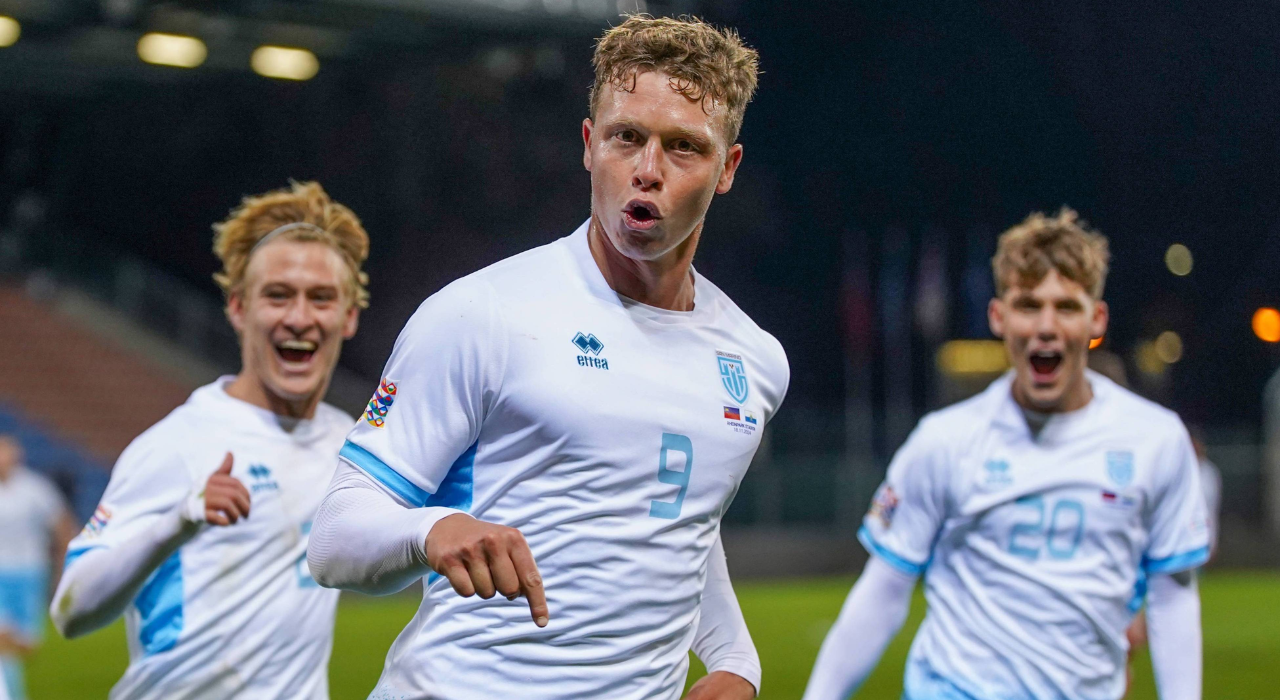
San Marino is a tiny enclave surrounded by Italy, famous for its medieval architecture and a national football team that defined the bottom of the FIFA rankings for thirty years. To the casual observer, they are the "worst" team in the world, a punchline for fans of larger nations. Yet, beneath the surface of a record-breaking losing streak, the 2024–25 international cycle revealed a startling reality. Through a combination of UEFA's structural overhaul and a rare win over Liechtenstein, the squad traditionally relegated to the basement of world football found themselves mathematically closer to a 2026 World Cup playoff spot than anyone thought possible.
The story isn't just about a fluke victory. It is about how the mechanics of modern football governance inadvertently created a narrow corridor for the world's smallest nations to dream.
The Architecture of the Underdog Path
To understand how a team with a win rate of less than one percent nearly stumbled into the global spotlight, you have to look at the UEFA Nations League. This isn't just a collection of glorified friendlies. It is a complex, tiered system designed to give small nations something to play for other than a 5-0 drubbing at the hands of France or Germany.
San Marino competes in League D, the lowest basement of the competition. For decades, their primary objective was simply to concede fewer than four goals. But the Nations League changed the stakes. By winning their group in League D, San Marino earned more than just a trophy for their cabinet; they secured a potential safety net for World Cup qualification.
The math is dense. FIFA and UEFA have integrated these competitions so that group winners in the Nations League—even those from the lowest tier—get a priority ranking for the World Cup playoff spots. If the heavy hitters from Leagues A, B, and C qualify through the traditional groups, those leftover playoff spots start trickling down. Suddenly, a team that has never won a competitive away match finds itself three or four mathematical "ifs" away from a playoff bracket against Europe’s elite.
The September Shift
For twenty years, San Marino didn't win a single competitive match. Not one. Their only victory had been a 1-0 friendly win against Liechtenstein in 2004. The weight of that history is heavy. It breeds a specific kind of mental fatigue.
On September 5, 2024, that cycle broke. Facing Liechtenstein again, Nicko Sensoli scored a 53rd-minute goal that sent the Republic into a frenzy. It wasn't just a win; it was a proof of concept. The players, mostly amateurs who spend their days as accountants, graphic designers, and factory workers, proved that the gap between the "worst" and the "second worst" had narrowed.
This victory was the catalyst. It put them at the top of their Nations League group. In the Byzantine world of European qualification, being a group winner is the golden ticket. While the traditional World Cup qualifiers are a brutal gauntlet where San Marino is expected to lose every game, the Nations League provided a shortcut. By finishing top of their three-team group, they positioned themselves to be one of the highest-ranked group winners not already qualified for the World Cup.
The Amateur Reality vs Professional Infrastructure
We often talk about "professionalism" in football as a matter of paycheck. In San Marino, it is a matter of sacrifice. The squad trains at night because the players have jobs. They don't have the luxury of recovery days or elite nutritional staff. When they travel to face teams like England or Spain, they are facing athletes whose weekly salary exceeds the entire annual budget of the Sanmarinese Football Federation (FSGC).
This disparity usually results in the "low block"—a defensive tactic where eleven men sit behind the ball and pray for the whistle. But under manager Roberto Cevoli, something changed. They started pressing. They started holding onto the ball for more than three passes.
The Numbers Behind the Struggle
Consider the raw data of San Marino's historical performance before this recent resurgence:
- Goals Scored per Game: Approximately 0.15
- Goals Conceded per Game: Over 4.2
- Average Possession: 24%
Against this backdrop, any upward movement is monumental. The 2024-2025 campaign saw their possession stats climb toward the 40% mark in matches against similar-tier opponents. This isn't just luck. It is the result of a long-term investment in youth academies that are finally producing players who have spent their entire lives playing on turf pitches with modern coaching, rather than the gravel lots of the previous generation.
The Playoff Paradox
The prospect of San Marino in a World Cup playoff sounds like a fever dream. If the stars had aligned—specifically, if the top nations in Leagues A, B, and C had all won their respective World Cup qualifying groups—San Marino would have been vaulted into a four-team playoff bracket for one of the final European spots in the 2026 tournament.
The critics argue this "participation trophy" mechanics cheapen the World Cup. They claim that a team that loses 10-0 to England has no business being anywhere near a playoff. But the counter-argument is the lifeblood of the sport: incentive. Without the Nations League path, small nations play meaningless matches in empty stadiums. With it, every goal matters. Every 1-0 win over a fellow minnow becomes a national event.
The 2026 World Cup is expanding to 48 teams. This expansion is often criticized as a cash grab by FIFA, but for nations like San Marino, it represents the only crack of light in an otherwise closed door. The path remains narrow, nearly impossible, and fraught with statistical anomalies. But for the first time in the history of the Republic, the math didn't say "zero."
The Psychological Burden of the Streak
Losing becomes a habit. When a team goes two decades without a win, the expectation of failure is baked into the pre-match warm-up. You could see it in the body language of the players during the mid-2010s. After the second goal went in, the shoulders slumped. The goal wasn't to win; it was to survive without injury.
The current squad has a different edge. Many of these players compete in the lower tiers of Italian football (Serie C and Serie D). They are used to the grit of semi-pro ball. They are physically fitter than their predecessors. Most importantly, they have tasted blood. The win in September 2024 removed the "never" from their vocabulary.
When you remove the fear of a record-breaking drought, the players take more risks. They play with a freedom that is dangerous to other small nations. Liechtenstein and Gibraltar used to view San Marino as a guaranteed three points. Now, they view them as a threat.
Beyond the 2026 Horizon
Whether San Marino actually sets foot on North American soil for the World Cup is almost secondary to the structural victory they have already achieved. They have validated the UEFA Nations League experiment. They have proven that there is a market—and a soul—in bottom-tier international football.
The real challenge now is sustainability. One win is an anomaly. Two wins is a trend. To move out of the "worst team" conversation permanently, the FSGC needs to leverage this momentum to improve domestic facilities. The San Marino Academy, which integrates young players into the Italian league system, is the engine room of this progress.
Success for a nation of 33,000 people isn't measured in trophies. It is measured in the ability to compete until the 90th minute. It is measured in making a world-class striker like Harry Kane work for his goals. It is measured in the sheer audacity of an amateur accountant believing he belongs on the same pitch as a Premier League millionaire.
The 2026 qualification cycle will eventually conclude, and San Marino will likely be watching from home. But the fact that we are even discussing the mathematical pathways for their inclusion proves that the hierarchy of global football is no longer a static pyramid. It is a shifting, volatile landscape where the smallest stone can occasionally cause a ripple that reaches the shore of the World Cup itself.
Stop looking at the FIFA rankings as a permanent sentence. Look at them as a snapshot of a moment that is rapidly being overhauled by a generation of players who refuse to be a punchline any longer. The math of the 2026 playoffs offered a glimpse into a future where the "worst" team in the world is anything but.
The next time San Marino takes the pitch, don't check the score for the margin of defeat. Look at the clock, look at the shape of the defense, and realize you are watching the most significant tactical evolution in the history of micro-state sports. They aren't just playing for pride; they are playing the system. And for a brief window in 2024, they almost beat it.