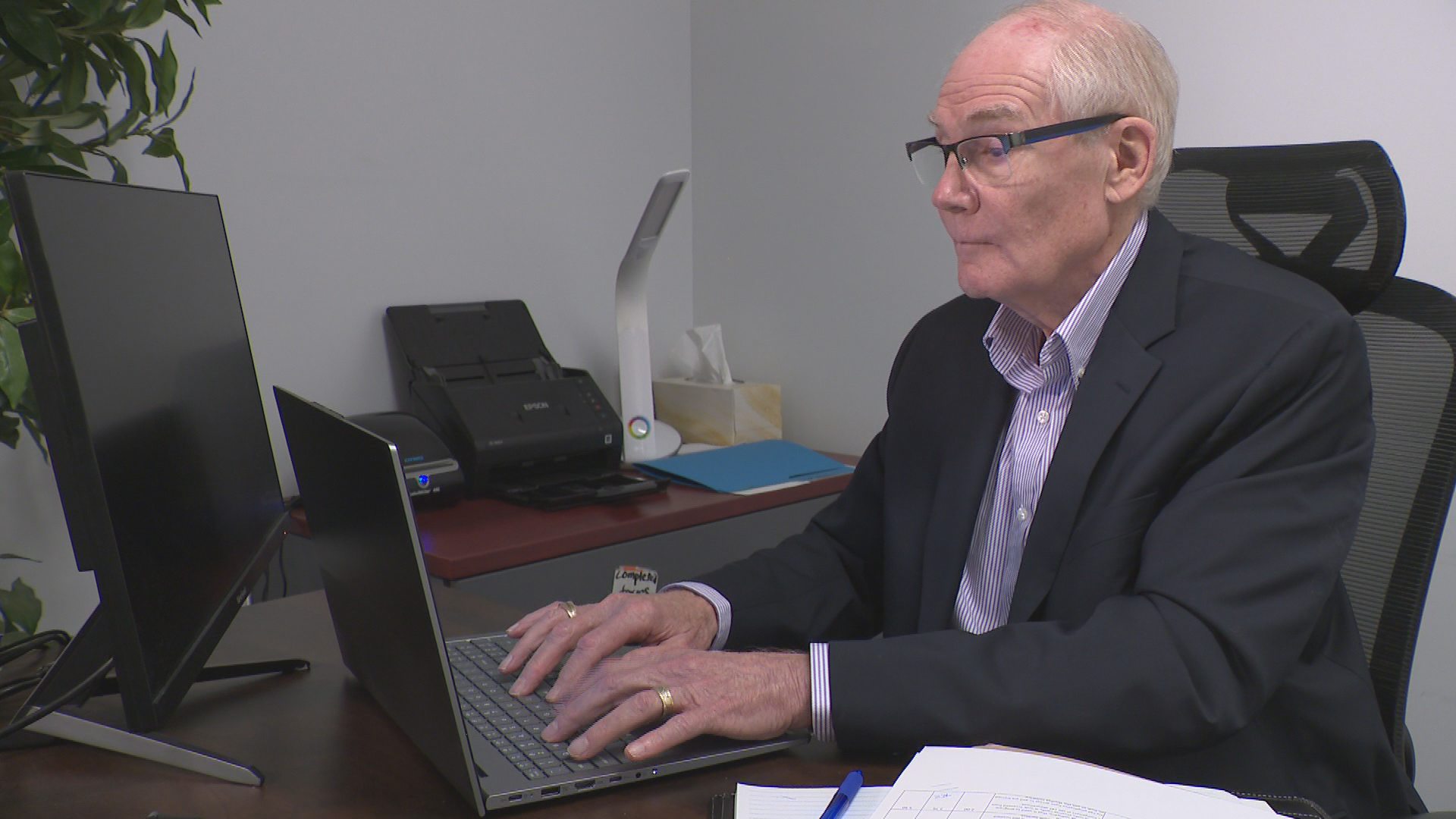
Saskatchewan is spending $1 million on a six-month independent review of hospital safety and security, led by former Saskatoon police chief and chief coroner Clive Weighill. The Ministry of Health and Buckingham Security Services Ltd. will evaluate 26 facilities across the province to address rising violence, poor guard retention, and high-profile security incidents. However, critics and front-line workers argue the contract is a costly, bureaucratic delay tactic. By explicitly excluding the investigation of recent fatal altercations and core operational issues like emergency room wait times, the provincial government is focusing on the symptoms of a broken healthcare system while ignoring the root causes of hospital violence.
The provincial government quietly attached the million-dollar price tag to the review only after direct inquiries from journalists. The announcement itself was framed as a proactive measure to protect patients, families, and healthcare staff. Behind the press release lies a system in acute distress, buckling under chronic understaffing, systemic addictions, mental health crises, and an increasingly volatile front-line environment.
The Scope Exclusion Hole
The most glaring flaw in the newly launched safety review is what it is forbidden to look at.
The review will completely bypass detailed investigations into individual incidents, including the January death of 36-year-old Trevor Dubois. Dubois died following a violent physical altercation with security staff at Saskatoon’s Royal University Hospital. Family members stated that security guards mistook a pink and yellow novelty cigarette holder for an imitation firearm, a fatal misunderstanding that sparked intense public outrage.
Just a month prior to that tragedy, the Saskatchewan Health Authority blacklisted multiple contract guards from Victoria Hospital in Prince Albert. A video circulated widely on social media showed guards removing an intoxicated man from the emergency room and leaving him outside in the snow.
Instead of investigating these profound operational failures to assign accountability, Weighill’s team is mandated to look at the past five years of complaints from a high-level, service-wide perspective to identify trends. The review team will not investigate individuals.
For families seeking justice and healthcare workers demanding immediate systemic accountability, this high-level approach feels like an intentional avoidance strategy. If a million-dollar safety review cannot dissect the exact structural failures that led to a patient dying on a hospital floor, its eventual recommendations risk being too broad to create meaningful change.
High Turnover and Low Wages
The provincial strategy relies heavily on private, third-party security contractors like GardaWorld, alongside internal protective services officers. This multi-tiered security model has created a fragmented environment where training standards vary wildly, and retention rates are dismal.
Healthcare unions have repeatedly pointed out that hospital security work is treated as a low-wage, high-risk stepping stone rather than a stable career. Guards are frequently exposed to physical violence, verbal abuse, and complex needle-borne risks, yet their compensation rarely reflects that reality. The result is a revolving door of inexperienced personnel who are often short-staffed and forced to manage complex psychiatric and behavioral emergencies with minimal de-escalation training.
While the review plans to examine training policies and procedures over the next six months, the crisis on the ground is worsening daily. Front-line officers report that chronic understaffing leaves existing security teams exposed and vulnerable, turning emergency departments into powder kegs.
Band-Aids Before the Diagnosis
The province is not waiting for Weighill’s report to act, creating a contradictory strategy. Even as the review begins its first phase of information gathering, the Ministry of Health has already spent millions implementing aggressive security measures.
- Metal Detectors: Walk-through metal detectors have been installed at emergency department entrances in Saskatoon, Regina, Prince Albert, and North Battleford.
- Personnel Surge: The province committed $3 million to hire an additional 51 security officers specifically to staff these metal detectors.
- Private Security Expansion: The Saskatchewan Health Authority issued active Requests for Proposals to bring private, third-party security services into rural and regional facilities, including La Loche, Shellbrook, Swift Current, Moose Jaw, Weyburn, Nipawin, Melfort, and Kamsack.
This reveals a fundamental tension in the government's approach. If the province already knows it needs metal detectors, more guards, and private security contracts in rural hubs, what exactly is the million-dollar review supposed to discover?
The installations resemble an admission of failure. Turning public hospitals into high-security checkpoints might deter weapons, but it does nothing to soothe the systemic anxieties of patients waiting ten hours for a doctor.
The Broken Triage Environment
Hospital violence does not occur in a vacuum. It is directly fueled by the collapse of primary care, long surgical wait times, and severe overcrowding in emergency wards.
When an emergency room becomes a waiting room for days at a time, tempers flare. Patients experiencing acute psychiatric episodes or severe substance withdrawal are left sitting in plastic chairs for hours alongside families with injured children. This environment is highly volatile, yet the mandate of the security review explicitly forbids it from examining triage practices, medical diagnosis, treatment protocols, or general health system administration.
By firewalling security from operations, the province is ignoring the primary driver of hospital aggression. Security guards are being used as human shields for systemic healthcare underfunding. Until the Ministry of Health addresses the administrative bottlenecks that trap vulnerable, desperate people in waiting rooms for hours on end, no amount of security training or metal detectors will truly make Saskatchewan hospitals safe.