A few weeks ago, a massive gorse fire tore through Brookeborough in County Fermanagh. Eighty-five firefighters spent eight grueling hours trying to contain a blaze that swallowed nearly two square kilometers of land. In the middle of that smoking chaos, crew members spotted something tiny on the ground. It was a curlew nest, sitting directly in the path of the advancing flames.
In a fast-moving disaster, nobody would have blamed them for focusing strictly on the perimeter. Instead, firefighters worked alongside the RSPB to pull four small, speckled eggs from the heat.
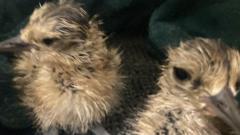
Fast forward to June 2026, and the Sliabh Beagh Curlew Conservation Trust confirmed the news. All four eggs hatched. The chicks are alive, healthy, and eating.
It sounds like a heartwarming, page-three filler story. A feel-good moment to break up a heavy news cycle. But if you think this is just a sweet story about cute baby birds, you completely misunderstand the scale of the crisis facing wading birds.
Saving four eggs isn't just a minor victory. It's a massive deal for a species currently staring directly down the barrel of regional extinction.
The Brutal Math Behind the Curlew Crisis
Let's look at the actual data, because the numbers are grim.
Since 1987, breeding curlew populations in Northern Ireland have collapsed by a staggering 82%. We aren't talking about a casual dip in numbers. We're talking about a total freefall. Across the entire region, experts estimate there are only about 150 breeding pairs left in the wild.
When a population gets that small, the math changes. Every single egg becomes a critical asset. Every successful hatch alters the survival probability curve for the local population.
Curlew Population Decline (Northern Ireland)
1987: Common across the landscape
2026: ~150 Breeding Pairs Remaining (-82%)
Curlews are large, long-billed wading birds known for their haunting, evocative calls. They used to be a permanent fixture of wet grasslands, bogs, and moorlands. Today, they're ghosts.
The biggest bottleneck for their survival isn't adult mortality; it's the fact that the chicks never make it to adulthood. Curlews nest on the open ground. Their strategy relies entirely on camouflage. That worked beautifully for thousands of years. It doesn't work at all against intensive modern agriculture, an explosion of generalist predators like foxes and crows, and dry, combustible landscapes.
Why Wildfires and Ground-Nesting Birds Don't Mix
The Brookeborough fire wasn't an isolated incident. Peatland and gorse fires have become a regular fixture of the spring and summer seasons.
When a wildfire sweeps through a bog or a heath, adult curlews can fly away. They escape the smoke and the heat, but their nests are rooted to the floor. The eggs roast. If the eggs have already hatched, the tiny chicks don't run. Their evolutionary instinct is to hunker down, flatten themselves against the soil, and rely on their mottled feathers to blend in. Against a wall of fire, that instinct is a death sentence.
Even if a nest miraculously survives the edge of a fire, the surrounding habitat is ruined. The fire burns away the diverse vegetation cover that chicks use to hide from predators. It destroys the damp, insect-rich environments where the birds forage for food. A burned bog is a desert for a wading bird.
The Reality of Headstarting
You can't just pick up wild bird eggs, put them under a desk lamp, and hope for the best. The process used to save these four chicks is an intense, highly technical conservation method known as headstarting.
The Sliabh Beagh team, operating under a strict license from the Northern Ireland Environment Agency, had to transport the eggs with extreme care. Once in the lab, the eggs live in specialized incubators that constantly regulate temperature and humidity while automatically turning the eggs to mimic a mother bird's natural movements.
Now that they've hatched, the real work begins.
- Phase 1: The chicks stay in heated indoor holding pens to stabilize.
- Phase 2: They transition to large, predator-proof outdoor enclosures.
- Phase 3: They spend weeks learning to forage for natural insects, supplemented by specialized high-protein wader pellets.
The goal is to get them past their most vulnerable life stage without a predator snacking on them or a fire burning them alive. Once they are fully fledged and capable of strong flight, conservationists will release them back into the wild pastures of Sliabh Beagh.
Is it a permanent fix? No. Artificial rearing is expensive, time-consuming, and takes an immense amount of human effort. But when you only have 150 pairs left, headstarting buys you the one thing the species desperately needs: time.
What Needs to Change Next
We can't rely on firefighters happening to stumble across camouflaged ground nests in the middle of emergency operations. That's luck, not a strategy.
If we want curlews around in the next few decades, the focus has to shift toward systematic landscape restoration.
First, we have to look at the bogs themselves. Decades of draining wetlands for agriculture or peat extraction have left these landscapes dry and hyper-vulnerable to catching fire. Rewetting bogs by blocking old drainage ditches keeps moisture in the soil. Damp bogs don't ignite easily, and they happen to produce the exact type of insect life that curlew chicks need to grow.
Second, local land management needs to prioritize early detection. Organizations like Conservation Detection Dogs NI are already showing how trained dogs can sniff out nests before machinery or fires destroy them.
Keep your eyes on the local conservation updates from Sliabh Beagh over the next month. The trust will be tracking these four chicks as they move to outdoor pens. If you live near rural or peatland areas, pay attention to local fire warnings during dry spells. Most of these fires are completely preventable, and keeping the ground from burning is the easiest way to give the next generation of wild birds a fighting chance.