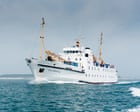
The salt hits your tongue before you even clear the harbor wall at Penzance.
You stand on the timber deck, gripping a cold white rail, watching the Cornish coastline shrink into a smear of granite and grey mist. Beneath your boots, twin Mirrlees Blackstone diesel engines thrum with a rhythmic, mechanical heartbeat that vibrates right up into your teeth. For nearly five decades, this exact vibration meant one of two things to anyone boarding the Scillonian III. Either you were about to embark on a magical holiday to a subtropical archipelago twenty-eight miles off the southwestern tip of England, or you were about to spend two hours and forty-five minutes praying to a cardboard sick bag.
Locals and regulars never called her by her formal maritime title. They called her the Vomit Comet.
Now, she is gone. After forty-nine years of faithful, stomach-churning, life-sustaining service, the Scillonian III has completed her final crossing from St Mary’s to the mainland, closing a chapter on British maritime history that most outsiders only ever understood as a punchline.
To understand why grown men and women wept on the quay at Hugh Town as she slipped her moorings for the last time, you have to stop looking at the ship as a piece of steel and start seeing her as an umbilical cord.
The Physics of a Floating Lifeline
If you have never crossed the Western Approaches in a Force 7 gale, it is hard to grasp why a 68-meter passenger ferry commands such fierce, contradictory affection.
Let’s strip away the romance for a second and look at the geography. The Isles of Scilly sit right where the English Channel collides with the open Atlantic Ocean. There is no land between those islands and the eastern seaboard of North America. When a winter depression rolls across the Atlantic, it pushes thousands of miles of uninterrupted swell straight onto the shallow continental shelf around Land’s End.
Imagine trying to balance a teacup on the back of a swimming Labrador. That is roughly the hydrodynamic profile of a passenger vessel crossing the Wolf Rock channel in rough weather.
Built in 1977 at the Appledore Shipbuilders yard in North Devon—and famously christened by Prince Charles—the Scillonian III was designed for a very specific set of constraints. The harbors at Penzance and St Mary’s are shallow and tidal. A deep-hulled ocean liner would run aground before it could drop its gangway. So engineers gave her a relatively shallow draft of just under three meters, allowing her to carry up to 485 passengers and cargo into tight Cornish ports.
The trade-off was stability.
Without a deep keel to slice through the waves, the ship didn't cut the swell; she rode over it, corkscrewing with a distinctive pitch-and-roll motion that could turn a seasoned sailor green within twenty minutes of passing the Lizard Peninsula. Veteran crew members learned to walk the corridors with a wide-legged, bent-knee stance, timing their steps to the rise and fall of the deck like surfers on a moving floor.
First-time tourists, however, usually made the fatal mistake of eating a full Cornish pasty before departure.
I still remember my own first crossing fifteen years ago. A bright July morning in Penzance gave way to an angry, slate-grey swell halfway to the Wolf Rock lighthouse. Inside the lower lounge, the air grew thick with the scent of diesel fumes, damp wool, and peppermint. Strangers who had been chatting brightly over tea suddenly went pale, staring fixedly at the horizon line through salt-streaked windows while stewards moved calmly down the aisles, handing out brown paper bags with the practiced grace of battlefield medics.
You hated the ship in those moments. You swore you would fly back on a Skybus Twin Otter, regardless of the cost.
And then, almost magically, the violent pitching would stop. The deep Atlantic rollers would break against the outer granite reefs of St Mary’s Sound, and the Scillonian III would glide into turquoise, sheltered water so clear you could count the pebbles on the seabed twenty feet below. The misery evaporated instantly. The boat hadn't just transported you; she had initiated you.
More Than a Tourist Ferry
To the 2,200 permanent residents of St Mary’s, Tresco, St Martin’s, Bryher, and St Agnes, the Scillonian III was never a novelty ride. She was oxygen.
On the mainland, if a grocery store runs out of milk, a lorry arrives overnight on the motorway. If a teenager breaks an arm playing football, an ambulance reaches an emergency room in twenty minutes. If a couple wants to see a movie, attend a wedding, or buy a new washing machine, they simply get in their car and drive.
On an archipelago twenty-eight miles out in the Atlantic, nothing happens automatically. Everything—literally every pint of milk, every sack of post, every hospital appointment, every wedding dress, and every coffin—must cross that stretch of water.
Consider a hypothetical scenario that played out in real variations thousands of times over the ship's lifespan. Picture a young mother living on St Mary’s in late November. Her toddler has a scheduled specialist appointment at Royal Cornwall Hospital in Truro. Fog has grounded the small planes at Land’s End Airport for three straight days. The Scillonian III is the only way off the rock.
She boards at dawn in driving rain. The crossing is brutal, the sea boiling white around the bow. Inside the warm, wood-paneled saloon, a deckhand brings her a cup of sweet tea and checks on the child, knowing both of them by their first names because his cousin went to school with her husband. Four hours later, she is sitting in a mainland clinic.
That intimacy is something modern transport has largely engineered out of existence.
Over 49 years, the Scillonian III completed thousands of round trips, carrying millions of passengers across one of the busiest and most treacherous shipping lanes in the world. She operated from March through November each year, pausing only for winter refits while the dedicated freighter Gry Maritha kept the islands supplied through the worst of the January storms.
She was a floating village square. Deals were struck over instant coffee at the buffet counter. Schoolchildren returning from mainland boarding schools reunited on her decks at the start of every holiday. Generations of families took the exact same bench on the upper sun deck every summer, watching dolphins race the bow wave as the granite silhouette of the islands rose out of the mist.
The Quiet Creep of Obsolescence
So why retire a ship that everyone loves?
The answer lies in the harsh arithmetic of maritime engineering and the changing reality of island life. Steel fatigues. Regulations tighten. What passed muster in 1977 looks wildly outdated through the lens of modern accessibility, emissions standards, and passenger expectations.
Maintaining a nearly fifty-year-old vessel in saltwater is a relentless war against entropy. Every winter dry-docking uncovered more expensive repairs—corroded plates to replace, obsolete engine parts that had to be custom-machined because the original manufacturers had closed decades ago, wiring harnesses that predated the internet.
At the same time, the Scillonian III had physical limitations that modern travelers increasingly struggled to accept. Accessibility for wheelchair users was cramped and awkward, constrained by steep companionways and narrow doors built long before modern disability standards existed. There were no stabilizers to tame the notorious Atlantic roll. Her top speed of around 15.5 knots meant the journey remained a nearly three-hour commitment each way, eating up half a day of travel before a holiday even began.
For years, debates raged across the islands and in Westminster over what should replace her. Should the Isles of Scilly Steamship Group build a faster catamaran? A bigger monohull? Would a larger ship ruin the quiet, car-free character of the islands by dumping too many day-trippers onto narrow lanes at once?
Island communities are fiercely protective of their way of life, and rightly so. Change on a tiny archipelago feels existential. A new boat isn't just a fleet upgrade; it alters the rhythm of the harbor, the capacity of local businesses, and the delicate balance between tourism revenue and overtourism.
Eventually, the decision crystallized into the Scillonian IV—a modern, purpose-built replacement designed with contemporary hull geometry, active stabilization systems to reduce that legendary seasickness, improved accessibility, and cleaner propulsion.
Progress won. It always does.
What We Lose When the Journey Gets Easy
Here is the uncomfortable truth that nobody likes to admit when modernizing infrastructure: friction creates meaning.
When travel becomes completely frictionless, it stops feeling like a journey and starts feeling like a commute. You step onto a stabilized, climate-controlled modern vessel, stare at your phone on high-speed Wi-Fi for two hours, and step off without ever noticing the wind direction or the state of the tide.
The Scillonian III refused to let you ignore the ocean.
She demanded your attention. She reminded you that the Isles of Scilly are not a theme park bolted onto the edge of Cornwall, but a fragile, windswept outpost separated from the mainland by twenty-eight miles of untamed water. Earning your arrival through two and a half hours of salt spray and rolling decks made that first step onto the warm granite of St Mary’s quay feel like a genuine arrival.
On her final voyage from the islands, crowds lined the harbor walls at St Mary’s and again at Penzance. Local boats formed a flotilla around her, sounding their horns in a cacophony of brass and air that echoed off the cliffs. People stood on headlands with binoculars, watching the familiar white-and-black hull with its red funnel cut through the grey water one last time.
Nobody was cheering the end of seasickness that day.
They were mourning the passing of a faithful workhorse that had carried their parents, their children, their livelihoods, and their memories through nearly half a century of Atlantic weather. They were watching a piece of their own personal history steam slowly toward the horizon, knowing that whatever replaces her will be smoother, faster, and infinitely more comfortable—and will never quite feel the same beneath their boots.


