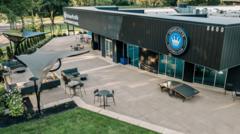
Scotland just spent months scouting the perfect "base camp" for a tournament that doesn't care where you sleep.
The narrative from the national team camp is predictable. They want a "home away from home." They want "tranquility." They want a luxury bunker where the players can escape the pressure of a traveling World Cup. It sounds logical. It sounds professional. It is actually a fundamental misunderstanding of high-performance psychology and modern logistics.
While the Scottish FA pat themselves on the back for securing a secluded five-star resort, they are effectively building a gilded cage. In a tournament spread across vast distances, the "base camp" model isn't a foundation for success. It’s a logistical anchor that breeds stagnation.
The Myth of the Sacred Training Pitch
Standard football journalism loves the "base camp" story. It’s an easy filler piece. You talk about the quality of the grass, the distance to the nearest airport, and the bespoke coffee machine in the media center.
Here is the reality: the grass doesn't win games.
Teams obsess over having a private, dedicated training ground for three weeks. They treat it like a monastery. But the rigid adherence to a single location in a "travelling" tournament—where games are thousands of miles apart—creates a physiological tax that no amount of cryotherapy can fix.
When you choose a static base camp in a continent-sized tournament, you are choosing more hours on a pressurized tube. You are choosing more time in transit. You are choosing "dead time."
I have seen national setups blow hundreds of thousands of pounds on "familiarity," only to watch their players’ reaction times drop by 15% because they spent the day before a quarter-final flying back and forth to a base camp they didn't need to return to.
Stability is Just Another Word for Boredom
The "home away from home" argument is the most dangerous fallacy in the sport.
Coaches think they are providing comfort. In reality, they are providing a vacuum. Professional footballers are used to high-intensity, changing environments. Forcing them into a sanitized, repetitive environment for thirty days creates a "bubble effect" that leads to mental fatigue.
The Staleness Scale
- Week 1: Luxury and novelty. The players enjoy the golf course and the game room.
- Week 2: Routine sets in. The same breakfast buffet. The same view. The same three teammates at the same table.
- Week 3: Irritability. The "luxury" feels like a prison. Small grievances become squad-splitting arguments.
Psychologically, the "travelling" nature of a modern World Cup should be embraced, not mitigated. Movement creates a sense of progression. New cities, new hotels, and new training environments provide a natural dopamine hit that keeps the brain sharp. By retreating to a base camp after every match, Scotland is effectively hitting "undo" on the emotional momentum of the tournament.
Logistics are the New Tactics
The competitor's piece praises Scotland for finding a "central" location. "Central" is a geometric term that has no place in elite sports recovery.
If your game is in New York and your base is in Munich, "central" is a lie.
The teams that actually win in this format—the ones who don't just "show up" but actually compete—operate like high-speed tech startups. They are agile. They don't have a "home." They have a rolling circus. They utilize "pop-up" high-performance centers. They prioritize proximity to the next stadium over the comfort of a permanent dressing room.
We need to stop asking "Where is the base camp?" and start asking "What is the total flight time?"
If a team spends 20 hours more in the air than their opponent over the course of the group stages because they wanted to sleep in the same bed every night, they have already lost. The physiological cost of altitude changes, cabin pressure, and disrupted circadian rhythms is cumulative. It’s a hidden injury that doesn't show up on an MRI until the 80th minute of a knockout game.
The Performance Cost of "Comfort"
Let’s look at the data on travel fatigue.
$$Total Fatigue = (Flight Hours \times C) + (Time Zone Shifts \times Z) - (Recovery Quality)$$
In this equation, $C$ represents the metabolic cost of travel and $Z$ represents the neurological disruption of shifting clocks. When you keep returning to a base camp, you are multiplying your Flight Hours and Time Zone Shifts. You are intentionally increasing the left side of the equation for a marginal, subjective increase in "Recovery Quality."
It is a bad trade.
The Superior Alternative: The Hub-and-Spoke 2.0
Instead of a single base, elite organizations should be looking at "Regional Clusters."
- Phase 1: A 10-day intensive camp in a climate-matched environment.
- Phase 2: Strategic hotel buyouts in match cities 48 hours earlier than the "minimum" requirement.
- Phase 3: Total abandonment of the "home base" once the knockout rounds begin.
Stop Treating Players Like Fragile Tourists
The argument that players need a "quiet place" to focus is an insult to their professionalism. These are athletes who play in front of 60,000 screaming fans and live under the microscopic heat of global social media. They don't need a quiet forest in the middle of nowhere; they need a sense of purpose and a lack of friction.
Friction is a three-hour bus ride from a "secluded" resort to the airport. Friction is a TSA line because you chose a base camp near a secondary hub to save money. Friction is the boredom of seeing the same wallpaper for a month.
Scotland’s "success" in finding a base camp is actually a failure of imagination. They have followed the 1998 playbook for a 2026 problem.
The Myth of "Team Bonding" in Isolation
The SFA believes that locking 26 young men in a luxury hotel will "foster" (forgive the term) a brotherhood.
It does the opposite.
Human beings are wired for variety. When you remove the external stimuli of the host country, the only thing left to focus on is each other. That’s when the cracks form. You want your squad to bond? Let them experience the tournament. Let them feel the energy of the host cities. Let them be "travellers" in a travelling World Cup.
Isolation breeds introspection, and introspection is the enemy of the reactive, instinctive flow state required for top-tier football.
The Financial Black Hole
Every penny spent on securing a "base camp" a year in advance is a penny not spent on mobile recovery tech.
I’ve seen federations spend $2 million on a resort deposit while their players are using three-year-old GPS trackers and basic massage tables. The "base camp" is a vanity project for executives. It’s a place for them to host sponsors and feel like they’ve "built" something.
The players? They just want to win. And you don't win by being the most comfortable team in the tournament. You win by being the most adaptable.
The Wrong Questions
The media is asking:
"Is the pitch at the base camp up to standard?"
"How far is the media center from the players' lounge?"
The media should be asking:
"How many total miles will the squad travel compared to their group opponents?"
"What is the specific plan for mitigating jet lag on the return leg to the base camp?"
"Why are we tethering ourselves to one coordinate when the trophy is moving?"
Scotland’s "perfect base camp" is a psychological security blanket. It’s a sign of a team that is afraid of the chaos of a World Cup, rather than a team ready to master it.
If you want to survive a travelling tournament, stop trying to find a home. Start learning how to live on the road. The obsession with the base camp isn't "preparation"—it's a refusal to accept the reality of modern sports logistics.
Pack your bags and keep them packed. The first team to realize that "home" is a locker room in a new city every four days is the team that makes it to the final. The rest are just tourists with a very expensive hotel reservation.
Burn the base camp. Embrace the road.
Otherwise, don't be surprised when the "comfort" of your luxury resort feels exactly like the comfort of an early flight home.