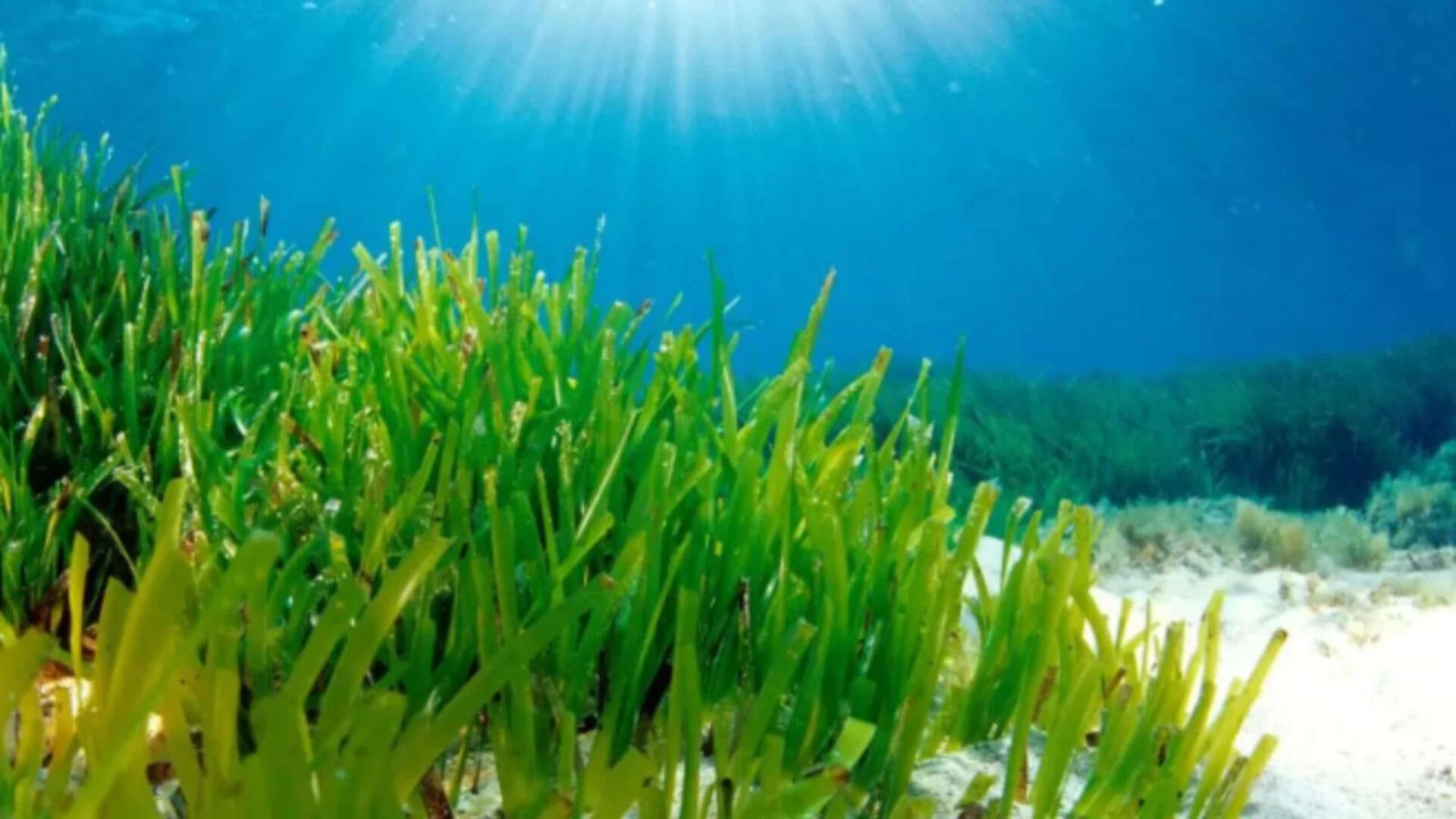
The water at forty meters deep isn’t blue. It is a heavy, suffocating indigo that presses against your dive mask with the weight of a hundred thousand tons of moving ocean. Down here, the sun is no longer a comforting companion. It is a ghost.
If you drop beneath the surface of the Mediterranean, past the sun-drenched swimmers and the glittering yachts of the coast, you enter a world of rapidly fading energy. For every meter you descend, the water steals a fraction of the sun's power. By the time you reach the dim, undulating valleys of the seabed, more than ninety-nine percent of that life-giving light has vanished.
To a human diver, it feels like twilight. To a plant, it should be a death sentence.
Yet, stretching across the dim seafloor is a vibrant, emerald wilderness. This is Posidonia oceanica, Neptune grass. It doesn’t just survive in this watery gloom. It anchors the entire Mediterranean ecosystem. For decades, marine biologists have stared at these deep-water meadows with a profound sense of confusion. According to the standard equations of plant biology, these fields should starve. They don't receive enough photons to fuel the basic engine of photosynthesis.
The mystery isn't just an academic puzzle for scuba-diving academics. It is a fundamental question about how life adapts when resources hit absolute zero.
Consider a hypothetical diver named Elena. She spends her days swimming along these deep ridges, collecting samples of a plant that is quietly breaking the rules of biology. When Elena brings a blade of deep-water seagrass up to the blinding light of the surface, it looks identical to the grass growing in the shallow, sun-kissed waters just off the beach. But underneath the microscope, a radical, invisible transformation reveals itself.
Plants are solar engineers. To capture light, they build microscopic molecular structures known as photosynthetic antennas. Think of these antennas like the satellite dishes mounted on houses. In the bright, shallow waters, a plant only needs a small dish. The photons are raining down in torrents; catching them is easy. If the dish is too large, the plant risks getting overloaded and damaged by the sheer intensity of the sun.
But as Posidonia oceanica creeps down into the dark, it undergoes a profound architectural shift. It doesn't grow taller. It doesn't grow wider leaves. Instead, it reallocates its internal resources to radically expand the size of its microscopic light-harvesting antennas.
It builds a bigger satellite dish.
By packing more light-absorbing pigments into specific protein complexes, the seagrass constructs a hyper-efficient net designed to catch the lonely, stray photons drifting through the deep water. It is a masterclass in biological optimization. The plant sacrifices other metabolic functions, pouring its energy into building these massive internal arrays. It gambles everything on the ability to catch the faintest glimmer of light.
This biological redesign is not a slow, evolutionary shift taking place over millions of years. It is dynamic. A single species, possessed of an extraordinary cellular fluidity, alters its own internal machinery based entirely on how far it sits from the sun.
We often view nature as a static backdrop to our lives, a collection of scenery that reacts to the world rather than actively rewriting its own rules. We look at a forest or a seagrass meadow and see passive green. But beneath the waves, a desperate, silent scramble for survival plays out every single second. The seagrass is actively engineering its way out of starvation.
The stakes of this silent adaptation are impossibly high. Neptune grass is often called the lungs of the Mediterranean. A single square meter of these seagrass meadows can produce more oxygen than a square meter of the Amazon rainforest. They are massive carbon sinks, burying carbon dioxide in the seafloor at rates that put terrestrial forests to shame. They hold the coastline together, preventing erosion, and provide a nursery for hundreds of species of marine life.
When you look at the Mediterranean from a plane, you see a brilliant turquoise ribbon tracing the land. That ribbon is held together by a plant that has learned how to live on the absolute margins of existence.
But this incredible evolutionary superpower reveals a fragile truth. The system only works if the dim light remains constant.
Today, human activity is threatening to pull the plug on this delicate dark-room operation. Agricultural runoff, coastal construction, and rising global temperatures are fueling massive algae blooms and stirring up sediment. The water is losing its clarity. The heavy indigo of the deep is turning into a murky, impenetrable brown.
The seagrass has already expanded its antennas to the absolute physical limit. It cannot build a bigger dish. When we muddy the waters, we don't just reduce the light; we push a hyper-optimized system past the point of no return. If the stray photons disappear entirely, the antennas catch nothing, the engine stalls, and the meadow dies.
Elena swims over a dying patch of meadow where a passing boat anchor has dragged through the sediment, leaving a scar of pale, bare sand. In the surrounding gloom, the remaining grass blades sway in the current, their oversized internal nets straining for a sunrise that feels further away with each passing year. It is a reminder that the most spectacular engineering feats on Earth don't belong to us, and they are far more vulnerable than we care to admit.