The metal groans. It is a low, bass-heavy frequency that you do not just hear; you feel it in the soles of your boots, rattling up through your shins and settling somewhere deep in your chest. For eight months, that sound was the baseline soundtrack for more than four thousand souls trapped inside a floating steel fortress in the Eastern Mediterranean.
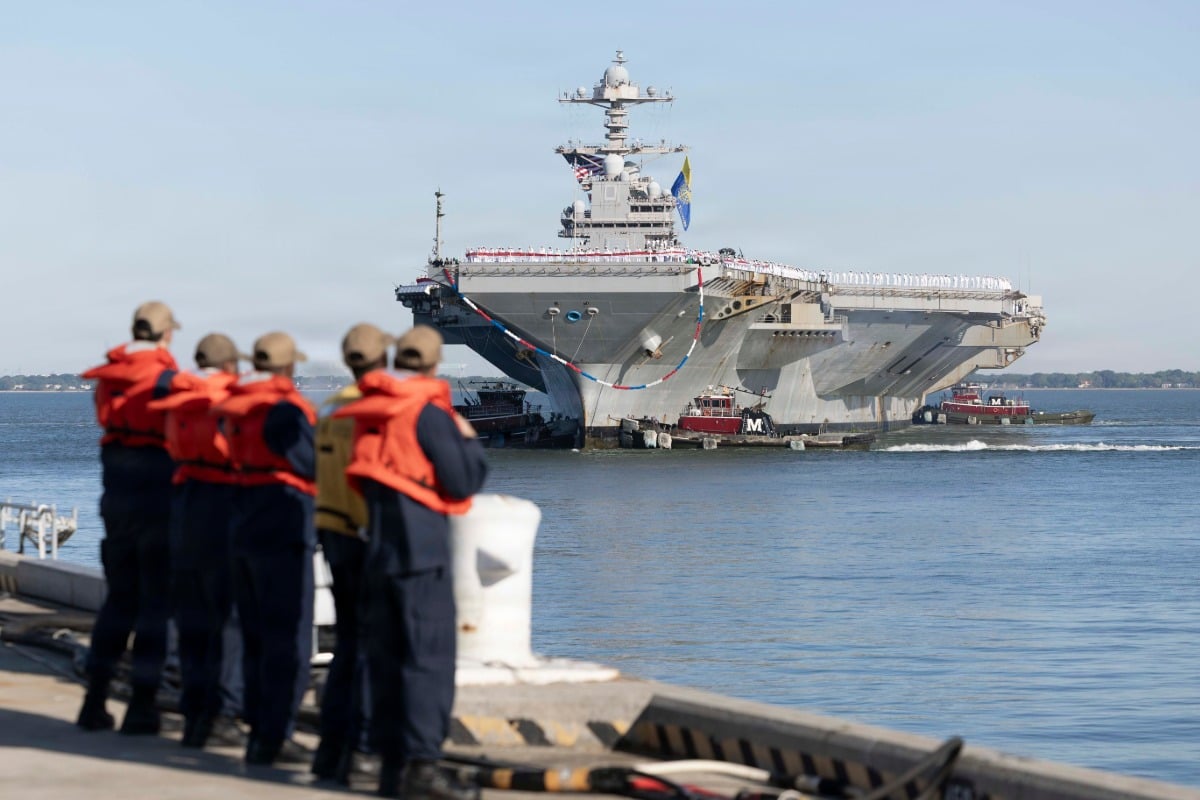
When the USS Gerald R. Ford finally tied up at the pier in Norfolk, Virginia, the cheers from the families waiting on the dock drowned out the machinery. There were tears. There were long, suffocating hugs. But as the sailors marched off the gangway, they left behind a three-hundred-meter hull that had essentially been run ragged at the edge of a knife.
The headlines that followed the carrier’s return were predictable. They focused on a number: $17.6 million. The United States Navy had just committed that sum to a post-deployment contract to patch up, fix, and overhaul the world’s most advanced warship. To a taxpayer, $17.6 million sounds like a fortune—a king's ransom spent on a ship that was supposed to be the pinnacle of modern engineering.
But if you look past the ledger, the real story isn't about the money. It is about the friction between cutting-edge technology and the brutal, unforgiving reality of the open sea.
The Weight of the First Watch
Imagine a pristine, state-of-the-art smartphone. Now, imagine dropping it in salt water, baking it in the sun, and forcing it to run its processor at one hundred percent capacity for 263 consecutive days without a single reboot.
That is the life of a first-in-class naval vessel.
The USS Gerald R. Ford is not just a bigger version of the Nimitz-class carriers that preceded it. It is an entirely different beast. It replaces steam catapults with electromagnetic launch systems. It swaps out old hydraulic arresting gear for advanced turbo-electric engines. It is less of a ship and more of a floating, nuclear-powered supercomputer designed to hurl seventy-ton fighter jets into the sky.
But being the first means you bear the scars of discovery.
Consider a hypothetical mechanic on board—let’s call him Chief Petty Officer Miller. Miller doesn't see a $17.6 million contract. He sees the specific pump on the third deck that has been weeping hydraulic fluid since November. He sees the saltwater corrosion eating away at the seals of a brand-new radar system that the manuals didn't quite account for. He knows that when you push a machine through a high-tempo combat deployment right out of the gate, things do not just wear down. They warp.
The Ford was extended in the Mediterranean three times. It was supposed to come home sooner, but history had other plans. As geopolitical tensions flared, the carrier stayed on station, launching sorties, monitoring skies, and acting as a massive, unmistakable deterrent.
Every extra day on station was a victory for American diplomacy. It was a disaster for the ship's maintenance schedule.
The Illusion of the Flawless Machine
We have grown accustomed to technology that just works. We swipe a screen, and information appears. We turn a key, and the engine purrs. This expectation has bled into how we view the military. We assume that a $13 billion warship should emerge from a deployment looking as pristine as it did when it left the shipyard.
This is a dangerous misunderstanding of reality.
The sea hates steel. Saltwater is a relentless, microscopic army dedicated to turning trillion-dollar military investments back into iron ore. When you combine that natural hostility with the violence of flight operations—where aircraft slam onto a pitching deck with enough force to crush a concrete building—the wear and tear is exponential.
The $17.6 million contract awarded to Huntington Ingalls Industries is not evidence of a failure. It is the cost of friction.
The scope of the work tells a story of survival. It covers the hull, the propulsion systems, the flight deck, and the complex computing networks that tie the whole island together. Think of it as an emergency triage after a marathon. The ship’s systems were pushed to their absolute design limits, and in some cases, slightly beyond them.
The electromagnetic catapults, known as EMALS, represent a massive leap forward, but they are notoriously finicky. On older ships, if a steam valve leaks, you fix it with a wrench and some packing material. On the Ford, if an electromagnetic sensor misbehaves, you might need a software engineer and a highly specialized replacement part that only exists in a handful of warehouses worldwide.
The Unseen Stakes of the Overhaul
There is a quiet panic that happens in naval strategy circles when a carrier goes into maintenance. The global chessboard does not pause just because a ship needs its turbines inspected.
Right now, the oceans are busier and more volatile than they have been in decades. When one carrier sits in a dry dock in Virginia, it leaves a vacuum somewhere else in the world. The pressure to get the Ford back out to sea is immense.
But rushing the process is how catastrophes happen.
The technicians now crawling through the narrow passageways of the Ford are engaged in a delicate dance. They are replacing parts that have been stressed by months of constant vibration. They are updating software that encountered real-world glitches while tracking actual targets, not simulation data.
The real problem lies in the unpredictability of first-in-class hardware. When a Nimitz-class carrier goes in for maintenance, the yard dogs have forty years of data to tell them exactly what is broken before they even open the hatch. With the Ford, they are writing the playbook in real time. Every broken bolt and fried circuit board is a lesson that will dictate how the rest of the Ford-class carriers are built and maintained for the next half-century.
The True Cost of Readiness
It is easy to get lost in the defense budget debates. The numbers become abstract, shifting from millions to billions until they lose all human meaning.
To understand why $17.6 million is actually a bargain, you have to look at the alternative. A carrier that cannot launch planes is just a massive, multi-billion-dollar target. The investment isn't just about fixing what broke; it is about buying reassurance for the next time the phone rings in the middle of the night.
The crew of the Ford is currently catching their breath, sleeping in beds that don't rock, and eating food that didn't come out of a freezer box. But the ship itself cannot truly rest. Even as the welders spark and the grinders scream in the hull, the clock is ticking down to the next deployment.
The steel will be patched. The software will be patched. The groaning of the metal will quiet down, at least for a little while, replaced by the hum of shore-power lines keeping the ship alive while it heals.
Step away from the pier, look at the massive silhouette of the island against the Virginia sky, and the truth becomes clear. The price of American power isn't just paid in the initial construction of these behemoths. It is paid in the quiet, unglamorous intervals between wars, where men and women with grease on their hands use millions of dollars to fight back the sea, one weld at a time.