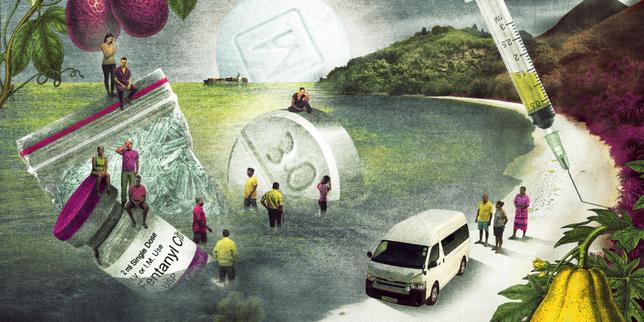
Stop Blaming Powder for a Structural Collapse
The global media loves a predictable narrative. Drop a journalist onto an equatorial island, show them a syringe rusting under a palm tree, and the article writes itself: Paradise Lost.
That is precisely how western media framed the addiction surge in the Seychelles. They paint a picture of a pristine postcard ruined by the sudden, inexplicable arrival of cheap heroin and synthetic cathinones. They cite per-capita addiction statistics with breathless horror, lamenting how a tiny nation lost its soul to the needle.
It is a comfortable, lazy explanation. It is also dead wrong.
Heroin did not ruin the Seychelles. Heroin merely exposed the pre-existing economic and social rot that the tourism industry spent four decades sweeping under expensive Turkish rugs. When a society sees up to 10% of its working-age population hooked on hard drugs, you are not looking at a sudden moral failing or a simple law enforcement breakdown. You are looking at a rational escape attempt from an economic dead end.
Treating the crisis in Victoria as a law enforcement or public health emergency misses the entire point. Until we address the artificial economic isolation created by a monolithic luxury tourism model, every dollar poured into rehabilitation centers or coastal patrols is just money burned on the beach.
The Myth of the Ruined Paradise
Mainstream coverage relies on a fundamental fallacy: the idea that the Seychelles was a functional, equitable society before illicit trade routes shifted.
I have tracked economic development models across island nations for years. The pattern is always the same. A nation builds its entire GDP around high-end, enclave tourism. Foreign developers build five-star resorts where a single night costs more than a local worker earns in two months. The local population is pushed into low-wage service roles—cleaning rooms, mixing cocktails, driving taxis.
The domestic economy becomes severely distorted:
- Hyper-inflation of basic goods: Importing everything to satisfy international resort standards drives up living costs for locals.
- Property pricing out citizens: Land values skyrocket to accommodate foreign investors and luxury real estate buyers.
- Zero upward mobility: The local workforce hits a ceiling fast. You are either a hotel manager (usually an expat) or a service worker.
When young people realize that working 60 hours a week at a resort leaves them unable to afford a home or build a future in their own country, societal cohesion disintegrates. The drug trade did not create despair in the Indian Ocean. Despair created the market.
The Math Behind the Epidemic
Let us look at the mechanics of the market rather than indulging in sensationalist tear-jerkers.
The Seychelles sits along the "Southern Route," a maritime highway for Afghan opiates moving through East Africa. Mainstream analysts point to this geography as if it were a curse of pure chance. They argue that proximity dictates consumption.
Nonsense. Geography provides supply, but local economics dictate demand.
+-----------------------------------------------------------+
|               THE SEYCHELLES DESPAIR TRAP                 |
+-----------------------------------------------------------+
|  1. Enclave Tourism Economy                               |
|     -> High living costs + Low wage ceiling               |
+-----------------------------------------------------------+
|  2. Structural Hopelessness                               |
|     -> Lack of economic diversification               |
+-----------------------------------------------------------+
|  3. High Domestic Demand for Anodynes                      |
|     -> Heroin/Synthetics become rational coping mechanisms|
+-----------------------------------------------------------+
|  4. Heavy-Handed Enforcement / Taboo                      |
|     -> Criminalization pushes market underground          |
+-----------------------------------------------------------+
When an economy produces high living costs alongside zero generational wealth opportunities, the demand for cheap, powerful anodynes surges. Heroin in the Seychelles became extraordinarily cheap relative to local purchasing power because the logistics network was already built to serve the luxury supply chain. Boats move continuously. Port infrastructure is built to move high-value goods quickly.
The surge in synthetic drugs like "cannabinoid" blends and cathinones is not a new crisis; it is the logical evolution of supply chain pressure. When the government cracked down on heroin importation, the market adapted. It substituted bulk opiates with high-potency synthetic chemicals that are easier to conceal in standard freight.
The prohibition model failed. It always fails.
Harm Reduction Without Economic Reform Is a Band-Aid
In recent years, the Seychellois government pivoted toward harm reduction, launching Methadone Maintenance Therapy (MMT) programs. Foreign journalists praised this as a progressive breakthrough.
MMT saves lives. It reduces crime. It stops the spread of blood-borne pathogens. But calling it a solution to the island’s crisis is a delusion.
Providing methadone to an addict without changing the economic realities that drove them to use in the first place creates a permanent, state-managed underclass. You trade an acute heroin problem for a chronic dependency on government clinics, while the underlying cause—economic disenfranchisement—remains completely untouched.
Thought Experiment: Imagine taking a city with an 80% youth unemployment rate, handing out free anti-anxiety medication to every resident, and declaring the mental health crisis solved. That is precisely what relying solely on MMT achieves.
If an individual wakes up, takes their daily dose of methadone, and returns to a tin-roof home in an informal settlement with no job prospects and an inflated cost of living, they have not been rehabilitated. They have been placated.
How to Actually Fix the Crisis
If the traditional playbook—police raids, moral panic, and isolated medical clinics—does not work, what does? We have to stop viewing this as a drug issue and start treating it as a structural economic failure.
1. Break the Resort Monopoly
The nation must dismantle the enclave tourism model. Resisting foreign resort conglomerates in favor of locally owned, decentralized eco-lodges keeps capital inside the community. If local workers own a stake in the infrastructure, local wealth builds. Wealth creates long-term planning horizons; long-term planning horizons kill drug markets.
2. Legalize, Tax, and Control the Supply
The war on drugs in a nation of 100,000 people spread across dozens of islands is physically unwinnable. Coast guard operations bleed the national budget to intercept a fraction of incoming shipments.
The government must consider radically pragmatism: treat the drug supply as a regulated state monopoly or decriminalize possession entirely while focusing resources on economic diversification. Stop spending millions on security assets that accomplish nothing against small, mobile speedboats.
3. Divert Tourism Revenue Directly into Youth Equity Funds
A tax on high-end tourism should not disappear into general government coffers or pay for police boats. It must go directly into dividend-paying equity funds for young citizens, funding micro-loans, vocational training outside of hospitality, and land acquisition. Give young Seychellois a reason to stay sober.
The Uncomfortable Truth
It is easy to write a tragic story about a tropical paradise lost to dark forces. It sells clicks. It appeals to western voyeurism.
The uncomfortable truth is that the Seychelles is not a victim of external evil forces. It is a victim of its own success as a luxury playground for the world's elite—a model that produced immense top-line growth while leaving its own citizenry economically stranded.
The powder on the street is just a symptom. The system itself is the addiction.
Stop trying to cure the symptom while feeding the disease.