We often imagine power as a fortress. Stone walls, iron gates, armed guards standing motionless against the sun. We picture leaders insulated from the raw, beating heart of ordinary human terror, living behind layers of bureaucracy and tactical defense where danger is merely a data point on a classified report.
Reality is far more intimate. And far more fragile.
Consider the ordinary act of a father sitting down for a meal. The clink of silverware. The low murmur of a television in the background. The quiet exhaustion that settles into the shoulders after a fourteen-hour day of governing a nation perpetually walking a tightrope over an abyss. In a normal world, the dinner table is a sanctuary. A place where the heaviest burdens are supposed to be laid down, if only for twenty minutes, while someone asks about school or work.
But power does not grant immunity. It magnifies exposure.
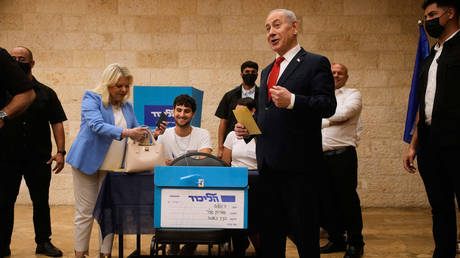
When the Prime Minister of Israel stepped forward to make a staggering accusation, the geopolitical chatter focused immediately on the macro level. Analysts scrambled. Diplomats reached for their encrypted phones. Talk shows lit up with panels dissecting the escalation, the regional fallout, the strategic calculus of proxy warfare.
They missed the human core.
Behind the title, behind the decades of polarizing political theater, behind the motorcades and the podiums, there is a parent looking across a room and realizing that the invisible war has breached the front door.
"Iran tried to murder one of my sons."
The words carry the weight of a lead weight dropping onto a hardwood floor. Silence follows.
Let us pause and strip away the political armor for a moment. Imagine looking at your child—watching them sleep, watching them laugh at a clumsy joke, remembering the exact weight of them when they were small enough to carry in one arm—and knowing that thousands of miles away, an apparatus of state power has sketched their face onto a target. Not because of who the child is, not for anything they have built or broken, but entirely because of whose blood runs through their veins.
This is the psychological reality of modern targeted statecraft. It is personal. It crawls under the skin and turns every shadow in the hallway into a potential threat.
In the architecture of international conflict, we talk endlessly about drones, centrifuges, cyberattacks, and deterrence thresholds. We treat these elements as abstract variables in a complex algebraic equation. If Country A does this, Country B retaliates by that. Yet, every single strategic maneuver is executed by terrified, angry, protective human beings who bleed when cut.
When a leader makes a claim of this magnitude, it fundamentally alters the temperature of the room. It shifts the conflict from a territorial dispute or a ideological clash into a blood feud. And blood feuds are notoriously difficult to de-escalate because they bypass the rational cortex entirely. They trigger the ancient, primal circuitry of survival.
Think about how security details operate in the shadows. To the public, they are men in dark suits wearing earpieces, moving with practiced efficiency. To the family they protect, they are a constant, heavy reminder that normal life has been permanently cancelled. Every car ride is a calculated risk. Every knock on the door causes a microscopic spike in the heart rate. The children of high-profile leaders do not get to walk down the street to grab a coffee or stumble into a late-night diner without a phalanx of watchful eyes dissecting every passing stranger.
That is not living. That is surviving in a cage made of glass.
Why does this specific claim matter far beyond the immediate news cycle? Because it redefines the rules of engagement. For generations, the unspoken code of intelligence operations maintained a certain boundary around the immediate families of political heads of state, even during periods of intense hostility. Direct assassination attempts against the children of sitting leaders cross a terrifying threshold. It signals that the gloves are not just off; they have been thrown into a furnace.
When the invisible lines of containment erode, the entire global neighborhood becomes vastly more dangerous. If the families of leaders become fair game, the calculation changes for every capital city on earth. Retaliation no longer targets military installations or economic assets; it targets lineages. It invites a spiral of generational vengeance that has no natural stopping point.
We look at the Middle East with a sense of helpless exhaustion. We watch the maps shift, the borders bleed, the rhetoric sharpen into a razor's edge. We wonder how anyone survives the sheer density of hatred accumulated over centuries.
The answer, painfully, is that many don't.
Behind every breaking news alert scrolling across a screen are human beings locked in a terrifying loop of action and reaction. The father fighting to keep his nation intact is also a father wondering if his son's next step outside will be his last. The architects of regional terror are calculating collateral damage while shielding their own families in underground bunkers.
The tragedy of our era is not merely that we possess the technology to destroy one another on an industrial scale. It is that we have weaponized the most intimate vulnerabilities of the human condition. We have made love, family, and parental instinct into tactical vectors.
As the echoes of this latest revelation reverberate through diplomatic channels and intelligence agencies around the globe, the air feels a little thinner. The margin for error grows dangerously narrow. One miscalculation, one emotional overreaction, one misunderstood signal, and the simmering shadow war could boil over into something entirely uncontrollable.
And when the smoke clears, the grand strategies of nations will matter very little to the parents staring across an empty chair at the dinner table.