The sound of a bowling alley is a highly specific architecture of noise. It is a predictable symphony of heavy polyurethane sliding down oiled synthetic lanes, the distant, rhythmic rumble of the ball return, and the sudden, chaotic explosion of tenpins colliding. To anyone who spent their youth under the neon glow of a local recreational center, that sound is a sanctuary. It is the backdrop to birthday parties, first dates, and league nights where the stakes feel monumental but are, in reality, beautifully low.
You expect the crash. You count on it. But you expect it at the end of the lane.
On a recent Friday evening, that familiar geometry of noise shattered.
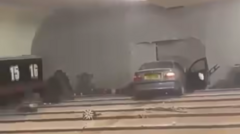
Consider the ordinary momentum of a weekend kicking off. Families were lacing up rented shoes, the leather stiff and the sizes always slightly off. Kids were pleading for quarters to feed the arcade machines. Pitchers of cheap beer were sweating against laminate tabletops. Then, the exterior wall gave way.
The Anatomy of an Intrusion
A car is a missile disguised as convenience. When a vehicle leaves the asphalt, crosses a sidewalk, and breaches a building, it does more than displace brick and mortar. It violently disrupts the unspoken contract of public safety. We walk into indoor spaces under the assumption that walls are absolute barriers.
The immediate aftermath of a vehicular building breach is defined by an eerie, disorienting silence that punctures the initial scream. Dust from pulverized drywall hangs in the air like a localized fog. The smell of burning rubber and leaking coolant clashes aggressively with the scent of fried food and floor wax.
According to local authorities, a vehicle driven by a local resident lost control, jumped the curb, and plowed directly through the front facade of the establishment. The structural damage was immediate. Support beams groaned under a sudden, uncalculated distribution of weight. Plate glass, designed to withstand high winds, rippled and burst into thousands of blunt-edged cubes.
The driver, subsequently identified and charged with multiple offenses including reckless operation and property damage, remained in the vehicle until first responders arrived.
But the dry police report fails to capture the true casualty of the evening: the collective peace of mind of fifty ordinary citizens who thought they were just playing a game.
The Invisible Stakes of Public Space
We rarely think about the vulnerability of our communal hubs. A bowling alley, a diner, a grocery store—these are the spaces where our guards are entirely down. You are focusing on your posture, adjusting your grip on a fourteen-pound ball, trying to pick up a difficult split. Your back is to the world.
When that world forces its way inside, the psychological ripple effect extends far beyond the physical debris.
Imagine standing in lane four. You are mid-approach. Your mind is entirely occupied by the mechanics of a sport that dates back to ancient Egypt. Suddenly, the wall thirty feet to your left ceases to exist. The physical shockwave alone is enough to knock a person off balance. But the mental shockwave is what lingers.
Psychologists often talk about situational awareness, the idea that we are constantly scanning our environments for threats. In a jungle, we look for predators. In a modern city, we look for erratic behavior. But inside a building, our brains switch off that evolutionary scanner. We trust the architecture to protect us.
When a sedan replaces a storefront, that trust vanishes.
The Cost of a Second
Reckless driving is often framed as a victimless crime until the exact moment of impact. We see it on highways every day: the aggressive lane changes, the tailgating, the brief glances down at a glowing smartphone screen. It is a gamble played with a two-ton machine.
The physics of a crash are uncompromising. A vehicle traveling at even thirty miles per hour carries enough kinetic energy to compromise standard commercial framing. When that energy is unleashed on a structure filled with people, survival becomes a matter of inches and sheer luck.
In this instance, the charges filed against the driver reflect more than just a broken window. They represent a legal reckoning for a cascade of poor decisions. Court documents indicate that the driver's blood alcohol content was significantly above the legal limit, a factor that dulls reflexes and inflates confidence in equal, deadly measure.
The human brain requires approximately 1.5 seconds to perceive a hazard and apply the brakes under normal conditions. Impairment doubles that time. At city speeds, those extra seconds mean the difference between stopping safely at the curb and parking in the middle of a concession stand.
Rebuilding the Sanctuary
The plywood will go up first. It always does. A raw, unpainted patch of timber covering the wound where glass and aluminum used to be.
For the owners of the establishment, the calculation shifts from hospitality to logistics. Insurance adjusters will pace out the damage, clipboards in hand, assigning monetary value to ruined carpet and twisted metal frames. Structural engineers will assess the integrity of the roof line.
But for the community, the process of returning is more complicated.
Will the league bowlers return next Tuesday? Probably. Human beings are remarkably resilient, driven by a desire for routine that overrides temporary trauma. But the environment will feel different. Every sudden thud from the back of the house will cause a few heads to turn. Every pair of headlights sweeping across the front windows from the parking lot will draw a lingering glance.
We live in a world where the boundaries between the chaotic outside and the structured inside are thinner than we care to admit. It takes only a single turning of a wheel, a momentary lapse in judgment, or a compromised state of mind to dissolve those boundaries entirely.
The lanes will eventually be cleared of dust. The pins will be reset. The heavy machinery that sets the targets will hum back to life. Yet, the memory of the night the outside world crashed through the wall will remain embedded in the floorboards, a silent reminder of how quickly the ordinary can turn into the unforgettable.