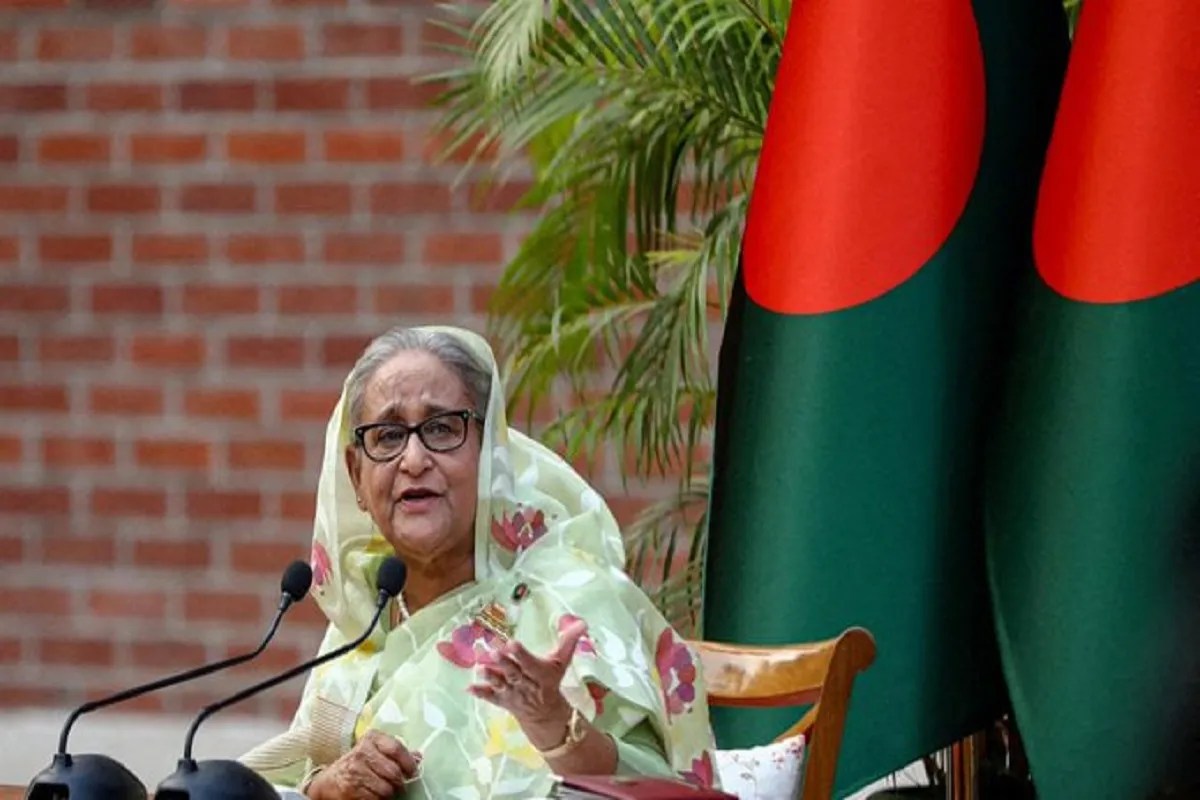
The mainstream narrative loves a clean villain and a dramatic fall. Standard commentary treats the recent political upheaval in Dhaka, specifically the media frenzy surrounding President Mohammed Shahabuddin and former Prime Minister Sheikh Hasina, as a simple morality play. Pundits scream about sudden power vacuums, institutional collapses, and shocking presidential resignations as if politics operates on cinematic plot twists.
It is lazy analysis.
Anyone tracking South Asian statecraft with actual skin in the game knows that transitions of this magnitude are never sudden accidents. They are slow-cooked institutional collisions. When commentators obsess over whether the president is stepping down or what it means for Hasina's return, they are asking the wrong question entirely. The real question is how the machinery of the state survives when every constitutional guardrail has been treated like optional decoration for decades.
The Myth of the Sudden Vacuum
Every headline wants you to believe that Bangladesh woke up one morning and accidentally misplaced its government.
Let us look at the structural mechanics. Power does not vanish into thin air because a high-profile figure boards a helicopter or a titular head of state faces intense political crosswinds. Power simply contracts back to its functional core. For years, observers relied on a comfortable fiction: that rapid economic growth numbers could permanently mask underlying democratic erosion.
When that facade cracked, the analysis didn't get sharper; it got lazier. Analysts started treating routine political survival tactics as unprecedented constitutional crises.
Real political risk is rarely loud. It is the quiet accumulation of unaddressed structural rot until the system can no longer absorb a single routine shock.
Consider the obsession over presidential authority in a parliamentary system. In theory, the president acts on advice. In practice, during a profound executive transition, the office becomes a lightning rod for competing factions seeking retroactive legitimacy. Shifting focus exclusively to Shahabuddin's status misses the broader institutional chess match happening behind closed doors.
Dismantling the Return Narrative
Will Sheikh Hasina return? The media treats this like a binary choice. Either she mounts a triumphant comeback, or she remains an exile in perpetual limbo.
Both scenarios ignore the brutal reality on the ground. Political longevity in modern South Asia is not about personal nostalgia or the loyalty of a fragmented base; it is about institutional capture and control over fiscal pipelines. Once those pipelines are severed, nostalgia buys you very little.
I have watched foreign policy experts misread foreign interventions and domestic pushback time and time again because they project Western legal norms onto entirely different political ecosystems. They assume institutions possess self-healing properties. They do not. Institutions are only as resilient as the people willing to risk their careers to defend neutral processes over partisan victories.
What Everyone Gets Wrong About Continuity
- The illusion of stability: Economic metrics under a dominant regime are often artificially smoothed over, masking deep systemic vulnerabilities.
- The scapegoat fallacy: Blaming a single leader or a single presidential exit ignores the complicit networks of bureaucrats, judges, and security elites who enabled the status quo.
- The transition timetable: Change does not happen on the neat timeline dictated by evening news cycles or foreign press briefings.
The Uncomfortable Truth About Post-Regime Realities
Let us address the elephant in the room that polite diplomatic circles refuse to touch. Transition governments do not magically restore pristine democracy. They manage a violent reallocation of patronage networks.
When power changes hands through mass mobilization rather than orderly ballot boxes, the victors inherit a compromised administrative apparatus. Purging loyalists from the police, the judiciary, and the civil service sounds great on a protest placard, but try running a nation of 170 million people when you fire every experienced administrator at once.
This is where the contrarian perspective bites hard. The chaos you are witnessing right now is not a temporary deviation from normal governance. For the foreseeable future, this is normal governance. The friction, the constitutional gray zones, the backroom negotiations between civil society leaders and military brass—this is how political orders are violently hammered into new shapes.
Stop looking for a neat conclusion or a return to the old playbook. The old playbook was shredded the moment the streets proved stronger than the state's monopoly on force.
Adapt or keep getting blindsided by reality.