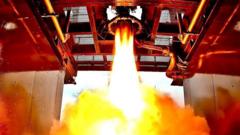
The scrubbed test rocket launch from the Shetland spaceport marks another sobering moment for the commercial orbital sector. When countdown clocks halt, the public hears about weather anomalies or minor telemetry glitches. Those who have tracked aerospace logistics for decades recognize a different reality. This pause on the remote Scottish archipelago is not just a localized technical hiccup. It is a symptom of a much larger, systemic friction point where hyper-ambitious orbital timelines collide with the unforgiving physics of remote infrastructure and regulatory gridlock.
The Geography of Ambition
Shetland is far from Cape Canaveral or Kourou. SaxaVord Spaceport sits at the edge of the British Isles, battered by North Atlantic gales and isolated by narrow rural roads that struggle to handle heavy transport trailers. Building a vertical launch facility in the Shetland Islands was always an exercise in extreme engineering stubbornness.
Proponents sold the location as the ultimate vantage point for sun-synchronous and polar orbits. They downplayed the logistical nightmare of moving multi-tonne cryogenic tanks, delicate avionics arrays, and volatile propellants across ferry routes and fragile bridges.
When a test campaign faces suspension, look at the supply chain before blaming the wind. Specialized rocketry components do not sit in local warehouses. Every replacement valve, every batch of liquid oxygen, and every specialized diagnostic tool must travel hundreds of miles through a bottlenecked logistics chain.
[Shetland Location] ---> [Fragile Island Supply Chain] ---> [Weather Vulnerability] ---> [Launch Hold]
Regulatory Drag Meets Hardware Reality
The narrative pushed by spaceport developers often implies that once concrete is poured and launch pads are bolted down, rockets will fly with the regularity of commercial airliners. That narrative ignores the glacial pace of modern aerospace regulation.
In the United Kingdom, the Civil Aviation Authority holds the keys to the skies. Obtaining a license to burn propellants and hurl metal past the stratosphere requires navigating a labyrinth of environmental impact assessments, air traffic clearance corridors, and safety margins designed for much larger national programs.
When a test launch goes on hold, it usually means the friction between what the engineering team wants to test today and what the safety regulator will permit tomorrow has reached an impasse.
- Environmental Constraints: Protecting nesting grounds for rare seabirds restricts active windows.
- Airspace Coordination: Closing vast sectors of North Atlantic commercial air routes costs millions in airline rerouting.
- Licensing Thresholds: Proving containment protocols for unproven rocket designs takes months of administrative review.
The Financial Pressure Cooker
Private capital is losing its patience with sub-scale orbital startups. Investors poured billions into the small-launch ecosystem over the last ten years, operating under the assumption that demand for dedicated rides to low Earth orbit would scale infinitely.
Reality proved far more complicated. Mega-constellations like Starlink swallow up capacity on heavy-lift vehicles at a fraction of the cost per kilogram. Small-sat operators scrambling for custom drops find themselves priced out or forced to wait years for an available slot.
Every time a test countdown reaches zero and aborts, burn rates accelerate while revenue remains at zero. The Shetland pause forces investors to ask hard questions about cash runway. If a simple suborbital or low-altitude test article cannot leave the pad without a prolonged scrub, how long until commercial payloads actually clear the tower?
Hardware Rich Versus Data Poor
There is a distinct difference between being hardware rich and data poor. Launch companies love to show off shiny rocket bodies standing tall against dramatic coastal backdrops. A rocket on a pad is a marketing asset. A static fire or a completed flight is a data generator.
When tests are put on hold, engineers are denied the telemetry streams needed to validate computational models. You can run fluid dynamics simulations until your servers melt, but nothing replaces the brutal feedback loop of a hot-fire test under real environmental stress.
The delay in Shetland highlights a wider industry trend where vehicle designs outpace test infrastructure. Companies try to skip intermediate testing steps to save capital, only to hit a wall when regulatory authorities demand empirical proof of structural integrity before granting clearance for ignition.
The North Sea Reality Check
Europe wants its own sovereign access to space. Continental leaders look at the dominance of American and Asian launch providers and panic. They fund regional spaceports from Scotland to Sweden, hoping to capture a slice of the multi-billion-dollar orbital economy.
Yet enthusiasm cannot bend metallurgy or shorten the laws of thermodynamics. The weather windows in the extreme north are narrow, unforgiving, and prone to rapid shifts. Ground crews work in freezing drizzle, trying to troubleshoot complex electrical harnesses while wearing heavy protective gear.
This is the unglamorous side of modern spaceflight. It lacks the slick production values of corporate launch webcasts. It is greasy, cold, and slow.
The suspension of the Shetland test rocket launch should serve as a cold dose of realism for anyone tracking the European small-launch sector. The barriers to orbit are not just technical; they are geographic, regulatory, and financial. Until the industry stops treating remote launch sites like plug-and-play facilities and starts respecting the profound difficulty of operating at the edge of the map, these holds will remain the rule rather than the exception.
The countdown clock will eventually restart. The valves will open, the igniters will spark, and the vehicle will either clear the pad or tear itself apart over the grey waters of the North Sea. Until then, the rocket stays bolted to the concrete, a quiet monument to the stubborn gap between orbital dreams and terrestrial constraints.