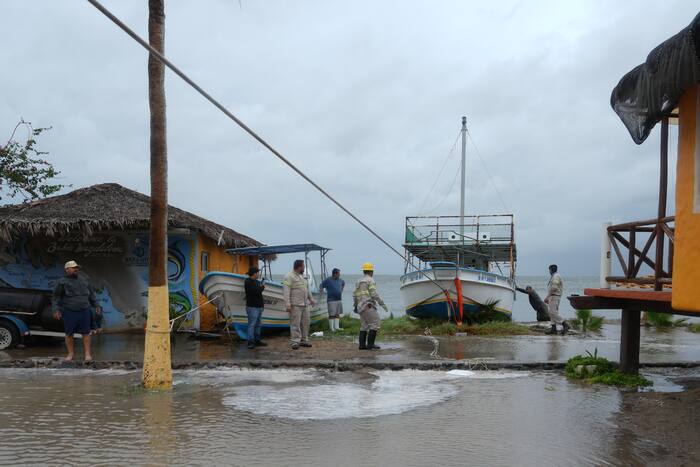
The air smells of salt and heavy, unmoving copper. It is that particular brand of thick stillness that precedes a reckoning, the kind of quiet that makes every ticking clock sound like a hammer strike against a floorboard. Out on the edge of the Baja California peninsula, the ocean has stopped breathing normally. It is swelling, rising in dark, rhythmic pulses, whispering warnings to the mangroves and the sun-bleached concrete seawalls.
Hurricane Polo is coming.
For the meteorologists staring at satellite loops hundreds of miles away, Polo is a swirl of high-contrast infrared color, a tight, spinning eye wrapped in bands of crimson and gold. But for the people whose laundry is still flapping on backyard lines in towns like Cabo San Lucas and San José del Cabo, Polo is not a map graphic. It is a mounting dread. It is the sound of masking tape tearing off the roll, strips crisscrossing glass windows to create frantic, desperate X shapes against the inevitable impact.
Consider Mateo, who runs a small family-owned pangas rental business down by the marina. His fiberglass boats are his life's savings, bobbing gently in rows that have weathered dozens of squalls over the decades. Yet, as the barometer drops, Mateo feels a familiar, cold knot tighten in his chest. He knows the statistics. He knows that forecasters are throwing around phrases like life-threatening winds and catastrophic storm surges. But statistics do not capture the sheer, brute violence of water pushed by a hurricane. Water does not just flood; it arrives with weight, carrying tree trunks, broken docks, and the wreckage of homes like battering rams.
"Tie them down twice," Mateo tells his youngest nephew, his voice dropping an octave to mask the tremor of anxiety. They are securing ropes to heavy concrete bollards, muscles straining against the humid wind that has finally begun to whip across the harbor.
Around them, a community prepares for a test of endurance. Schools are empty, their classrooms turned into provisional shelters where families drag mattresses across tile floors. Storefronts pull down corrugated metal shutters, sealing their interiors into dim, cavernous vaults. There is a strange, shared solidarity in these hours. Neighbors who barely exchanged a nod on ordinary Tuesday mornings are suddenly checking roof tiles together, sharing flashcards, batteries, and quiet reassurances.
Nature does not negotiate. When a storm of Polo's magnitude steps ashore, it discards human infrastructure like discarded toys. The winds build slowly at first, hissing through palm fronds with an eerie, rising pitch before transforming into a continuous, deafening roar. Tin roofs lift and flutter like paper in a gale. Power lines snap with bright, electrical flashes that briefly turn the darkening sky a sickly, electric blue before plunging entire neighborhoods into blackout.
Inside a concrete home several blocks back from the shoreline, a young mother named Elena sits on the floor with her two children. The power is gone. The only illumination comes from the nervous glow of a single flashlight pointed at the ceiling. Outside, the wind screams, throwing gravel and heavy rain against the shuttered windows with the force of thrown stones. Every few seconds, the house shudders, a low-frequency groan that rattles the dishes in the kitchen cupboards.
Her son asks if the house will stay put. Elena smiles, a brave, practiced curve of her lips, even as her own heart hammers against her ribs. She tells him the walls are strong, built of concrete and rebar, designed to withstand the fury. But she knows, too, as anyone who has lived through a hurricane knows, that nature always holds the winning hand. You do not conquer a hurricane; you endure it. You yield to it, hide from it, and pick up the pieces after it passes.
This is the invisible story behind every weather advisory headline. Behind every dry meteorological bulletin detailing wind speeds and barometric pressures lies a human landscape holding its breath. It is about the teacher packing her grandmother's photo album into a plastic Ziploc bag. It is about the fisherman watching his livelihood take its chances against the tide. It is about the fragile line between everyday routine and utter disruption.
Hours crawl by like days. The eye of the storm passes, offering a deceptive, eerie calm—a breathless window where the wind drops and the stars might even peek through a torn ceiling of clouds, before the backside of the tempest slams down with renewed vengeance from the opposite direction. No one dares step outside. Everyone knows the stillness is only a pause in the violence.
By dawn, the howling begins to soften, easing into a steady, gray drizzle. The sun rises over a transformed world. Streets are choked with fallen branches, dunes of wet sand, and tangles of downed power lines. In the harbor, some boats sit upright while others list drunkenly against broken piers.
Mateo walks down the dock, his rubber boots squelching in the mud. He looks at his marina, takes a deep, ragged breath of the rain-washed air, and touches his shoulder to a tilted post. It survived. Not unscathed, but standing.
Farther inland, Elena opens her front door to let the fresh morning air sweep through the humid rooms. The children peer outside at the flooded street, wide-eyed and silent. The storm has moved on, spinning itself out over colder waters or jagged mountain ranges, leaving behind a scarred earth and a long, exhausting road of recovery.
The wind is gone. The silence returns, heavy this time not with dread, but with the quiet, stubborn resilience of people who have weathered the worst and are already looking toward the sun breaking through the gray.