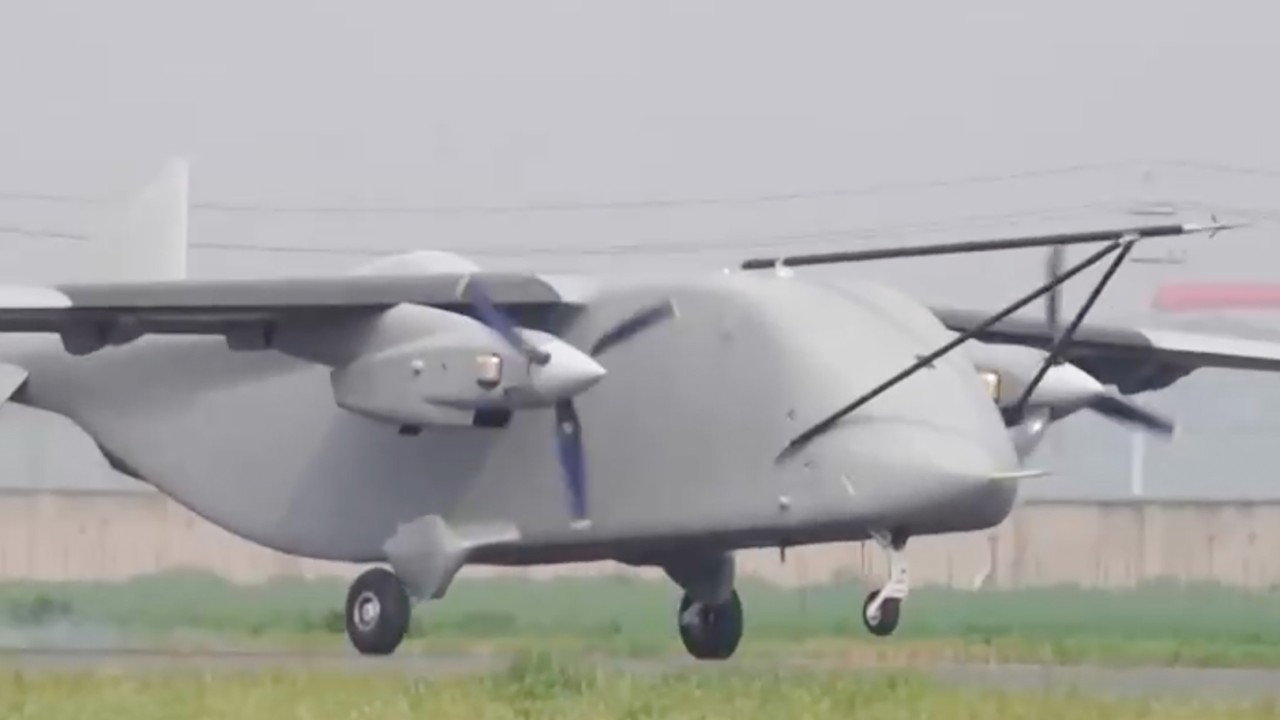
The air at Zigong Lantian Airport was thick with the kind of stillness that usually precedes a storm. But the sky was clear. On the tarmac sat a machine that looked less like a traditional aircraft and more like a reimagined whale, its twin engines humming with a low-frequency vibration that rattled the teeth of the engineers standing nearby. They weren’t looking at a cockpit. There was no glass canopy reflecting the morning sun, no pilot climbing a ladder with a helmet tucked under one arm. There was only a cavernous hold, empty for now, but designed to carry two tons of whatever the world needs most in a crisis.
China had just moved the needle.
On a Sunday in mid-August, the SA3600 made its maiden flight. It lasted only twenty minutes, a brief hop in the grand scheme of aviation history, but those twenty minutes signaled a shift in how we think about the logistics of survival and commerce. This isn't about hobbyist drones dropping a latte on a suburban doorstep. This is about the "world's heaviest" cargo drone, a four-engine beast with a wingspan that rivals mid-sized passenger jets, designed to operate where humans and traditional planes simply cannot.
The Mathematics of a Heavy Lift
To understand why this matters, you have to look at the numbers, but not as dry statistics. Look at them as a capacity for change. The SA3600 has a maximum takeoff weight of about 3.6 metric tons. In the world of unmanned aerial vehicles (UAVs), that is a staggering figure.
Imagine a remote village in the Himalayas, cut off by a mudslide. Traditionally, you would send a helicopter. But helicopters are expensive, they require highly trained pilots who must risk their lives in unpredictable mountain thermals, and their payload is often limited by the fuel they have to carry to get back home.
Now, consider the SA3600. It offers a cargo space of 12 cubic meters. That is enough room to fit a small SUV, or, more importantly, enough medical supplies, food, and communication equipment to sustain a cut-off community for weeks. Because it is unmanned, the risk to human life during the delivery is zero. Because it is designed for "high-altitude operations," it breathes thin air as easily as a marathon runner in their prime.
The Invisible Stakes of the Island Chain
The technical specs mention "island operations" with a frequency that suggests more than just delivering mail to tourists in the South China Sea. There is a strategic tension here that the press releases don't explicitly name.
Islands are logistical nightmares. They are dots of land surrounded by vast, unforgiving blue. If you are a technician on a remote wind farm or a researcher on a distant atoll, you are at the mercy of the weather and the shipping lanes. A broken part could mean weeks of downtime. The SA3600 changes that math. It turns a three-day sea voyage into a four-hour flight.
But the "human-centric" reality of this tech is often darker. Large cargo drones are dual-use by nature. A machine that can carry two tons of rice can just as easily carry two tons of munitions or a swarm of smaller reconnaissance drones. When we watch these flight tests, we aren't just seeing a breakthrough in shipping. We are watching the birth of a new kind of infrastructure—one that can be deployed for mercy or for muscle, depending on who holds the remote.
The Engineering of a Whale
The Sichuan Tengden Sci-tech Research Co., the minds behind this project, didn't just build a big plane. They had to solve the problem of autonomy at scale.
A small drone can be twitchy; it reacts to a gust of wind like a hummingbird. A 3.6-ton drone has momentum. It has gravity. It has a soul made of carbon fiber and complex algorithms. During the flight from Zigong, the onboard systems had to manage four separate engines, ensuring that the thrust remained balanced even as the air density shifted.
The design is utilitarian. It isn't sleek like a fighter jet. It is boxy and broad-shouldered. It has a high-wing configuration, which allows it to land on unpaved, rugged strips of dirt. It doesn't need a pristine runway at Heathrow or Beijing Capital. It needs a flat-ish piece of earth and enough clearance to spin its props.
Consider a hypothetical scenario: A coastal city is hit by a typhoon. The main airport is flooded. The roads are buckled. A fleet of SA3600s could begin a shuttle service from an inland hub, landing on a highway or a cleared patch of parkland. They wouldn't get tired. They wouldn't need to sleep. They would just keep coming, a relentless conveyor belt in the sky.
Why the Pilot Stayed on the Ground
There is a specific kind of loneliness in modern aviation. We are moving toward a world where the "human element" is a supervisor rather than a practitioner. At the Zigong Lantian control station, the people involved in the SA3600 test weren't feeling the G-forces or smelling the jet fuel in the cockpit. They were staring at monitors, watching data points crawl across a map.
This transition is terrifying for some and a miracle for others.
For the logistics companies, it is the removal of the most expensive and fragile part of the plane: the person. No cockpit means more room for cargo. No life-support systems mean less weight. No pilot means the plane can fly into conditions that would be a "no-go" for a crewed flight.
But for those of us watching from the ground, there is a lingering question about what we lose when we remove the pilot. A pilot can make a "gut" decision. A pilot can see a child on a runway and pivot in a way an algorithm might not. We are trading that human intuition for a different kind of reliability—the reliability of a machine that never panics.
The New Silk Road is Vertical
China’s push for "low-altitude economy" isn't a hobby. It is a state-level directive. They are building a vertical highway system. The SA3600 is just the heavy-duty truck of that system.
While the West has focused heavily on the "last-mile" delivery—the tiny drones that bring you a new iPhone—China is building the "middle-mile." They are building the freighters. This is a massive bet on the idea that the future of global trade isn't just on the ocean or in the belly of a Boeing 747. It is in autonomous, modular, medium-sized craft that can bridge the gap between a massive port and a tiny, inland mountain town.
The success of the SA3600 test is a signal to the world. It says that the barriers of geography—the peaks of the Himalayas, the distances of the Pacific, the mud of the rainy season—are becoming optional.
The Weight of the Future
As the SA3600 touched down back at Zigong, the dust kicked up by its landing gear settled quickly. The engineers cheered, the data was backed up, and the headlines began to circulate.
But the real story isn't the flight itself. It’s the silence that followed.
It’s the realization that somewhere, right now, a logistics officer is looking at a map of a disaster zone or a remote military outpost and crossing out the word "impossible." They are realizing that 3.6 tons of cargo no longer needs a pilot, a paved runway, or a miracle to get where it's going. It just needs a flight plan.
We are entering an era where the sky will be filled with these silent giants. They will carry our food, our medicine, and perhaps our wars. They will move with a mechanical indifference to the terrain below. And as we look up, we won't see a pilot waving back. We will only see the steady, flickering lights of a machine that knows exactly where it is going, and exactly what we are worth.
The whale has learned to fly. And the ocean of air above us will never be the same.