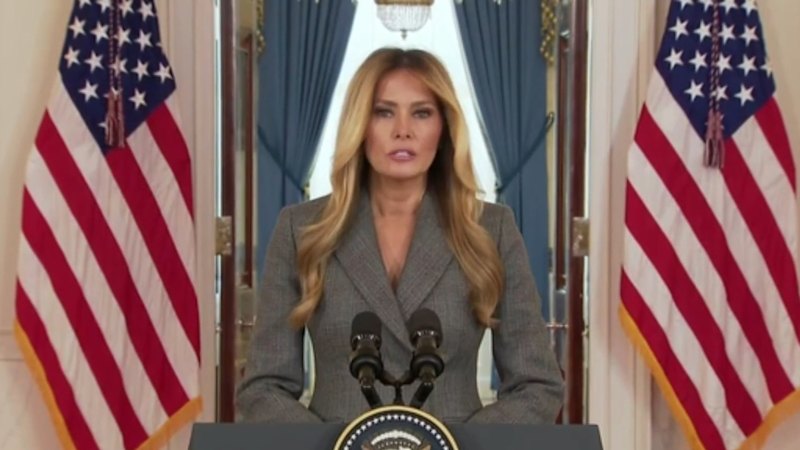
Truth is rarely a solid object. It is a flickering shape in a dark room, defined more by what it isn’t than what it is. For decades, the public has squinted at the figure of Melania Trump, trying to decide if she is a protagonist, a passenger, or a prisoner. But when the shadow of Jeffrey Epstein—a name that functions as a shorthand for the darkest corners of power—stretches toward her, the silence finally breaks.
She didn’t just issue a statement. She drew a line in the sand.
To understand the weight of a denial, you have to understand the gravity of the accusation. The world of high-stakes modeling in the nineties was a fever dream of flashing bulbs and champagne. It was also a predatory ecosystem. For a young woman arriving from Slovenia, the skyscrapers of Manhattan weren't just architecture; they were a labyrinth. In that labyrinth, men like Epstein operated like minotaurs, hidden behind the velvet curtains of "high society."
The rumor mill is a hungry beast. It doesn't need meat to survive; it eats whispers. For years, digital tabloids and social media sleuths have tried to connect the dots between the former First Lady and the disgraced financier. They pointed to the circles they moved in, the parties they attended, and the proximity of their orbits. They searched for a photograph that didn't exist. They waited for a victim to name a name that wasn't there.
Then came the memoir.
The Weight of a Name
When a person of that stature puts pen to paper, they aren't just telling a story. They are reclaiming a narrative that has been chewed on by the public for a quarter of a century. In her self-titled book, Melania Trump addresses the Epstein connection with a bluntness that feels almost jarring compared to her usual enigmatic persona.
She calls the allegations "baseless." She describes them as "malicious."
But there is a deeper layer here than mere legal defense. Imagine being a woman whose entire public identity is curated, polished, and protected, only to find yourself linked to a man who represents the absolute perversion of the "American Dream" you came here to find. It isn't just about avoiding a scandal. It’s about the visceral rejection of a specific type of darkness.
Consider the hypothetical young woman—let’s call her Elena—who arrives in a new country with nothing but a portfolio and an ambition. She attends the galas. She meets the power brokers. Every smile is a currency. Every handshake is a potential door or a potential trap. If Elena spends her life building a fortress of privacy, only to have the world tell her she was actually a victim in a basement she never entered, the fury that follows isn't just political. It's existential.
The Architecture of a Denial
The denial isn't just a "no." It is a structural defense of a life’s work.
Melania Trump’s account of her time in New York is one of discipline and distance. While the media painted a picture of a socialite caught in a web, she describes a professional focused on her career, navigating the city’s shark-infested waters with a watchful eye. She maintains that she never met Epstein, never visited his private island, and never participated in the grim reality that has since come to light.
The power of her denial lies in its simplicity.
In a world of "alternative facts" and spin, a flat refusal to acknowledge a connection can be more powerful than a thousand-page deposition. By stating she was not a victim, she is also asserting she was not a witness. She is placing herself entirely outside the Epstein orbit.
But why now? Why address a ghost that many had already relegated to the "conspiracy theory" bin?
The answer lies in the permanence of the written word. A memoir is a final draft of a life. To leave the Epstein rumors unaddressed would be to allow them to calcify into history. By naming the lie, she attempts to kill it.
The Invisible Stakes
We often forget that celebrities are the primary consumers of their own press. We see the headlines as entertainment; they see them as a distorted mirror. To be associated with Epstein is to be tainted by a very specific brand of evil—one that involves the exploitation of the vulnerable. For a woman who has spent her time in the East Wing focusing on the welfare of children through the "Be Best" initiative, the irony of an Epstein connection isn't just painful. It's a calculated insult to her legacy.
The stakes are higher than a PR cycle.
They are about the right to own one's past. If we live in a culture where a woman can be branded a victim without her consent, or accused of a tragedy she didn't experience, we have traded the truth for a more convenient story.
Melania Trump’s denial is a reminder that even the most photographed people in the world have corners of their lives that remain theirs alone. It is a pushback against the "guilt by proximity" that defines our modern era. Just because two people stood in the same city, in the same decade, in the same tax bracket, does not mean their souls ever touched.
The Labyrinth and the Light
New York in the nineties was a place of extreme contrasts. There was the gold-leafed opulence of the Trump Tower and the sordid, hidden rooms of Epstein’s Upper East Side mansion. They existed in the same zip code but in different universes. One was a stage; the other was a dungeon.
The narrative we’ve been fed for years suggests that these universes were constantly bleeding into one another. We want to believe the world is small. We want to believe that everyone at the top knows everyone else’s secrets. It makes the world feel more organized, even if that organization is sinister.
But reality is often more boring—and more lonely—than that.
Melania’s account portrays a woman who was remarkably solitary even in a crowd. She wasn't the life of the party; she was the observer at the edge of the room. This temperament, often criticized as coldness, might have been the very thing that kept her away from the predators who preyed on the desperate and the social-climbing.
The Resonant Silence
In the end, we are left with a choice. We can continue to squint at the shadows, looking for a connection that hasn't been proven, or we can listen to the person standing in the center of the frame.
Denials are complicated things. They can be shields, or they can be masks. But when a woman looks at the most heinous criminal legacy of the twenty-first century and says, "I was not there," she isn't just defending her reputation. She is defending the boundary of her own skin.
The story of Melania Trump and Jeffrey Epstein isn't a story of a secret connection. It is a story about the terrifying ease with which we can be rewritten by the world around us. It is about the fight to say, "This did not happen to me," and have that be enough.
The shadow is still there, stretching across the history of the American elite. But for once, the silhouette has stepped out of the dark and spoken.
Whether the world believes her is almost secondary to the act of the speech itself. She has claimed her history. She has closed the door. And in that closing, there is a finality that no headline can touch.
The ink is dry. The record is set. The rest is just noise.