Concentration of executive authority inside a single irreplaceable architect converts personal misconduct into systemic national security exposure. When the chief executive of the world's primary artificial intelligence hardware supplier engages in an undisclosed extramarital relationship with a former executive of a foreign cloud operator under federal export-control investigation, the resulting crisis is not a standard corporate governance lapse. It represents an operational breakdown across three distinct institutional layers: corporate board oversight, executive branch regulatory capture, and semiconductor supply-chain containment.
Standard business journalism treats this episode as a sensational collision of Silicon Valley celebrity, political access, and espionage allegations. That framing misses the structural mechanics at work. By isolating the scandal to personal betrayal or partisan friction in Washington, mainstream coverage obscures how founder-centric corporate structures create asymmetric vulnerabilities when private corporations become de facto instruments of statecraft.
The Anatomy of Asymmetric Governance Risk
To evaluate the institutional damage caused by Nvidia CEO Jensen Huang's relationship with Alice Huang, a former executive at Singapore-based cloud provider Megaspeed, analysts must separate verified operational facts from intelligence hypotheses.
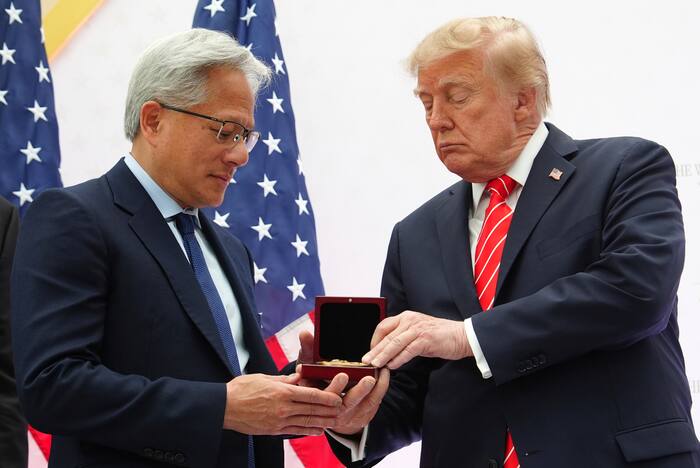
- Verified Operational Facts: Megaspeed faced U.S. Commerce Department scrutiny over allegations of circumventing export restrictions to route advanced Nvidia processors to Chinese end-users. That inquiry transferred to the Department of Justice's National Security Division. Nvidia donated $25 million toward White House construction projects, and Jensen Huang maintained direct policy access to President Donald Trump, accompanying him on a state visit to Beijing and receiving the National Medal of Science in October 2026. Following the revelation of his affair with Alice Huang, bipartisan congressional inquiries opened, Nvidia's board conducted an internal review, Huang briefly stepped down, and the board subsequently reinstated him after receiving assurances from senior executive branch officials.
- Contested Intelligence Hypotheses: Initial reporting cited anonymous intelligence assessments suggesting Alice Huang operated as an intelligence asset for Beijing. Subsequent classified briefings to congressional staffers indicated that U.S. intelligence agencies lacked definitive evidence proving the relationship was a state-directed espionage operation. Beijing officially dismissed the espionage claims as unsubstantiated.
The distinction between proven state-directed espionage and unverified counterintelligence risk is operationally secondary. In high-stakes national security environments, the existence of an undisclosed, compromised channel creates kompromat—blackmail or leverage exposure—regardless of whether a foreign intelligence service initiated the contact.
The Three Pillars of Institutional Vulnerability
When a market-dominant technology firm operates without meaningful internal checks on its founder, personal risk propagates outward through three transmission mechanisms.
1. Key-Person Dependency and Board Paralysis
In classical corporate finance, agency theory assumes a board of directors acts as an independent fiduciary monitor over management. When a founder-CEO generates trillions in market capitalization and commands singular technical credibility among institutional investors, that monitoring function collapses.
Reports that major shareholders conditioned capital commitments on Huang remaining at the helm illustrate a severe key-person trap. Even after Huang disclosed additional extramarital relationships—including involvements with company employees—during a multi-hour board session, directors voted unanimously to reinstate him. From a pure risk-management standpoint, the board priced the immediate equity destruction of removing Huang higher than the long-term legal, regulatory, and compliance liability of retaining a compromised executive.
2. Regulatory Capture and Executive Branch Entanglement
When a private corporation attains strategic parity with sovereign defense contractors, lobbying transforms into co-governance. Nvidia's $25 million philanthropic contribution to White House infrastructure, paired with Huang's frequent Oval Office access and advocacy for exporting H200-class processors to China, blurred the boundary between commercial lobbying and national security policymaking.
This entanglement damaged the credibility of executive branch national security reviews. When the White House intervened to assure Nvidia's board that reinstating Huang posed no national security threat—shortly after the administration had approved hundreds of thousands of advanced chip exports—it created an appearance of reciprocal accommodation. Whether or not any quid pro quo occurred, the optics permanently compromised the administration's ability to defend its export-control exemptions before a skeptical Congress.
3. Supply-Chain Diversion via Third-Party Intermediaries
Export controls rely on end-user verification across complex global distribution networks. Cloud service providers in neutral jurisdictions like Singapore act as critical nodes in this architecture. Because compute capacity can be rented remotely without physically moving silicon across borders, an intermediary like Megaspeed represents a high-efficiency vector for circumvention.
When the chief executive of the upstream hardware manufacturer maintains an undisclosed personal relationship with an executive at a downstream intermediary under DOJ investigation for illicit diversion, compliance firewalls lose credibility. Even if Huang never shared proprietary technical schematics or authorized illegal shipments, the relationship compromises the integrity of Nvidia's internal compliance audits and forces federal investigators to treat corporate assurances as hostile testimony.
The Cost Function of Washington Collateral Damage
The fallout in Washington extends well beyond Nvidia's legal defense budget or shareholder litigation. It imposes direct, quantifiable structural costs on U.S. industrial policy and executive branch authority.
First, it destroys legislative trust in executive discretion. Following midterm elections that shifted congressional control to the opposition party, lawmakers already inclined to scrutinize administration trade policy gained a potent political weapon. Bipartisan consensus on restricting advanced compute exports to China had previously allowed the executive branch broad latitude in drafting Commerce Department rules. By tying export licensing decisions to a CEO entangled in a counterintelligence probe, the administration invited rigid statutory mandates that will strip future presidents of tactical flexibility in trade negotiations.
Second, it degrades the deterrent value of the Department of Justice's National Security Division. Prosecuting export-control violations requires seamless coordination between intelligence agencies, Commerce Department enforcement officers, and federal prosecutors. When the White House publicly minimizes security concerns regarding a target's primary supplier while DOJ investigators are actively building a case against the intermediary, it signals institutional division. Foreign adversaries observe this friction and adjust their procurement strategies accordingly, betting that commercial lobbying in Washington can neutralize technical enforcement.
Third, it weaponizes corporate philanthropy and public-private partnerships. Strategic investments in domestic manufacturing and national scientific initiatives depend on bipartisan insulation from scandal. Tying high-profile presidential honors—such as the National Medal of Science—and White House capital projects to a single corporate leader turns routine statecraft into a political liability.
Operationalizing Counter-Exposure Protocols
For institutional investors, corporate boards, and policy architects managing frontier technology firms, relying on executive character or informal political assurances is an unviable risk model. Mitigating single-point executive failure requires structural insulation across three domains.
Corporate Governance Restructuring
Boards overseeing strategically critical enterprises must decouple operational leadership from compliance and government affairs oversight.
- Independent Chief Compliance Officer Reporting: The chief compliance officer must report directly to an independent audit and national security committee of the board, with unilateral authority to freeze shipments to flagged intermediaries without CEO sign-off.
- Mandatory Relationship Disclosures: Executive employment agreements must expand conflict-of-interest clauses to require immediate disclosure of any personal, financial, or romantic ties to employees of customers, distributors, or cloud partners operating in tier-two or tier-three export jurisdictions.
- Succession De-risking: Boards must elevate a visible, technically credible chief operating officer or co-president capable of assuming immediate operational control without triggering a liquidity crisis among institutional shareholders.
Export-Control Architecture Hardening
Policymakers cannot rely on vendor self-policing to enforce compute restrictions.
- Hardware-Level Telemetry: Export-licensed AI accelerators deployed in third-party data centers must incorporate cryptographic location verification and workload auditing mechanisms managed independently of the hardware vendor's commercial sales division.
- Know-Your-Customer (KYC) Liability: Regulations must shift strict liability onto upstream chipmakers for compute capacity resold by foreign cloud intermediaries, eliminating plausible deniability when regional data centers route processing power to restricted entities.
Limitations of Structural Controls
These interventions carry distinct operational trade-offs and cannot eliminate risk entirely. Strict KYC liability and hardware telemetry slow commercial deployment cycles, creating market openings for non-U.S. semiconductor competitors unburdened by domestic compliance overhead. Overly aggressive board oversight risks driving away visionary technical founders who view rigid governance as an impediment to execution speed. Furthermore, no compliance framework can fully prevent a determined insider from transmitting non-public strategic intent through informal channels.
The Strategic Trajectory
The reinstatement of Jensen Huang confirms that in the current market environment, systemic economic importance overrides traditional corporate governance standards. Because neither Nvidia's board nor the White House was willing to absorb the short-term market shock of removing the primary architect of the AI hardware boom, both institutions chose to internalize a massive, ongoing counterintelligence and political liability.
Congressional committees will exploit this vulnerability over the next twelve months. Expect lawmakers to bypass executive branch discretion entirely by embedding rigid, non-waivable export bans directly into upcoming defense authorization and appropriations bills. Simultaneously, institutional investors will quietly discount Nvidia's valuation multiple to account for unhedged governance risk, forcing the company to formalize an executive succession tier before the next regulatory shock arrives.


