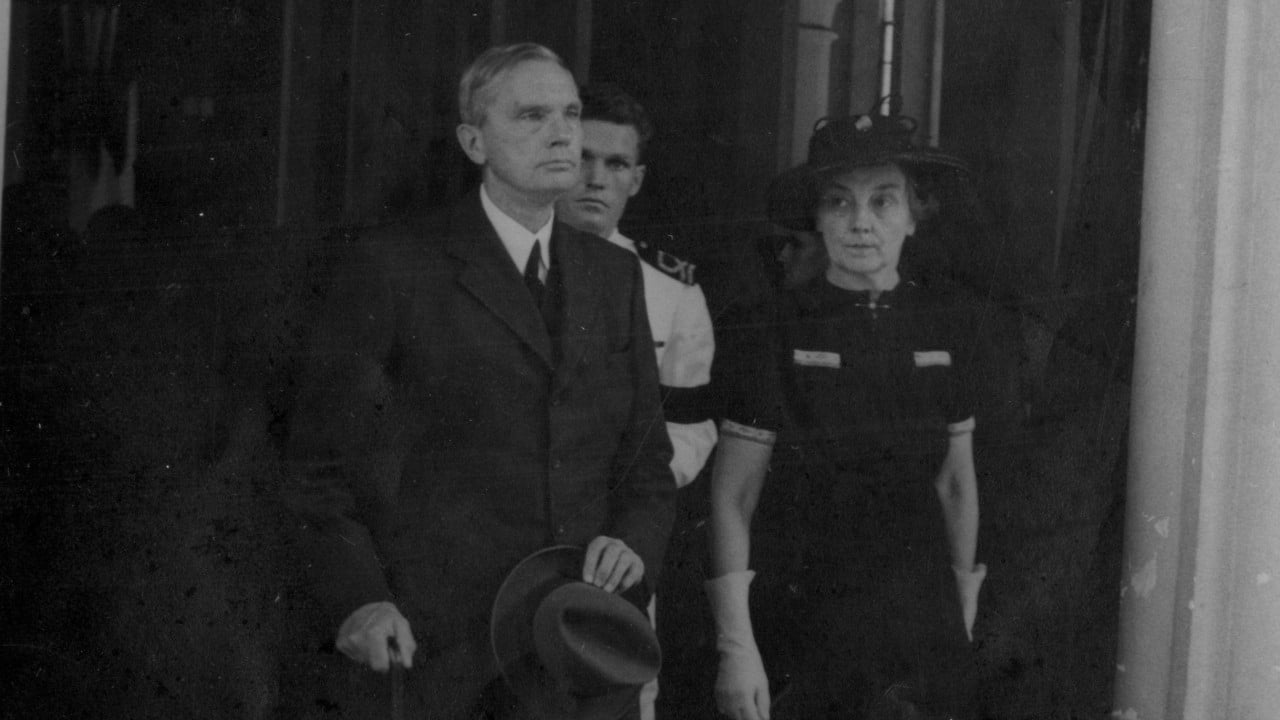
History books usually focus on the roar of the guns or the signing of treaties. They skip the messy, quiet, and incredibly tense moments when a broken society tries to put itself back together. When Sir Mark Young stepped back onto Hong Kong soil in May 1946, he wasn't just a governor returning to his desk. He was a man who had been broken by years of Japanese captivity, returning to a colony that had been effectively gutted.
Most people think the end of World War II meant an immediate return to "normal." It didn't. Hong Kong in 1946 was a skeletal version of its former self. Infrastructure was non-existent. People were starving. The British Empire was looking at its bank accounts and wondering if keeping the territory was even worth the headache. Young's return marked the shift from military rule back to civil administration, a move that basically saved Hong Kong from becoming a forgotten footnote of the post-war era.
The governor who refused to stay broken
Sir Mark Young wasn't your typical stiff-upper-lip bureaucrat. He arrived in Hong Kong in 1941, just weeks before the Japanese invasion. He had to surrender the colony on Christmas Day—a date that would haunt any leader. Then he spent nearly four years as a prisoner of war. The Japanese moved him around constantly, from the Peninsula Hotel to Taiwan, and eventually to Manchuria.
When he finally came back in 1946, he looked like a ghost. He was thin, weathered, and likely suffering from what we'd now call PTSD. But he didn't head back to England for a quiet retirement. He insisted on finishing what he started. That's the part of the story that gets lost. We talk about policies and treaties, but we forget the raw human grit required to lead a city when you've just spent years behind barbed wire.
His return wasn't just symbolic. It was a signal to the world—and specifically to Chiang Kai-shek’s China—that the British weren't planning on packing their bags. The British Military Administration (BMA) had been running things since the surrender in August 1945, but military rule is blunt and often cruel. Young brought back the rule of law, or at least the promise of it.
The Young Plan was ahead of its time
If you want to understand why Hong Kong’s political identity is so complicated, you have to look at the "Young Plan." Almost immediately after stepping off the ship, Young realized that the old colonial model was dead. The war had changed everything. You couldn't just rule over people who had seen the "invincible" British Empire collapse in a matter of days.
He proposed a radical idea for 1946. He wanted to create a municipal council where the majority of members were elected. He wanted to give the local Chinese population a real voice in how the city was run. Honestly, it was a brilliant move. He saw the tide of decolonization coming and tried to get ahead of it.
Why didn't it happen? A mix of local business interests who feared losing their grip and a British government that started getting cold feet as the Cold War heated up. When Young retired in 1947, his successor, Alexander Grantham, basically buried the plan. It’s one of the great "what ifs" of history. If the Young Plan had gone through, the entire trajectory of Hong Kong’s democratic development might have looked different. We'd probably be looking at a much more stable political foundation today.
Reality on the ground in 1946
Let’s talk about what the city actually looked like when Young returned. It wasn't the neon-soaked skyline we know. It was a mess.
- Population collapse: The population had plummeted from 1.6 million to about 600,000 during the occupation.
- Starvation: Food shortages were so bad that the government had to strictly ration rice.
- Ruined infrastructure: The docks were trashed, and the housing stock was decimated.
The British Military Administration had done the heavy lifting of clearing mines and restoring basic power, but they weren't interested in long-term social stability. They were soldiers. Young had to pivot the entire economy from a military outpost back to a global trading hub while people were literally begging in the streets.
He didn't do it alone, but his presence provided a sense of continuity. It told the merchants and the refugees that the "Great Experiment" of Hong Kong wasn't over yet. He pushed for the reconstruction of the University of Hong Kong and tried to fix the health system, which had been ravaged by disease during the war.
Why we still get this story wrong
The SCMP archive and other historical records often paint this era as a triumphant "return to glory." That's nonsense. It was a period of extreme anxiety. The Chinese Civil War was raging just across the border. Thousands of refugees were pouring in every day. The British were terrified that the Communists or the Nationalists would just walk in and take the city.
Young's return was a gamble. The UK was broke. They were giving up India. They were pulling out of everywhere. Keeping Hong Kong required a specific kind of stubbornness. By reinstating civil government under a man who had personally suffered at the hands of the Japanese, the British were making a moral argument for their presence. They were saying, "We suffered with you, and now we’ll rebuild with you."
It wasn't perfect. It was still colonial. It was still deeply flawed. But compared to the chaos happening in mainland China at the time, Hong Kong became a lifeboat. That lifeboat was built during the short, grueling months of Sir Mark Young’s post-war tenure.
What you should take away from this
History isn't just a list of dates. It’s a series of decisions made by tired people in difficult rooms. Sir Mark Young's return in 1946 is the moment Hong Kong decided it was going to be a global city rather than just a military casualty.
If you're interested in how cities survive a total collapse, stop looking at modern tech hubs and start looking at 1946 Hong Kong. Read the reports from the Colonial Office from that year. Look at the photos of the harbor filled with wreckage. It’s a masterclass in resilience.
To really understand the roots of the city, you should visit the Museum of History in Tsim Sha Tsui or spend an afternoon in the Hong Kong Public Records Office. They have the actual documents from the Young administration. Seeing the signatures on those papers makes the struggle feel real. Don't just take the "official" version of history at face value. Dig into the missed opportunities like the Young Plan. That's where the real story lives.



