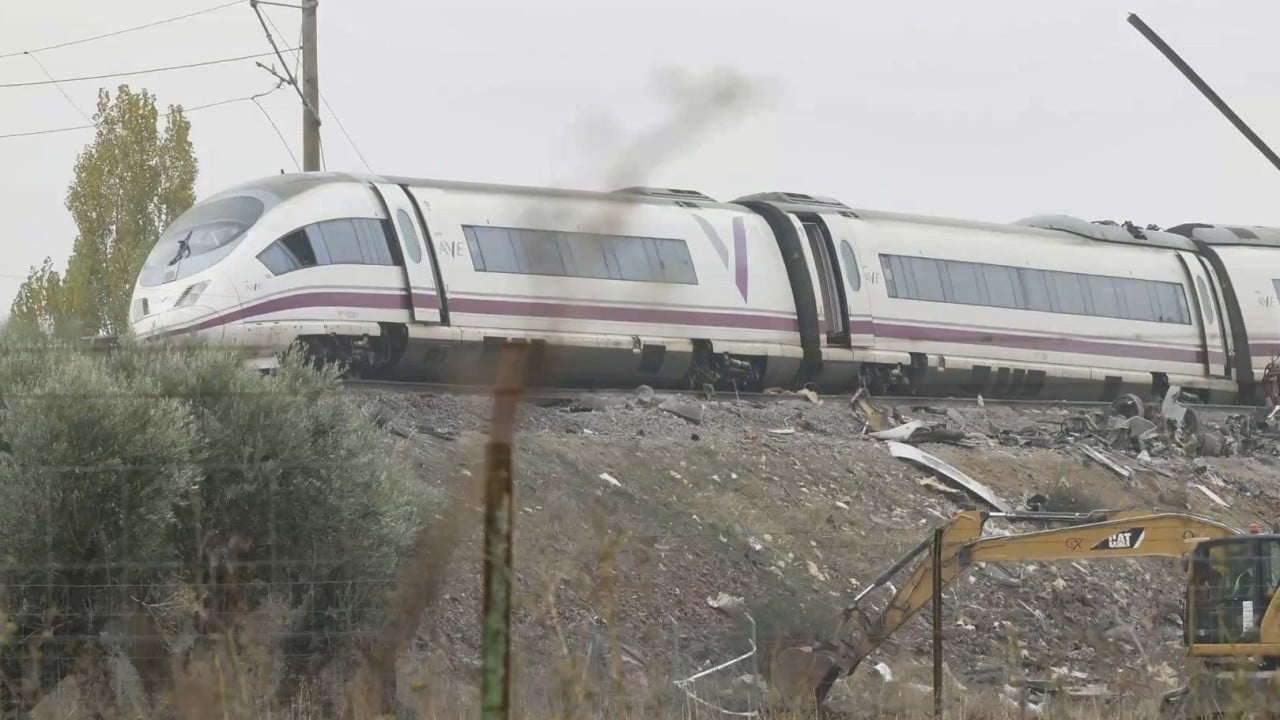
Metal screams before it breaks. Anyone who has ever stood on a train platform when a high-speed express thunders past knows the visceral, chest-rattling thrum of steel meeting steel at two hundred kilometers an hour. It feels invincible. It feels like progress made solid, a silver bullet slicing through the Spanish countryside, connecting Madrid to the coast, tying families together across mountains and plains.
Until the curve comes too fast. Until the signal stays green when it should have bled red.
When Spain’s transport minister stepped up to the podium this week to announce his resignation following the rail disaster that claimed sixty-nine lives, the cameras clicked with the mechanical rhythm of a bureaucracy processing its own grief. To a casual observer scrolling past a headline, the story appears tidy. A tragedy occurred. Sixty-nine people died. The man at the top took responsibility and walked away. Case closed.
Except grief does not resign. And a signature on a piece of stationery in Madrid does nothing to quiet the phantom rattle of derailing carriages in the minds of those who survived.
The Architecture of an Ordinary Morning
To understand what actually happened on those tracks, you have to step away from the press briefing room and stand on a departure platform at 6:45 in the morning.
Consider a composite passenger—let us call her Elena, a thirty-four-year-old architect commuting between regional hubs, carrying a lukewarm café con leche and a half-read novel. Elena is not a statistic. Neither were the sixty-nine real human beings who boarded that train expecting nothing more dramatic than a slight delay or a noisy carriage. When we buy a train ticket in a modern European democracy, we are not merely purchasing transit from point A to point B. We are signing an invisible social contract. We hand over our physical autonomy, strap ourselves—or simply sit unstrapped—inside a pressurized aluminum tube hurtling across the earth, and place absolute faith in a chain of strangers.
We trust the engineer in the cab. We trust the technician who inspected the braking calipers at three in the morning. We trust the software architect who wrote the signaling code. And at the very top of that pyramid of trust sits the Ministry of Transport, the ultimate guarantor that speed will never outpace safety.
I remember the aftermath of the 2013 Santiago de Compostela derailment, when an Alvia train entered a curve at nearly twice the speed limit, killing seventy-nine people. If you lived in Spain during those weeks, you remember the suffocating silence that settled over public squares. You remember the smell of diesel and scorched earth lingering in the Galician air, and the terrifying realization that a multi-billion-euro rail network—the pride of modern Spanish infrastructure—could be undone by a gap between human fallibility and automated safeguards.
Back then, the debate raged over track-side signaling systems—specifically, the transition between the advanced European Rail Traffic Management System (ERTMS) and older legacy tracks where safety depended heavily on a driver reacting to an auditory alarm. Twelve years later, as investigators sift through the twisted wreckage of this latest catastrophe, that same haunting question hangs over the Ministry like smoke: how does a system built to eliminate human error still leave sixty-nine people dead?
The Illusion of Accountability
Resignation. It is a clean word. Four syllables that sound like honor, duty, and closure.
In parliamentary democracies, ministerial resignation is the ultimate political circuit breaker. When public outrage surges to a voltage that threatens to fry the entire government, a minister steps down to absorb the shock. In his statement, the outgoing transport minister spoke of "political responsibility," of honoring the victims, of clearing the path for an impartial investigation without the shadow of executive interference.
It is easy to nod along to the nobility of the gesture. Compared to politicians elsewhere who cling to power with white knuckles even after bridges collapse or reservoirs burst, stepping down feels almost refreshing.
But the real problem lies elsewhere.
A resignation is an end to a career, not a repair to a system. When a minister packs up his office, the procurement contracts remain unchanged. The maintenance backlogs on regional feeder lines do not magically clear themselves. The pressure on rail operators to shave minutes off timetables to compete with low-cost airlines and private rail competitors—a dynamic that intensified after Spain liberalized its high-speed rail market—remains entirely intact.
Think of a modern rail network like a surgical theater. The minister is the hospital director. If a patient dies on the operating table because the anesthesia machine was improperly calibrated and the backup alarm had been muted due to frequent false positives, firing the hospital director makes a bold headline. Yet if the next director walks into the exact same operating room, with the exact same tired staff and the exact same faulty alarm system, nothing has been saved. Only the nameplate on the door has changed.
What the Black Boxes Actually Whisper
Investigators have already recovered the event recorders—the so-called black boxes—from the lead locomotive. While the full judicial inquiry will stretch across months, the preliminary physics of a mass-casualty rail crash rarely lie.
Trains do not simply leap off rails out of spite. In almost every major rail disaster in modern European history, the root cause is a deadly convergence of three factors: speed, signaling, and maintenance.
First, there is the physics of kinetic energy. Because kinetic energy increases with the square of velocity, doubling a train’s speed quadruples the destructive force unleashed during an impact. When an operator pushes rolling stock to the upper limits of its operational envelope, the margin for error shrinks from minutes to milliseconds.
Second, there is the human-machine interface. Modern train cabs are marvels of telemetry, glowing with screens, alerts, and automated braking curves. Yet psychologists who study transportation safety have long warned about "automation complacency." When a system works flawlessly ninety-nine point nine percent of the time, the human brain naturally dulls its vigilance. Conversely, when legacy stretches of track suddenly demand manual intervention after miles of automated cruising, the cognitive switch can happen too late.
Third, there is the quiet starvation of infrastructure maintenance. Ribbon-cutting ceremonies for sleek new high-speed lines win votes and grace magazine covers. Nobody holds a press conference to celebrate replacing worn ballast, upgrading track-circuit sensors, or hiring fifty more night-shift rail welders. Over years, budgets tilt toward shiny expansion while the unglamorous bones of the network endure silent fatigue.
I admit, looking at the gnarled steel beams in the photographs from the crash site, it is tempting to look for a single villain. A reckless driver. A corrupt contractor. A negligent minister. Villains make tragedies comprehensible. If one person caused the pain, removing that one person cures the disease.
The truth is far more frightening. Usually, nobody woke up intending to do harm. Instead, dozens of small compromises—a delayed software patch here, an overworked dispatch center there, a budget cut justified by spreadsheet logic—stacked up like dominoes until gravity tipped the first one over.
The Invisible Ledger of Sixty-Nine Lives
Walk through any town touched by a disaster of this scale and you realize how aggressively statistics lie. "Sixty-nine dead" fits comfortably into a push notification. You can read it while waiting for an elevator and forget it before the doors open.
You cannot summarize a life in a digit.
Among the sixty-nine were university students heading home with laundry bags stuffed into overhead racks. There were retirees traveling to see grandchildren they hadn't held since summer. There were nurses coming off double shifts, small business owners rehearsing pitches in their heads, and parents texting "Almost there, put the kettle on" five minutes before the world turned upside down.
Every single one of those sixty-nine seats represents an empty chair at a Sunday dinner table for the next forty years. It represents birthdays uncelebrated, mortgages suddenly impossible to pay, and survivors who will never again sit near a window on a moving vehicle without gripping the armrests until their knuckles turn white.
When the transport minister stood before the microphones and offered his resignation, journalists immediately pivoted to the political chessboard. Who will the Prime Minister tap as a replacement? Will the opposition use the tragedy to force a no-confidence vote? How will the coalition survive the autumn budget negotiations?
Listen closely to that chatter and you can hear the tragedy being stolen from the victims in real time. Within forty-eight hours, a catastrophe of steel and flesh was converted into political currency.
Beyond the Podium
So what does real accountability look like when the cameras turn away and the flowers taped to the station railings begin to wilt?
It starts with radical transparency. In too many European transport inquiries, technical reports are buried under layers of bureaucratic jargon or delayed until public anger has evaporated. The families of the sixty-nine do not need platitudes; they need an unvarnished, line-by-line accounting of every sensor reading, every maintenance log, and every budget decision that led to that stretch of track.
It requires independent safety oversight with teeth. When the agency investigating a crash answers—directly or indirectly—to the same ministry that oversees rail construction and operation, conflicts of interest are baked into the blueprint. Safety regulators must possess the unilateral authority to shut down a line the moment a signaling anomaly appears, regardless of how many commuters it inconveniences or how loudly executives complain.
And finally, it demands a cultural shift in how we measure success in public transit. Speed is intoxicating. Shaving twelve minutes off a journey between two major cities makes for triumphant advertising. Yet nobody ever boarded a train wishing it were five minutes faster at the expense of arriving alive. Reliability and safety are not obstacles to progress; they are the entire point of it.
The Quiet After the Siren
Late at night, long after the rescue cranes have hauled away the last twisted bogie and the emergency floodlights have been switched off, a railway line returns to silence. The gravel ballast settles. The overhead catenary wires hum faintly in the wind, carrying thousands of volts of electricity waiting for the morning’s first departure.
Somewhere in Madrid, a former minister is clearing personal photos off a mahogany desk, his public penance complete. Somewhere across Spain, sixty-nine families are learning how to breathe around a hole in their lives that will never close.
Tomorrow morning, at 6:45, another commuter will walk onto a platform with a lukewarm coffee, step across the yellow line, and trust the steel beneath her feet to carry her home.