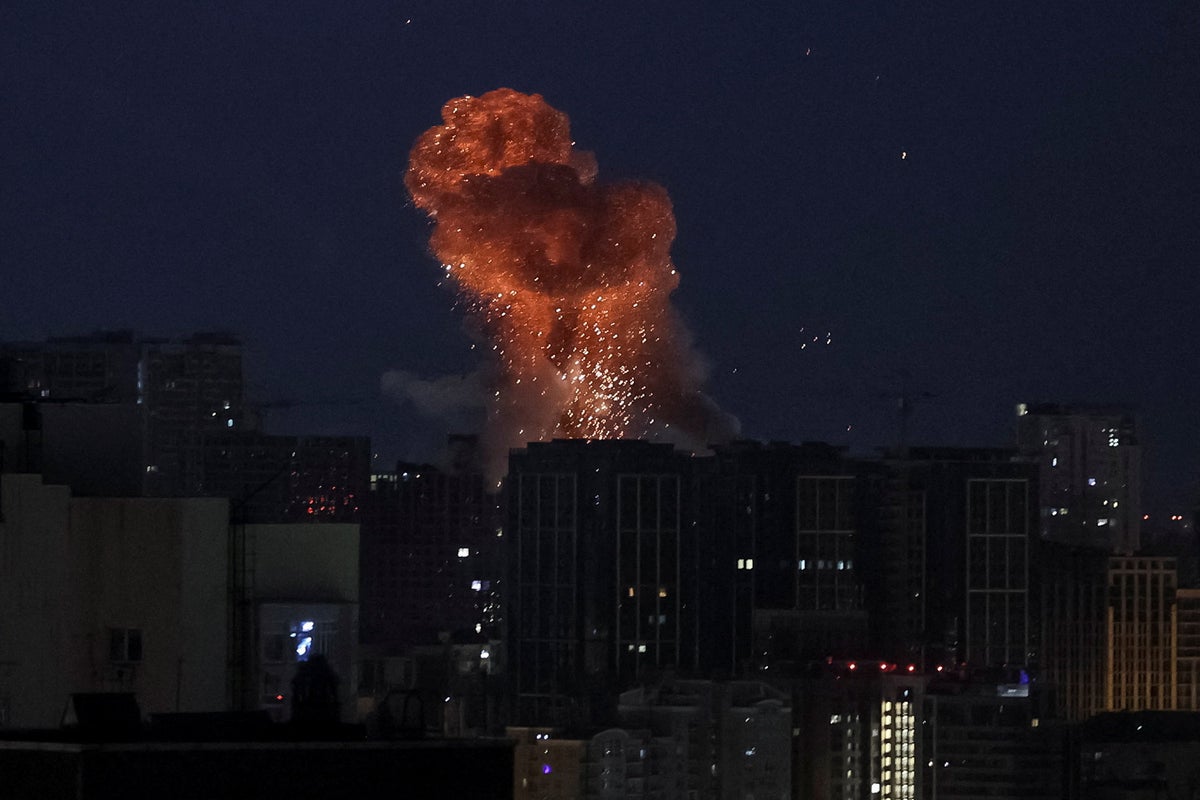
The siren does not start with a scream. It begins with a low, mechanical moan, a heavy vibration that rattles the cheap glass in the window frames of Kyiv long before it registers in the human ear.
Olena did not look up from her kitchen counter. She was waiting for the kettle to boil. In Kyiv, in the suffocating heat of mid-summer, waiting for electricity is a calculation of minutes. When the grid breathes life back into your neighborhood, you do not waste a single watt. You charge the power banks. You wash the clothes. You boil the water.
Then the sky ripped open.
Hours earlier, President Volodymyr Zelensky had sat before the cameras, his face etched with the familiar, bone-deep fatigue of a man who measures time in casualties. His warning had been explicit. An attack was imminent. The data was there, gathered by radar, whispered by intelligence feeds, confirmed by the unnatural movement of missile launchers hundreds of miles away in Russian territory.
But geopolitical warnings are abstract. They exist on screens and in press briefings.
They become real when the air pressure drops so violently that your ears pop.
The Geometry of Terror
A ballistic missile is not a drone. You cannot shoot it down with a truck-mounted machine gun or watch it wander lazily across the horizon. It travels on a terrifying, arc-like trajectory, climbing into the upper atmosphere before screaming downward at several times the speed of sound.
From launch to impact is a matter of minutes.
Consider the mathematics of survival in a modern capital under siege. When Russia fires a hypersonic or ballistic missile from the Bryansk region, a civilian in Kyiv has less time to reach safety than it takes to brew a standard cup of coffee. The warning system is sophisticated, yes. The Western-supplied air defense batteries—the Patriots and the NASAMS—are marvels of engineering. They track, lock, and intercept with staggering precision.
But they are fighting a war of attrition against gravity and momentum.
When an interception happens, the danger does not vanish. It changes form. Tons of burning metal, unspent fuel, and shattered fuselage must go somewhere. They rain down on residential blocks, on playgrounds, on the quiet streets of a city trying desperately to pretend it is still part of the civilized world.
The explosions that morning were loud enough to shake the dust from the ceilings of subterranean metro stations where thousands of people had fled in their pajamas. It is a specific kind of helplessness. You sit on concrete steps, surrounded by the smell of damp earth and too many human bodies, waiting for a thud that signifies either the salvation of an interception or the obliteration of a home.
The Illusion of the Normal
To walk through Kyiv on a regular afternoon is to experience a strange, psychological vertigo. The cafes are open. Young professionals sit in the sun, tapping away at MacBooks, sipping iced lattes. The tram rattles along its tracks.
This is not denial. It is defiance.
When a war lasts for years, the human psyche cannot remain in a permanent state of high alert without fracturing entirely. The mind normalizes the absurd. You learn to recognize the difference between the dull thud of an outgoing air defense missile and the sharp, chest-vibrating crack of an incoming strike. You map your daily commute not by the prettiest route, but by the density of concrete shelters along the way.
But Vladimir Putin’s strategy relies entirely on breaking this fragile normalcy. The timing of these strikes is never accidental. To launch a heavy ballistic barrage just hours after the Ukrainian leadership warns of its arrival is a calculated act of psychological theater. It is an attempt to demonstrate omnipotence. The message is simple: We can hear you. We know you are waiting. And you still cannot stop us.
The political stakes are clear enough on the international stage. Every missile that slips through the defensive umbrella is an argument used by Ukraine to pressure its Western allies for more batteries, more ammunition, and fewer restrictions on striking the launch sites inside Russia itself.
On the ground, however, the stakes are measured in smaller, far more fragile increments.
What Remains in the Dust
By midday, the smoke over the Dnipro River had begun to clear, thinned out by a hot breeze. The emergency crews were already at work, their orange vests bright against the gray rubble of a struck building. They do not shout. They move with the quiet, synchronized efficiency of people who have done this hundreds of times before.
They look for survivors. Then they look for bodies. Then they clear the bricks so the cars can pass again.
Olena’s kettle never did finish boiling. The power cut out the moment the first blast shook the district, leaving the water lukewarm and the kitchen silent except for the distant, fading wail of the ambulances.
She did not go to the shelter this time. She had stood in the corridor, the strongest part of her small apartment, gripping the doorframe until her knuckles turned white, listening to the sky tear itself apart outside.
It is a mistake to think that people get used to the terror. They merely get used to the administrative details of it. They learn where to stand, what papers to keep in their pockets, and how to breathe through the nose when the air fills with the acrid smell of pulverized concrete and burnt insulation.
The world watches these updates in brief, sporadic bursts of breaking news. A headline flashes on a smartphone screen in London, New York, or Tokyo. A few numbers are digested—missiles fired, intercepted, casualties confirmed. Then the thumb swipes upward, and the world moves on to something else.
But in the dust of Kyiv, the silence that follows the explosion is the heaviest part of the day. It is the moment where thousands of people simultaneously realize they are still alive, look at the sky, and begin waiting for the next mechanical moan to rise from the earth.