Silence.
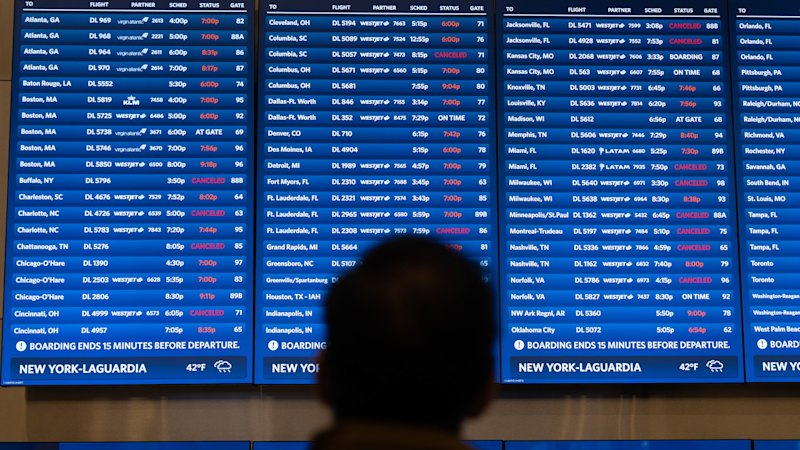
In an airport terminal, silence is never peaceful, because a healthy airport is supposed to sound like a low, thrumming machine made of rolling luggage wheels, overlapping boarding announcements, and the sharp hiss of espresso wands. When that noise suddenly evaporates at four in the morning, the air pressure in the room seems to drop, leaving thousands of stranded strangers staring up at departure boards that have turned into walls of red text.
I have stood on that sticky linoleum floor in Chicago during a system-wide ground stop, watching a toddler fall asleep on top of a hard-shell suitcase while his mother quietly cried into her phone. You do not think about aviation infrastructure when you are booking a Tuesday morning flight to see an aging parent or close a contract that keeps your small business afloat. You think about legroom, coffee prices, and whether your carry-on will fit in the overhead bin. You treat the sky like a highway that simply exists, permanent and paved, waiting for you to merge onto it.
Until the moment someone pulls the emergency brake on the entire system.
News reports about a major US flight shutdown usually read like autopsy reports written by accountants. They list the raw numbers of canceled departures, quote spokespeople from the Federal Aviation Administration, and offer dry bullet points about airline refund policies. Those reports tell you what happened to the schedule, yet they miss what happens to the human nervous system when modern mobility vanishes overnight. To understand what a nationwide aviation freeze actually means for your upcoming travel, your wallet, and the fragile machinery keeping commercial flight alive, we have to look past the press releases and step inside the chain reaction.
The Architecture of a Standstill
Picture a hypothetical traveler named Elena, a structural engineer from Denver who booked a routine 7:15 AM flight to Atlanta for a bridge inspection. In a normal week, Elena’s morning is governed by predictable friction—a twenty-minute security line, a delayed gate assignment, maybe a bumpy descent over Georgia. Her itinerary relies on an invisible choreography that moves roughly forty-five thousand flights and nearly three million passengers across American airspace every single day.
Now watch what happens to Elena when a nationwide ground stop or systemic flight shutdown hits that choreography.
At 5:30 AM, while Elena is lacing her boots, a critical failure cascades through the national airspace system. Whether triggered by a corrupted Notice to Air Missions database, a severe air traffic control staffing collapse, a catastrophic weather wall across the Midwest hubs, or a sudden federal grounding order, the mechanism works the exact same way. Aviation does not operate like a city bus system where one broken vehicle leaves the rest of the route intact. Commercial airlines run on tightly wound hub-and-spoke networks where a single aircraft in Denver is scheduled to fly to Atlanta, turn around in forty-five minutes to become a flight to Boston, and finish its night in Seattle.
Think of the American flight grid less like a highway and more like a mechanical watch built from ten thousand interlocking gears. If you jam a single brass tooth in Dallas or Washington, the entire timepiece does not slow down—it stops dead.
By the time Elena reaches the terminal, the departures screen has already begun its slow bleed from green to amber to crimson. Her 7:15 AM flight is not merely pushed back by an hour. Because the Federal Aviation Administration has halted departures nationwide to clear airspace or reboot failing safety networks, every plane on the ground stays glued to the tarmac. Worse, planes already airborne are diverted to the nearest available runways, filling up gates in mid-sized cities that were never built to absorb wide-body traffic.
Elena stands at Gate B14 with two hundred other people, and this is where the real confusion begins. The gate agent has no answers because the airline’s dispatchers in Fort Worth or Chicago are staring at the exact same frozen radar screens. When the sky shuts down, information becomes scarcer than an empty middle seat.
The Invisible Clock Running Out Inside the Cockpit
Most travelers assume that once the technical glitch is fixed or the airspace reopens, the planes simply start taking off again in order. That assumption costs stranded passengers days of their lives.
The moment a flight shutdown stretches past two hours, an invisible biological and legal clock begins ticking inside every cockpit and cabin across the country. Federal aviation regulations strictly limit how many consecutive hours pilots and flight attendants can remain on duty before they must legally stop working to rest. These crew timeout rules exist for an obvious, life-saving reason—nobody wants an exhausted captain landing a seventy-ton jet in a crosswind at midnight.
Yet during a systemic shutdown, those safety clocks keep running while the planes sit parked at the gate.
Consider what happens next. Even after the FAA lifts a ground stop at noon, Elena’s aircraft cannot leave Denver because its first officer just timed out at 11:45 AM. The airline now needs a fresh pilot, except the reserve pilots are stuck in different cities because their own incoming flights were grounded three hours earlier. Meanwhile, the aircraft itself is now out of position, sitting three states away from where its scheduled maintenance check is supposed to happen tonight.
This domino collapse explains why a four-hour shutdown on a Wednesday morning routinely ruins travel plans through Friday night. Airlines spend up to seventy-two hours untangling misplaced crews and scattered jets, canceling hundreds of flights under clear blue skies simply because the human beings legally permitted to fly the planes are trapped on the wrong side of the country.
What Happens to Your Ticket When the System Breaks
When you are standing in a winding customer service line that stretches past three empty gates, rage and exhaustion make it almost impossible to read fine print. Knowing the exact rules before chaos hits is the only leverage a passenger actually holds.
Under United States Department of Transportation regulations, your rights depend heavily on one brutal distinction—whether your flight is canceled or merely delayed, and who caused the disruption.
If an airline cancels your flight for any reason whatsoever—including a nationwide FAA shutdown, a software outage, or severe weather—and you choose not to travel, the airline legally owes you a full refund to your original form of payment. Not a travel voucher. Not loyalty points with an expiration date. Actual cash back on your credit card, processed within seven business days for credit purchases and twenty days for debit or cash tickets.
Airlines have historically tried to steer panicked travelers toward electronic credits during mass disruptions, counting on passengers to accept the first offer thrown at them. Under federal automatic refund rules, carriers must issue that cash refund automatically if you decline rebooking, without forcing you to fill out buried online forms or wait on hold for six hours.
Delays operate under much murkier territory. If your flight is delayed rather than canceled, you are generally only entitled to a full refund if the delay is "significant"—defined under federal rules as three hours or more for domestic flights and six hours or more for international itineraries—and you decide to abandon the trip entirely.
And what about hotel rooms, meal vouchers, and rental cars when you are stranded overnight in a city you never intended to visit? Here lies the hardest truth in modern air travel. Airlines are only required to cover hotels and meals when the disruption is classified as "controllable," meaning it stemmed from airline-specific failures like mechanical breakdowns, internal IT crashes, or carrier staffing shortages. When the fault lies with an external federal airspace shutdown, air traffic control failures, or extreme weather, airlines classify the event as "uncontrollable." You are suddenly paying three hundred dollars out of pocket for an airport motel room next to an interstate, praying your credit card’s built-in trip delay insurance covers the receipt.
Why These Shutdowns Keep Happening
If it feels as though American air travel has become strangely brittle over the past few years, your instincts are sharper than the press releases.
Beneath the sleek airport lounges and mobile boarding passes, large stretches of the nation’s aviation backbone still run on aging architecture strained to its absolute limit. For decades, air traffic control facilities across the United States have operated with chronic staffing shortages, forcing thousands of controllers into mandatory six-day workweeks and ten-hour shifts just to keep daily traffic moving. At the same time, legacy software systems built thirty years ago are constantly patched to communicate with modern satellite navigation tools.
Imagine trying to upgrade the engine of a freight train while it is hurtling down the tracks at eighty miles an hour. Every airline is flying fuller planes than ever before, operating with razor-thin spare capacity. In the early 2000s, carriers routinely kept extra aircraft and standby crews parked at major hubs to absorb bad days. After decades of mergers and ruthless cost-cutting, that buffer is gone. Today’s flight schedule is stretched so tight that a single snapped wire resonates from coast to coast within minutes.
When a shutdown strikes, it is rarely a freak bolt of lightning. It is the predictable sound of a system running at ninety-nine percent capacity suddenly hitting one hundred and one.
How to Survive a National Ground Stop Without Losing Your Mind
Let us return to Elena in Denver, standing in front of Gate B14 as the terminal begins to hum with anxious energy. Around her, two hundred people are making the exact same mistake—they are lining up at the gate podium to argue with an agent whose computer terminal has completely locked up, or they are calling the airline’s main 1-800 number, joining a hold queue alongside fifty thousand other stranded callers.
If you want to make it home before the system freezes solid, you have to move differently than the crowd.
First, abandon the physical line immediately. While standing in the terminal, open the airline’s mobile app on your phone while simultaneously dialing the carrier’s international customer service number—such as their Canadian, UK, or Australian support line—using Wi-Fi calling. International call centers access the exact same reservation database as domestic agents, yet their phone queues are often empty during a domestic US crisis.
Second, book a backup seat before your current flight officially cancels. During a creeping shutdown, every seat on rival airlines disappears within twenty minutes. If you have refundable miles or the financial cushion to buy a fully refundable ticket on a competing carrier flying out of a secondary nearby airport—say, switching from Chicago O’Hare to Midway, or from JFK to Newark—lock that seat down the second delays cross the ninety-minute mark. If your original flight miraculously departs, you cancel the refundable backup for zero loss. If your original flight collapses, you are already walking toward a different gate while everyone else is still screaming at a kiosk.
Third, watch the incoming aircraft, not the departure board. Airlines routinely post optimistic fifteen-minute rolling delays to keep passengers near the gate area. Use a free flight-tracking app to check the tail number of your specific plane. If the aircraft assigned to your 2:00 PM flight is still sitting on the ground in Miami under a ground stop at 1:30 PM, your flight is not leaving at two, no matter what the screen above the counter claims. That single piece of data gives you a two-hour head start on rebooking or securing a hotel room before every room within twenty miles of the airport sells out.
Fourth, pack your carry-on as though you will be separated from your checked bag for four days. During a systemic shutdown, luggage handling systems choke faster than passenger terminals. Bags get pulled off carts, left in rainstorms on tarmacs, or routed onto cargo holds bound for cities you never booked. Essential medications, chargers, a fresh shirt, and toiletries belong on your back, never in the belly of the jet.
The Long Silence After the Storm
By late afternoon in Denver, Elena is no longer standing at Gate B14. While two hundred people remained queued at the customer service desk waiting for paper meal vouchers, she used an international support line to rebook onto an early morning regional flight out of Colorado Springs, rented the last compact car on the airport lot, and drove seventy miles south along the Front Range as the sun dropped behind the Rockies.
She missed her afternoon inspection. She lost four hours of sleep and spent ninety dollars on gas and highway coffee. Yet by eight o'clock the next morning, she was standing on concrete in Georgia, watching morning commuters roll across the bridge deck below her boots.
We spend so much of our lives complaining about the minor indignities of air travel—the cramped knees, the boarding group hierarchies, the overpriced water bottles—that we forget what a fragile miracle commercial aviation truly is. Every safe landing requires thousands of exhausted controllers, mechanics, dispatchers, and pilots executing millions of micro-decisions without a single fatal flaw. A nationwide flight shutdown strips away the illusion that convenience is guaranteed, reminding us how thin the margin really is between effortless movement and complete standstill.
The next time you buckle your seatbelt and feel the engines spool up into that familiar, deafening roar, pay attention to the vibration beneath your feet. That noise is not an annoyance. It is the sound of a delicate machine working against gravity, weather, and human error—and for a few hours at least, holding together against the odds.