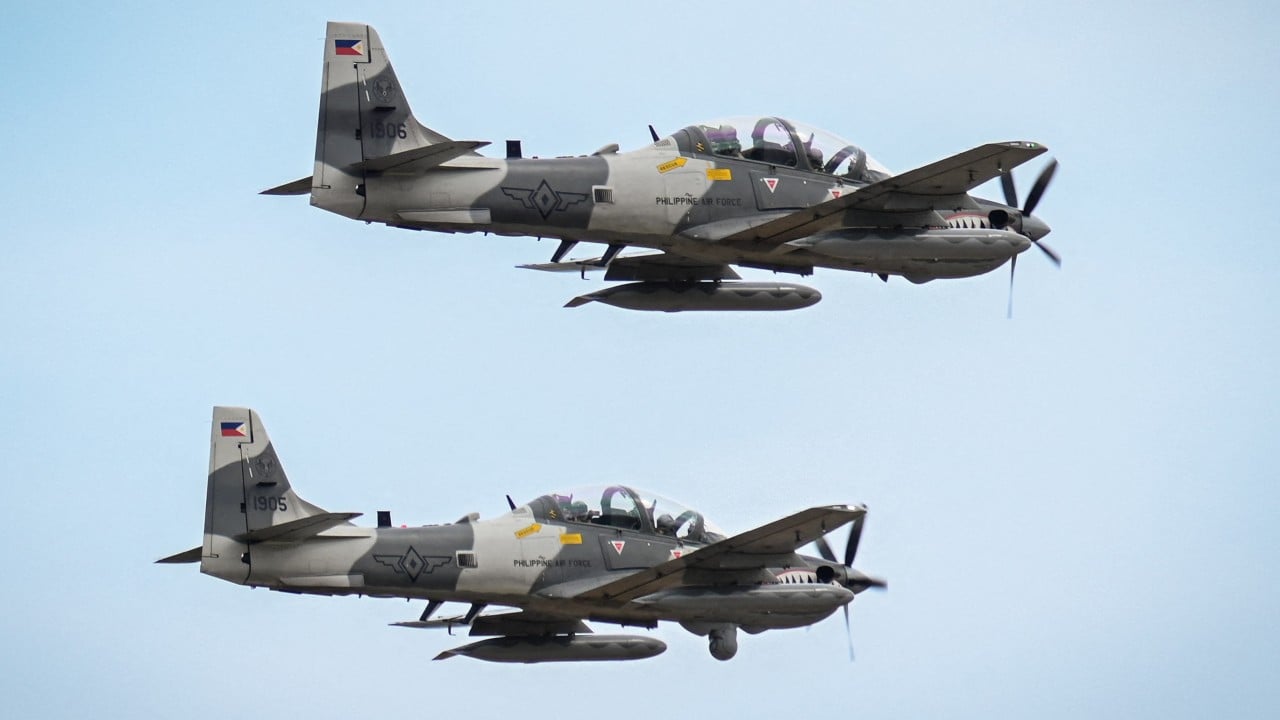
The cockpit of a South Korean-built FA-50 fighter jet is small, loud, and entirely unforgiving when you are dangling twenty thousand feet above a stretch of water that the rest of the world watches with bated breath.
Below the wing, the South China Sea stretches out like an endless sheet of hammered turquoise. From this height, the disputed reefs and artificial islands look like tiny, pale scars on the ocean floor. But if you look closer, the grey shapes of massive naval vessels appear, slicing through the water, leaving white wakes that point toward the Philippine coast.
For the young men and women of the Philippine Air Force, this is not a theoretical geopolitical puzzle. It is their morning shift.
Consider a young pilot. We can call him Tomas, a composite of the real, flesh-and-blood aviators stationed at Basa Air Base north of Manila. Tomas is twenty-eight. His grandmother still worries every time he gets into a car, completely unaware that his daily routine involves intercepting heavy, modern foreign military aircraft with a light supersonic trainer that has been pressed into service as a frontline defender.
When Tomas looks out his canopy, he is often staring down the barrel of a staggering mathematical imbalance.
On one side of the ledger is the superpower to the west, possessing hundreds of advanced fifth-generation stealth fighters, sophisticated missile cruisers, and a sweeping maritime militia capable of swarming an area until the map changes by default. On the other side is a proud but historically underfunded air wing that, until relatively recently, did not even possess a single supersonic jet after retiring its aging F-5 fleet in 2005. For nearly a decade, the country’s airspace was defended by little more than propeller-driven trainers and sheer willpower.
The gap between these two realities is where the human element takes over.
The Weight of the Instrument Panel
To understand how the Philippine Air Force found itself holding the line with such limited resources, you have to look back at a long history of shifting priorities. For decades, the primary threats to the archipelago were internal. The military fought decades-long counterinsurgency campaigns in the dense jungles of the south, chasing communist rebels and separatist factions. For that kind of warfare, you do not need Mach-2 interceptors. You need rugged, slow-flying turboprops like the venerable OV-10 Bronco or the newer A-29 Super Tucano—planes that can linger over a canopy and support troops on the ground.
The world changed while the old planes were still flying.
Suddenly, the threat shifted from the jungle to the sea. The shoals and banks within the Philippines' Exclusive Economic Zone—areas rich in fish, natural gas, and national pride—began to see an influx of foreign dredgers, maritime surveillance ships, and advanced fighter patrols. Scarborough Shoal and Second Thomas Shoal became household names, symbols of a quiet, grinding encroachment.
When the country looked up, its air defense radar screens were largely blank.
The purchase of twelve FA-50PH Golden Eagle light fighters from South Korea in the mid-2010s was celebrated as a massive step forward. It was. The planes are agile, fast, and equipped with modern avionics. But they are fundamentally light combat aircraft, designed to train pilots for heavier fighters or to handle low-intensity conflicts. In a major air-to-air engagement, they are outranged and outnumbered by an adversary that views the entire sea as its sovereign territory.
Yet, when the alarm sounds at Basa or Antonio Bautista Air Base, the pilots do not talk about the math. They strap in.
A David and Goliath in the Clouds
Imagine the scene at fifteen thousand feet. Tomas receives a vector from a ground radar station. An unidentified track is approaching the edge of the country’s sovereign airspace. He pushes the throttle forward, the engine whines behind him, and the jet surges through a cloud bank.
When he closes the distance, the silhouette that emerges from the haze is massive. It is an twin-engine fighter, heavy, dark grey, and bristling with long-range air-to-air missiles. It is an aircraft built for air dominance, weighing twice as much as Tomas's nimble trainer.
The two planes shadow each other. It is a tense, silent dance. The foreign pilot looks down from a heavy, heavily armored cockpit; Tomas looks back, aware that a single twitch of a finger on either side could trigger an international incident that drags global superpowers into open conflict.
The foreign jet makes a slow, deliberate turn, cutting across the nose of the smaller Philippine plane, a classic intimidation tactic meant to wake up the pilot with a blast of jet wash. The FA-50 shuddering violently as it hits the turbulent air. Tomas corrects, holds his line, and keeps his camera rolling to document the encounter.
He does not run. He cannot.
This asymmetry is the defining characteristic of the West Philippine Sea defense. The pilots are fighting a war of presence. They are not there to shoot down the enemy; they are there to bear witness, to say to the world, We are still here, and this is still ours.
But relying on raw courage is a dangerous long-term strategy.
The Cost of the Waiting Game
The nation's leadership knows the current situation is unsustainable. For years, there have been grand plans for modernization, projects designed to acquire legitimate, twin-engine multirole fighters like the American F-16 or the Swedish Saab Gripen.
But building an air force from the ground up is not like buying a fleet of trucks. It requires billions of dollars that a developing nation must constantly balance against building hospitals, upgrading schools, and recovering from the devastating typhoons that batter the islands every single year.
Every time a procurement decision nears completion, a new crisis arises, or the budget is diverted. The acquisition process becomes a bureaucratic marathon, clogged with red tape, shifting political winds, and the painful reality that defense spending doesn't put food on tables in the provinces.
Meanwhile, the aluminum skin on the existing jets gets a little older. The maintenance crews work miracles in humid hangars, cannibalizing parts where they must, polishing every bolt, and ensuring that when the scramble horn blows, the engines turn over.
There is a profound vulnerability in this work. Ask any mechanic at these bases, and they will tell you about the sleepless nights. They know that if a part fails over the open ocean, there is no runway for hundreds of miles. The sea is deep, and it does not care about sovereignty.
The View from the Beach
Away from the airbases, on the shores of Palawan and Zambales, the coastal fishermen look to the sky. For generations, these communities lived by the rhythm of the tides, sailing out to the rich waters of Scarborough Shoal to fill their nets with grouper and tuna.
Today, those fishermen are often blocked by massive foreign coast guard cutters using water cannons to drive them away from their traditional fishing grounds. Their livelihoods have shrunk. Their worlds have become smaller and more dangerous.
But every so often, they hear the distinct, sharp crack of a jet engine high above the clouds.
They look up, squinting into the tropical sun, trying to catch a glimpse of the small, gray shapes tracking north toward the disputed waters. One fisherman, a father of four whose boat was chased away from the shoal last year, noted that the sound of those jets is the only thing that makes them feel like they haven't been completely forgotten by the capital, hundreds of miles away.
The planes represent a promise. It is a fragile promise, kept alive by a few dozen pilots and a handful of flyable aircraft, but it is a promise nonetheless.
The true stakes of this aerial standoff are not found in the legal texts of the United Nations Convention on the Law of the Sea, nor are they found in the defense policy white papers published in Washington or Beijing. They are found in the quiet determination of a pilot who knows he is outgunned but flies anyway, because the alternative is to watch his country's borders slowly dissolve into the sea.
The next time a radar screen blinks to life in the Luzon hills, showing a flock of fast-moving targets heading toward the reefs, a mechanic will pull the chocks away from a light fighter's wheels. A young man will salute, taxi out onto the tarmac, and take off into the blue.
He knows exactly what is waiting for him out there. He goes anyway.