The morning did not break. It merely leaked into a dull, yellowish-gray room.
On the island of Borneo, where the horizon usually dissolves into a brilliant, emerald-blue infinity of ancient rainforest and wide rivers, the air has turned into something heavy. It is an ocean of particulate matter, thick enough to chew, smelling fiercely of scorched earth, smoldering peat, and the bitter ghost of a thousand unseen fires.
Ask Wayan, a veteran pilot who has spent twenty-two years navigating the temperamental skies of Indonesia, what it looks like from twelve thousand feet, and he will tell you about nothingness.
"You climb through the soup," he says, his hands sketching an invisible descent in the air, "and you are flying blind in a glass of warm milk. Your instruments tell you the runway is straight ahead. Your eyes tell you that the world has ended."
Around him, on the vast, lung-stretching expanses of Kalimantan, the Indonesian portion of Borneo, millions of people are waking up to an invisible siege. This is not a weather event. There are no storm clouds heavy with cool rain, no dramatic flashes of lightning, no thunder rolling over the mountains. Instead, there is a slow, silent suffocation.
Thick haze has descended across the island once again, turning daylight into a perpetual twilight and grounding the flights that keep remote communities stitched to the rest of the archipelago.
The Anatomy of a Choking Sky
To understand why flights are suddenly halting across Borneo, you have to look down before you look up.
Every dry season, a familiar choreography plays out across the equatorial forests of Southeast Asia. It is driven by a mix of agricultural clearing, slash-and-burn traditions, and the stubborn, internal combustion of ancient peatlands. Beneath the lush green canopy lies peat—layers of partially decayed organic matter accumulated over thousands of years. When these carbon-rich soils are drained for palm oil and pulpwood plantations, they dry out.
Once dry, peat does not merely burn on the surface. It smolders underground, hidden from view, pumping acrid smoke into the atmosphere day after day, week after week.
(Note: While slash-and-burn techniques are frequently cited as the primary catalyst, the underlying vulnerability is the widespread drainage of these subterranean carbon sinks, transforming them into subterranean tinderboxes.)
When the monsoon winds stall or shift, that smoke has nowhere to go. It pools against the mountain ranges. It settles over the river valleys. It rolls across the airstrips of cities like Palangka Raya, Banjarmasin, and Pontianak, reducing visibility to a few hundred meters.
For commercial aviation, visibility is everything. Even with modern avionics, satellite guidance, and precision approach systems, pilots require a visual window during the final moments of landing to ensure the runway is clear of obstacles, wildlife, or stray vehicles. When horizontal visibility drops below regulatory minimums—often a mile or less—the tower makes the only call it can.
Red lights blink on control panels. Departures are delayed. Arrivals are diverted hundreds of miles away or canceled entirely.
When the Lifeline Snaps
In bustling global capitals, a delayed flight is an annoyance. It means missing a dinner reservation, rescheduling a meeting, or sleeping awkwardly on an airport terminal chair.
In Borneo, a grounded flight is a severed artery.
Consider a hypothetical resident named Siti, living in a district deep within Central Kalimantan. For Siti, the small regional airport is not a gateway for holidaymakers; it is the emergency exit. When her infant son developed a severe respiratory infection weeks ago, the local clinic did what it could. But advanced pediatric care requires a specialist based in Jakarta or Kuching.
In normal times, that means a short flight across the Java Sea.
With the haze rolling in and flights suspended, the timeline shifts from hours to agonizing days. River travel becomes treacherous through the smoke-choked waterways where boats crawl blindly through gray currents. Roads are long, winding, and prone to logistical bottlenecks. The delay is no longer an inconvenience. It is a gamble with a human life.
This is the hidden cost of the haze. It disrupts more than aviation schedules; it fractures the fragile infrastructure of remote island life, cutting off medical supplies, fresh food deliveries, and the baseline mobility that modern populations rely upon.
The Human Cost of the Gray Veil
Step outside in Banjarmasin right now, and your eyes begin to sting within seconds. The taste of woodsmoke coats the back of your throat, metallic and dry.
Schools close. Children are ordered to stay indoors, their small lungs particularly vulnerable to the microscopic PM2.5 particles swimming in the air. These are particles so tiny they bypass the body's natural defense filters, slipping directly through the lung tissue and entering the bloodstream. They carry heavy metals, toxins, and carcinogens deep into the human body.
Pharmacies run out of surgical masks and nebulizers. Hospital waiting rooms swell with patients gasping for air, clutching their chests, coughing up the invisible debris of a forest in distress.
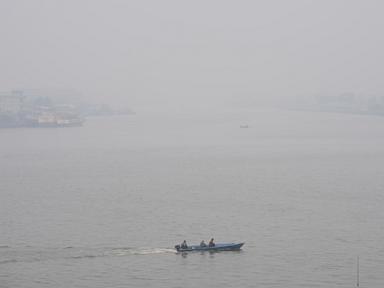
Yet, life must somehow stagger forward. Motorcyclists crawl through intersections with heavy-duty respirators strapped across their faces, looking like extras in a post-apocalyptic film. Street vendors wipe a thin layer of soot off their goods every twenty minutes. Fishermen guide their wooden perahu along the Barito River, wrapped in thick fog, steering by instinct and the familiar slap of water against the hull rather than the sight of the banks.
The Silence Before the Wind
Back at the airport, Wayan sits in the pilot's lounge, sipping bitter local coffee and watching the digital departure board flicker. Flight status: Delayed. Flight status: Rescheduled. Flight status: Pending weather evaluation.
He knows the routine. He has flown through these seasons before. He knows that no amount of technological wizardry can pierce an atmosphere choked by millions of tons of carbon ash.
The pilots wait. The passengers wait. The island waits.
They are all waiting for the same thing: the shift in the wind, the arrival of the rains, the cleansing sweep of the southern monsoons that will finally push the gray monster back out to sea. Until then, Borneo remains suspended in the amber gloom—a stunning, ancient wilderness temporarily silenced by the smoke of its own burning heart.