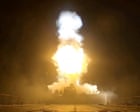
The coffee cups on the balcony table shook before the sound arrived.
It was three in the morning in Dubai. For tens of thousands of families sleeping in glass towers that scrape the clouds, the first sign of a shifting world order was not a press release or a cable news bulletin. It was a low, guttural vibration that vibrated through concrete foundations, followed seconds later by the deafening crack of air defense batteries firing into the darkness over the water.
Across the water, direct hits and retaliatory volleys were reshaping the map in real time. Following fresh American airstrikes targeted at regional proxy networks and strategic assets, military commanders in Tehran launched a direct, multi-pronged response aimed at targets across Gulf nations hosting American facilities. In a matter of hours, years of delicate diplomatic balancing acts evaporated into smoke trails against the pre-dawn sky.
War in the modern age rarely announces itself with a formal declaration. It arrives on mobile phone screens as frantic emergency alerts, in sudden air traffic diversions, and in the sheer, suffocating silence of an entire global trade artery holding its breath.
The Glass Towers and the Strait
Consider a tanker captain floating near the Strait of Hormuz.
Through this narrow stretch of water—barely twenty-one miles wide at its tightest choke point—flows nearly twenty percent of the world’s petroleum. On any given afternoon, hundreds of massive steel hulls sit low in the brine, carrying the fuel that powers factories in Asia, heats homes in Europe, and keeps airlines operating across North America.
When missiles cross that sky, the math changes instantly. Maritime insurance rates spike tenfold in a single trading session. Shipmasters receive panicked satellite transmissions ordering them to alter course or drop anchor in international waters. A single tactical error on a radar screen can turn a routine transit into an international crisis that reverberates to gas stations six thousand miles away.
This is where abstract geopolitical terminology collapses into concrete human reality. Geopolitics is not a game played on a board in Washington or Tehran. It is the immediate terror of a crane operator on a port dock in the Gulf, wondering whether the next siren means an incoming strike on nearby fuel depots or merely a false alarm.
For decades, the southern shore of the Persian Gulf built an identity on stability, modern infrastructure, and economic ambition. Cities rose from the sand as global crossroads for finance, tourism, and logistics. Millions of expatriates from India, the Philippines, Western Europe, and across the Arab world moved here under an unwritten promise: work hard, stay safe, and build a future far removed from the historical turbulence of the broader region.
That unwritten contract is now under severe strain.
The Domino Effect of Escalation
Military actions operate under a brutal logic of action and reaction.
When the United States conducts precision strikes against targets deemed direct threats to its forces or maritime shipping, the strategic intent is deterrence. The goal is to signal strength, destroy capabilities, and halt aggressive moves before they multiply.
Yet deterrence is in the eye of the beholder.
To strategic planners in Iran, static defense is framed as vulnerability. When American munitions fall on high-value targets, domestic political pressure and ideological imperatives demand a show of force that proves the country can strike back at will. And the most accessible targets are not always thousands of miles away in North America; they are right next door—the radar stations, naval ports, and logistics hubs scattered across neighboring Gulf states.
This cycle creates an agonizing dilemma for the leadership of regional nations.
They find themselves caught in a vice between two heavyweights. Host an American base, and you become a target when conflict flares. Ask the Americans to leave, and you lose the protective shield that deters neighboring powers from exerting total regional dominance.
The consequence is a permanent state of high alert where small miscalculations carry catastrophic weight.
Living on the Fault Line
Take the story of Layla, a thirty-two-year-old software product designer living in Abu Dhabi with her elderly mother and five-year-old son.
She is not a politician. She does not read defense white papers or study missile defense interception ratios. On the night of the strikes, her primary concern was trying to order formula online while checking flight trackers to see if her husband's incoming connection from London would be forced to divert to Riyadh or Mumbai.
When the windows rattled, her instinct was simple and primal. She grabbed her son from his bed, moved into the interior hallway away from exterior glass, and sat in the dark listening to the hum of the air conditioner mixed with the distant thud of air defenses active over the coast.
Her experience mirrors millions of others. The psychological toll of living under a military umbrella is rarely captured in defense statistics. It shows up in group chats overflowing with unverified rumors, in sudden runs on grocery store staples, and in the quiet, desperate calculation every family makes about whether to pack a bag and head for the airport—assuming the airport remains open.
The financial markets feel this tremor immediately. Stock indices across regional bourses dip within minutes of news breaks. Energy traders scramble to hedge positions, sending crude oil prices surging upward in global commodity markets.
Yet beneath the trading algorithms and policy announcements lies a deeper question: How long can a region thrive as a hub of global commerce when the threat of destruction hangs suspended overhead like a sword on a thread?
The Fallacy of the Containment Doctrine
For years, policy experts argued that regional conflicts could be successfully contained within specific geographic borders. The theory held that localized shadow wars, proxy skirmishes, and targeted strikes could continue indefinitely without burning down the surrounding neighborhood.
Recent events have shattered that assumption.
Modern weaponry has rendered geographic distance almost meaningless. Long-range drones, hypersonic ballistic missiles, and loitering munitions mean that a command decision made in one capital can translate to impacts across three different countries within fifteen minutes.
There are no isolated battlefields anymore.
When a facility in a regional host country is struck, the ripples pass instantly through global supply chains. Microchip manufacturers in East Asia face logistics delays because cargo routes must be recalculated around entire airspaces that have suddenly closed. Energy buyers in Europe recalculate heating budgets for the coming winter as spot market prices react to the destruction of fuel storage infrastructure.
The world is too interconnected for any war to remain local.
Beyond the Noise of Bulletins
As dusk falls over the Gulf, the air remains thick with tension. Patrol boats sweep the coastal channels, searching for unexploded ordnance or drifting debris. Flight paths remain altered, carving wide arcs around contested airspace.
On the ground, life attempts to resume a veneer of normal routine. Cafes open their doors. Traffic flows along coastal highways. Construction cranes move heavy steel into place against the humid sky.
Human beings possess a remarkable capacity to adapt to extraordinary circumstances. But adaptation is not peace. It is merely endurance.
The real narrative of this conflict is not found solely in the casualty counts or the press releases issued from military headquarters. It lives in the quiet conversations happening inside living rooms from Tehran to Washington, from Dubai to London. It lives in the lingering question of whether diplomacy can regain its footing before the next round of sirens cuts through the night air.
The sky over the Gulf may be clear for the moment, but everyone is watching the horizon, waiting to see which way the wind will blow next.