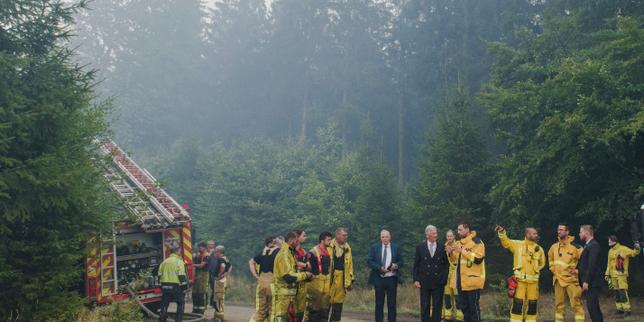
The air tasted like burnt pine and forgotten warnings long before the sirens reached the edge of the plateau.
Standing on the ridge of the High Fagnes, the ancient peat bog that forms the jagged eastern roof of Belgium, the horizon did not look like a disaster zone. It looked like a bruised twilight. Low, heavy smoke coiled across the damp heather, swallowing the silence of a protected nature reserve that had stood resilient through centuries of damp northern European rain.
For generations, locals knew this landscape as a sponge. The Fagnes were defined by water, by the dark, spongy mosses that drank the autumn storms and bled moisture slowly into the valleys below. Fire here belonged to mythology, not meteorology.
Yet, when the flames caught hold of the dry underlying peat during an unseasonably parched stretch, they did not merely burn. They smoldered. They dug deep into the ancient carbon layers, eating downward rather than racing across the surface. Firefighters who arrived with standard water hoses quickly realized the terrifying truth of the terrain beneath their boots. You cannot easily extinguish a fire that is breathing underground.
Panic followed, as it always does when the impossible happens. But beneath the panic lay a sharper, more uncomfortable emotion: a cold realization that the country had been caught sleepwalking.
The fire in the Fagnes was never just an isolated environmental accident. It was a mirror held up to a nation that built its infrastructure for a climate that no longer exists.
The Architecture of Denial
Consider how modern societies prepare for crisis. We build for the average. We pave roads, clear firebreaks, and design emergency response protocols based on historical weather charts compiled over the last hundred years. Those charts are now historical fiction.
In Belgium, a country famous for its temperate maritime dampness, wildfire management was long treated as an afterthought—something relevant to Mediterranean pine forests or Australian brushland, but entirely foreign to the Ardennes and the Fagnes. Fire brigades were equipped for urban rescues, structural blazes, and localized flooding. They were not structured to combat vast, sprawling ecosystems turning to tinder under persistent heatwaves and multi-year groundwater drops.
When the smoke cleared over the charred expanse of the plateau, public debate shifted rapidly from soot-stained trees to institutional culpability. Politicians scrambled to announce reviews, commissions, and modernization strategies.
Critics pointed to delayed response times, fragmented regional jurisdictions, and a chronic lack of specialized aerial firefighting equipment. It is easy to blame logistics. It is easier still to point fingers at bureaucratic inertia.
However, the failure runs deeper than institutional sluggishness. It is a failure of imagination.
We struggle to protect ourselves against threats we refuse to visualize. For decades, climate change in northern Europe was discussed in boardrooms and academic papers as a distant, abstract hypothesis—a slow-moving gradient of temperature change that would afford ample time for orderly adaptation.
The Fagnes fire tore that illusion to shreds.
The Invisible Stakes
To understand what was truly lost in the embers, you have to look beyond the charred hectares of protected flora.
Ecosystems like the High Fagnes are carbon vaults. For millennia, the accumulating peat locked away massive quantities of carbon dioxide, keeping it safely buried beneath layers of waterlogged moss. When a peat fire burns, it does not just destroy wildlife habitats; it reverses time. It unlocks those ancient vaults and vomits decades of stored carbon back into the atmosphere in a matter of hours, accelerating the very cycle that dried the landscape out in the first place.
It is a feedback loop. A cruel, self-reinforcing wheel.
Local farmers and conservationists watched the smoke rise with a familiar knot in their stomachs. They had been warning authorities for summers about dropping water tables. They had tracked the shrinking streams and the brittle, crackling mosses that felt more like dry autumn leaves in the middle of June than living vegetation. Their warnings were filed away, deemed alarmist by urban planners who measured risk in probability spreadsheets rather than the dry crunch of soil beneath their feet.
This is the hidden cost of our institutional comfort. We treat environmental degradation as an external budget line rather than an immediate security threat.
When a nation remains unprepared for climate shocks, the burden inevitably falls on the people least equipped to carry it: the local volunteers who spend forty hours battling subterranean embers without adequate gear, the rural communities whose livelihoods depend on the fragile balance of local tourism and agriculture, and the future generations who inherit a landscape stripped of its historical resilience.
The Turn Toward Reality
Change rarely arrives because of enlightened foresight. Usually, it requires a crisis loud enough to shatter the daily routine.
The debate sparked by the Fagnes fire forced a reluctant country to look in the mirror. It exposed the dangerous gap between policy and planetary reality. Belgium is now forced to confront a brutal architectural question: how do you retrofit an entire nation for a climate that refuses to stay still?
The answers are neither cheap nor easy. They require rethinking regional water management, investing in specialized heavy-duty rural firefighting units, restoring natural wetlands to act as biological firebreaks, and abandoning the comforting fiction that geography is destiny. Being in northern Europe no longer shields a nation from the fire.
As dusk settles back over the scarred plateau, the charred stalks of heather stand like silent sentinels against the gathering dark. The smoke has faded, but the question it left suspended in the Belgian air remains entirely unresolved.
The next spark is already waiting somewhere in the dry grass, and the clock is ticking down to see who is actually watching.