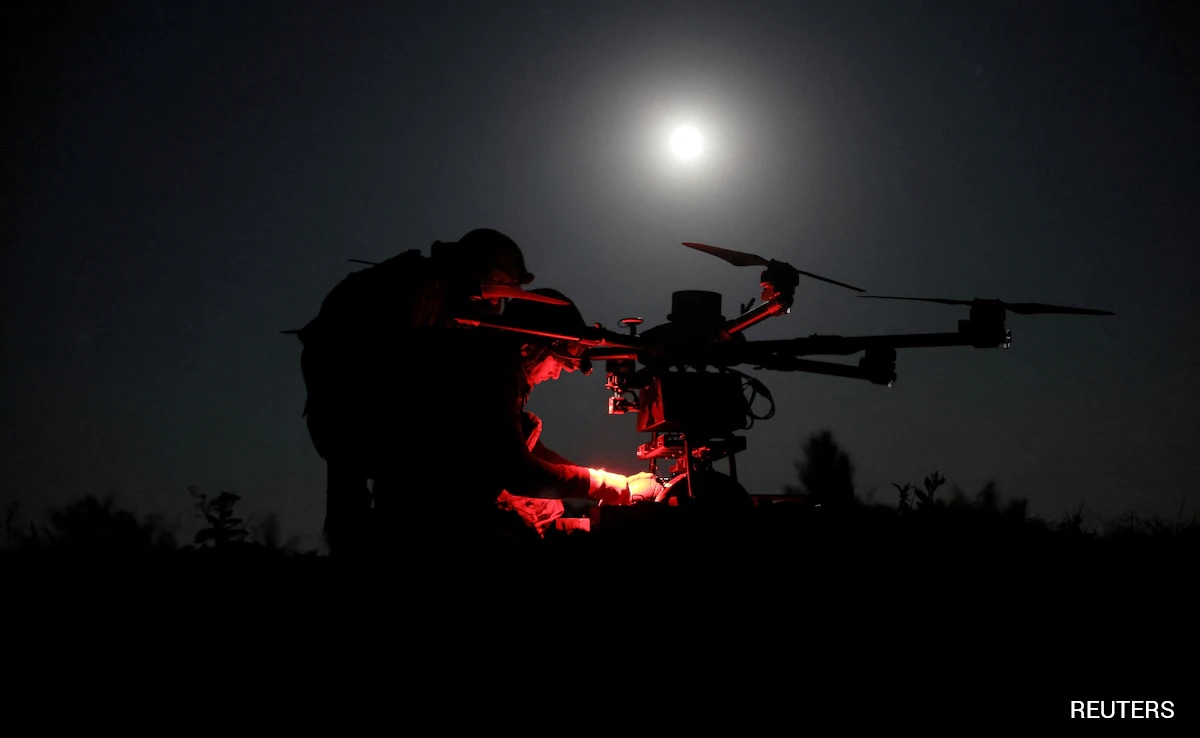
The headlines are obsessed with the "drone-ification" of the front lines. They paint a picture of a battlefield where the lonely marksman, the elite sniper, has been relegated to the museum alongside the cavalry charge and the musketry line. The narrative is seductive: why risk a highly trained human life when a $500 quadcopter with a taped-on RPG-7 warhead can achieve the same kinetic effect from three kilometers away?
It’s a neat story. It’s also wrong.
What we are witnessing in Ukraine isn't the replacement of the sniper. We are seeing a fundamental misunderstanding of what a sniper actually does. If you think a sniper is just a long-distance trigger-puller, you’ve been watching too many movies. Drones are exceptional at killing. They are terrible at being snipers.
The Precision Trap
The core of the "drones replace snipers" argument rests on a logical fallacy: that the primary value of a sniper is the kill. In reality, the kill is often the least important part of the mission.
A sniper is a persistent, multi-sensory intelligence node that happens to carry a long-range weapon. They provide real-time, nuanced reconnaissance that a drone pilot—tucked away in a basement five kilometers back, squinting at a grainy 720p feed through electronic interference—simply cannot replicate.
Drones suffer from "soda straw" vision. You see exactly what the camera is pointed at. You miss the subtle shift in the treeline 30 degrees to the left. You miss the smell of diesel that indicates an idling T-80 behind a barn. You miss the rhythmic sound of a digging tool that signals a new fortification. A sniper team sits in the dirt for 72 hours. They become part of the environment. They understand the "pattern of life."
When a drone enters the airspace, everyone knows it. The high-pitched whine of the motors is a psychological trigger. Soldiers duck, they hide, they mask their signatures. The drone is a loud, blinking "I am here" sign. A sniper is a ghost. The moment a sniper reveals their presence, the mission has usually transitioned to its final stage. Until then, they are the most efficient intelligence-gathering tool on the battlefield.
The Electronic Warfare Wall
Everyone loves to talk about FPV (First Person View) drones until the electronic warfare (EW) suites turn on.
The current conflict has become a massive laboratory for signal jamming. We are seeing a frantic cycle of frequency hopping and AI-driven terminal guidance to bypass EW, but the physics remain stubborn. If you jam the link between the pilot and the bird, the drone becomes an expensive paperweight.
A .338 Lapua Magnum round doesn’t care about frequency jamming. A 162-grain bullet does not require a GPS signal to find its mark. It is immune to spoofing. It doesn't need a battery recharge every twenty minutes.
The obsession with drones has created a dangerous dependency on the electromagnetic spectrum. Commanders who trade their sniper platoons for drone squads are trading a resilient, low-tech certainty for a high-tech fragility. When the sky becomes "dark" due to heavy jamming—which happens more often than the viral Telegram videos suggest—the infantry unit without snipers is blind and toothless. The sniper is the ultimate fail-safe.
The Resource Math That Doesn't Add Up
The "cheap drone" argument is the favorite of the bean-counters. They see a $500 drone versus a $15,000 Accuracy International rifle and a $100,000 training pipeline for the human. The math seems obvious.
Except it ignores the attrition rate.
In high-intensity zones, the lifespan of an FPV drone is measured in minutes. They are consumable items. You need thousands of them. You need a massive logistics tail to move them, charge them, and repair them. You need pilots who, while not in the direct line of fire, are frequently targeted by counter-battery fire the moment their signal is triangulated.
A sniper team is a long-term asset. They are an investment in human capital that pays dividends over months and years. They move under their own power. They forage. They adapt. They don't need a Starlink terminal to function. The "cost-effectiveness" of the drone vanishes the moment the enemy deploys a $50 signal jammer or a simple net.
Psychological Warfare: Terror vs. Annoyance
There is a specific kind of horror associated with drones. The "buzz" followed by the explosion. It’s terrifying, but it’s impersonal. It’s an act of God or a stroke of bad luck.
Sniper fire is different. It is intimate. It is the realization that a human being is watching you, specifically, and has decided you should die. The psychological paralysis a single sniper can impose on a company-sized element is disproportionate to their physical output.
I’ve talked to officers who have seen entire advances grind to a halt because of one shooter they couldn't locate. Drones cause soldiers to scatter and hide. Snipers cause soldiers to stop moving entirely. They freeze the battlefield. You can shoot down a drone. You can't shoot down a ghost you can't see.
The False Dichotomy of Modern Warfare
The most egregious error in the competitor's "replacement" narrative is the idea that it’s an either/or scenario. It isn't.
The most lethal units on the ground today are those that have integrated drones into the sniper team. Imagine a two-man element where the spotter operates a sub-250g "nanodrone" for over-the-horizon peeks, while the shooter maintains eyes-on through the glass.
This isn't replacement; it's augmentation. The drone handles the high-risk, short-term recon, while the human provides the long-term observation and the un-jammable kinetic solution.
By framing this as "Drones replacing Snipers," we are encouraging a generation of military planners to let a critical skill set wither away. We saw this after Vietnam, and again after the initial push into Iraq. Every time we think technology has made the "man in the grass" obsolete, we pay for it in blood when the batteries die or the signal drops.
The Expertise Gap
Training a drone pilot to fly an FPV into a tank hatch takes a few weeks. Training a sniper to calculate windage, elevation, humidity, and the Coriolis effect while remaining undetected for days in sub-zero temperatures takes years.
$$\Delta R = \frac{\omega_{e} \cdot v \cdot t^{2} \cdot \sin(\phi)}{1}$$
The above represents the horizontal deflection due to the Coriolis effect. A sniper calculates this instinctively or with a ballistic computer. A drone pilot doesn't have to worry about it—until they do. When we prioritize the "easy" kill of the drone over the "hard" mastery of the sniper, we are lowering the collective IQ of the infantry. We are trading craftsmanship for volume. In a war of attrition, volume is great. In a war of precision and intelligence, craftsmanship wins.
The drone is a surge. It’s a temporary dominance of a new medium. But history is a graveyard of "obsolete" soldiers. They said the machine gun made the rifleman obsolete. They said the tank made the infantryman obsolete. They said the nuclear bomb made the conventional army obsolete.
They were wrong every time.
The drone is just another tool in the box. It’s a loud, hungry, fragile tool. The sniper is a quiet, self-sufficient, and terrifyingly resilient one. If you’re betting on the drone to do the sniper's job, you’re not just misreading the battlefield—you’re setting yourself up for a very quiet, very sudden defeat.
The rifle isn't going anywhere. Neither is the man behind it. Stop looking at the sky and start looking at the shadows. That's where the real war is won.