Diplomacy usually rewards the person who lowers their voice first. Not in the South China Sea. Whenever officials in Manila signal a desire to dial down the rhetoric, cool the temperature, or seek quieter channels with Beijing, analysts and casual observers alike wonder if we're finally seeing an off-ramp to years of maritime friction.
We aren't. Don't forget to check out our recent post on this related article.
Lowering the volume doesn't change the underlying math of the region. South China Sea tensions aren't driven by hurt feelings, loud press conferences, or aggressive social media posts from Philippine Coast Guard spokespeople. They're driven by conflicting territorial claims, overlapping exclusive economic zones, and a massive imbalance in hard power. When Manila softens its tone, Beijing doesn't interpret that shift as an invitation to compromise. Instead, it reads it as a sign that pressure works.
The Structural Problem Behind the Rhetoric
To understand why tone policing fails here, you have to look at what both sides actually want. The Philippines wants to exercise its sovereign rights within its 200-nautical-mile Exclusive Economic Zone (EEZ), a right affirmed by the 2016 Permanent Court of Arbitration ruling in The Hague. That means Filipino fishermen fishing at Scarborough Shoal, Philippine energy companies exploring Reed Bank, and the Philippine military resupplying troops stationed on the grounded BRP Sierra Madre at Second Thomas Shoal. If you want more about the context here, NPR offers an excellent summary.
China wants control over virtually the entire sea, defined by its expansive dashed-line map, and it treats the 2016 arbitral award as an illegal piece of paper.
Notice the problem? Those two positions don't overlap. You can't split the difference between "this is our legal EEZ" and "this is our historic territory" just by using nicer adjectives at a bilateral summit in Beijing or Manila.
Over the past decade, the Philippines has actually tested both ends of the diplomatic spectrum. Under former President Rodrigo Duterte, Manila spent years bending over backward to avoid offending Beijing. Duterte set aside the 2016 tribunal victory, dialed back joint patrols with the United States, and used remarkably warm language toward Chinese leadership.
What did that softer tone buy the Philippines? Very little. Chinese coast guard vessels and maritime militia boats continued swarming Whitsun Reef, blocking Filipino fishermen at Scarborough Shoal, and expanding artificial island outposts across the Spratlys. Beijing pocketed the rhetorical goodwill and kept building.
Why Beijing Views Restraint as an Opening
In Western diplomatic culture, de-escalation is supposed to be reciprocal. You take a step back, I take a step back, and we meet in the middle.
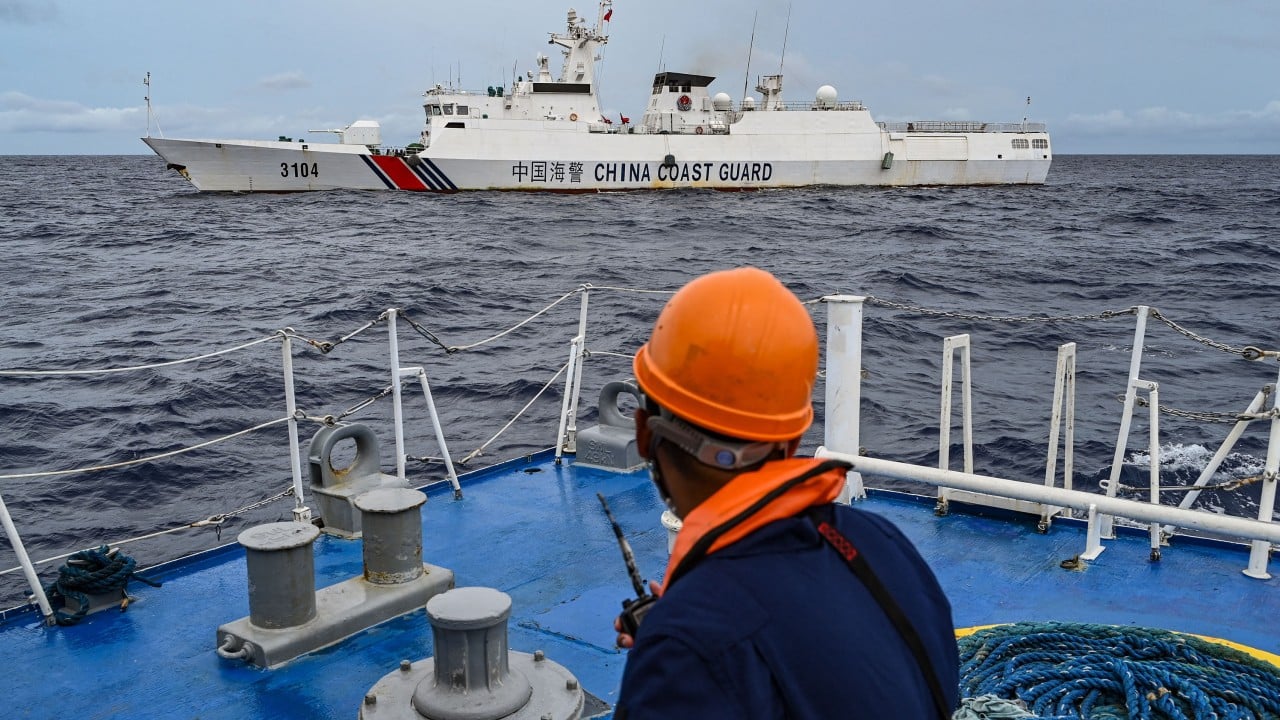
Strategic thinkers who follow People's Liberation Army Navy (PLAN) and China Coast Guard operations closely know that Beijing operates on a different playbook. Often described by defense analysts as "salami-slicing" or gray-zone coercion, the strategy relies on gradual, persistent pressure just below the threshold of open warfare. Water cannons, laser blinding, aggressive blocking maneuvers, and hull-to-hull collisions are designed to exhaust the smaller opponent without triggering a mutual defense treaty.
When Manila adopts a softer public posture—perhaps to protect trade ties, lure infrastructure investment, or simply give exhausted sailors a breather—the gray-zone pressure rarely stops. If anything, quiet diplomacy removes the one tool the Philippines actually has to level the playing field.
The Transparency Strategy Was Working
Starting around 2023 under President Ferdinand Marcos Jr., Manila shifted to what security experts call "assertive transparency." Instead of hiding bruised hulls and bruised egos behind closed-door diplomatic protests that Beijing routinely ignored, the Philippine Coast Guard invited journalists onto resupply boats. They filmed every water cannon blast. They broadcast every dangerous ramming maneuver to the global press within hours.
Honestly, it was one of the smartest asymmetric moves a smaller nation has made in years.
The Philippines couldn't match China's hull count or tonnage. By turning every confrontation into a global media event, Manila raised the reputational cost for Beijing. Suddenly, European nations, Australia, Japan, and the United States were issuing coordinated statements condemning Chinese actions. The narrative shifted from "two neighbors having a quiet border spat" to "a superpower bullying a smaller neighbor in violation of international law."
Trading that spotlight for a softer tone strips away Manila's main source of leverage. Quietly filed diplomatic notes—hundreds of them have been sent over the years—simply vanish into filing cabinets.
The Domestic Trap in Manila
There's also a political reality inside the Philippines that makes a softer tone unsustainable. Public opinion in Manila has hardened considerably over the last few years. Surveys from groups like OCTA Research and Social Weather Stations consistently show that overwhelming majorities of Filipinos view China's actions in the West Philippine Sea—Manila's official name for the waters within its EEZ—as a direct threat to national security and local livelihoods.
When a Filipino fisherman loses a day's catch because a coast guard cutter chased him away from traditional fishing grounds, he doesn't care about diplomatic nuance. When viral videos show Filipino sailors injured by high-pressure water cannons near Second Thomas Shoal, voters demand a spine from their leaders.
If the administration in Manila sounds too conciliatory, domestic critics immediately accuse it of weakness or appeasement. That political pressure forces leaders right back into tough talk the moment the next incident happens at sea. And in waters crowded with hundreds of vessels, another incident is always just a few days away.
Economic Promises Rarely Materialize
Proponents of a gentler approach toward Beijing usually point to economics. China is a massive trading partner, a major buyer of Philippine agricultural exports like bananas and pineapples, and a potential source of big-ticket infrastructure loans. The argument goes that cooling tensions will unlock billions in trade and investment.
The track record doesn't back that up.
During the height of Manila's previous pivot toward Beijing, Chinese officials pledged roughly $24 billion in loans and investments for Philippine railways, bridges, and energy projects. Years later, only a tiny fraction of those promised funds ever actually materialized. Projects stalled over high interest rates, bureaucratic delays, and shifting political winds. Meanwhile, private Western and Japanese investors grew nervous about regional instability.
Sacrificing maritime rights for promised economic windfalls has proven to be a bad trade. Markets reward predictability and the rule of law, not vague assurances that might vanish the next time a coast guard boat crosses a disputed shoal.
What Actually Shifts the Equation
If polite language won't calm the waters, what will? Defense analysts and former diplomats point to three concrete factors that carry far more weight than press releases.
First is physical presence and modernization. The Armed Forces of the Philippines has been steadily upgrading its capabilities, acquiring BrahMos anti-ship missiles from India, new frigates from South Korea, and patrol vessels from Japan. A softer tone paired with a weaker fleet invites encroachment. Steady modernization, even if modest compared to Beijing's massive shipbuilding capacity, complicates military planning for any aggressor.
Second is multilateral coalition building. Beijing prefers dealing with Southeast Asian claimants one-on-one, where its sheer size dominates the room. Manila's push to expand security ties—through the Enhanced Defense Cooperation Agreement (EDCA) with the United States, reciprocal access agreements with Japan, and joint maritime patrols with Australia and Canada—internationalizes the issue. China hates this because it turns a bilateral mismatch into a regional coalition.
Third is keeping the legal baseline front and center. The 2016 arbitral ruling isn't going away, no matter how many times Beijing calls it null and void. Every time Manila anchors its public messaging in the United Nations Convention on the Law of the Sea (UNCLOS), it reinforces the legal boundary that separates legitimate resource rights from raw power grabs.
Reading Between the Lines of Diplomatic Signals
When you see headlines about Manila calling for a "softer tone" or "managing differences peacefully," don't mistake diplomatic choreography for a strategic retreat. Governments routinely adjust their vocabulary to buy time, calm nervous financial markets, or test whether the other side is willing to honor temporary arrangements—like the provisional understanding reached over resupply missions to Second Thomas Shoal.
Smart observers watch the water, not the microphones.
If you want to know whether tensions in the South China Sea are genuinely easing, ignore the speeches at regional forums and track three things instead: the number of Chinese maritime militia vessels anchored around Spratly features, whether Filipino fishermen can enter Scarborough Shoal unmolested, and whether supply boats reach the BRP Sierra Madre without getting hit by water cannons. Until those realities on the water change, changing the tone in Manila is just adjusting the soundtrack to the exact same movie.