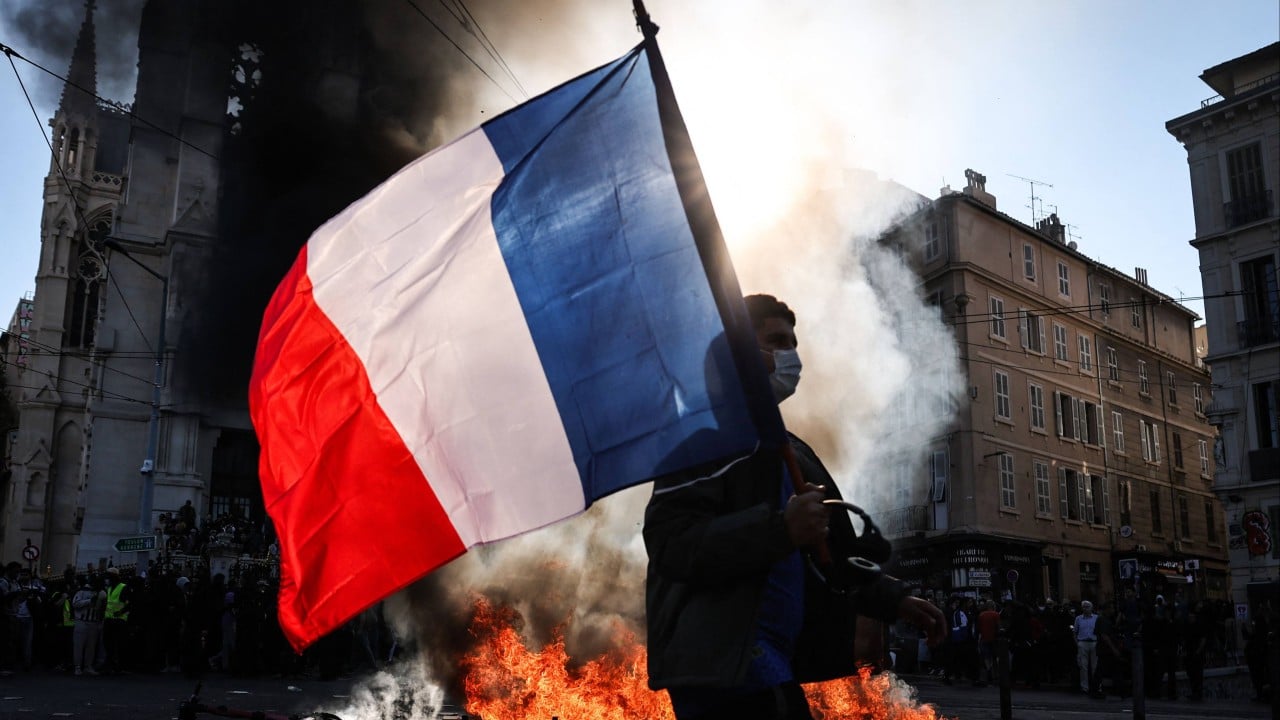
An amber travel alert issued by Hong Kong for France following violent school protests operates as a compressed risk signal rather than a literal map of street-level danger. A traveler reading a headline about school protests turning violent in France typically wants to know three things: whether the threat reaches tourist corridors, what an amber tier changes operationally, and how localized unrest spreads across transport and commercial nodes. This analysis breaks down the mechanics of that alert using a three-layer escalation model—localized friction, municipal spillover, and sovereign advisory signaling—and maps how cause and effect move through urban infrastructure when youth mobilization turns confrontational.
The Three-Layer Escalation Architecture
Conventional reporting treats a violent school protest as a single event with a clear boundary around a campus or a square. In practice, civil unrest involving students and youth unfolds across distinct operational layers that interact at different speeds. Distinguishing these layers separates immediate physical hazard from secondary friction that disrupts itineraries hours or days later. Discover more on a related issue: this related article.
Layer One: Localized Friction and Campus Perimeter Dynamics
School protests begin around specific grievances, exam pressures, curriculum disputes, or broader political flashpoints that resonate with secondary and university students. Violence at this stage usually takes the form of property damage, projectile throwing, barricade building, or clashes with municipal police near school gates, transit stops, or neighborhood plazas.
The defining characteristic of layer one is spatial concentration paired with high unpredictability. A single block can shift from routine foot traffic to tear gas and road closures within minutes. Yet spatial concentration also means that a violent incident outside a lycee or vocational school in one arrondissement does not automatically turn a museum district ten kilometers away into a combat zone. Additional journalism by AFAR explores related perspectives on this issue.
Layer Two: Municipal Spillover and Transit Bottlenecks
Unrest becomes a broader operational problem when movement patterns change across the wider city. Even when protesters do not march into major tourist districts, security forces and transit operators react defensively to prevent crowds from converging on symbolic targets or major rail hubs.
Bus reroutes, station closures, and heightened police perimeters act as network choke points. A traveler whose hotel sits two miles from any confrontation can still lose two hours in transit or miss a regional train connection because a feeder line suspends service or a boulevard closes to clear debris.
Layer Three: Sovereign Advisory Signaling
A travel alert issued by an authority such as the Hong Kong government sits one step removed from street conditions. Advisory tiers reflect an official risk assessment weighing citizen safety, consular support capacity, and diplomatic prudence. An amber alert generally signals heightened caution—advising travelers to monitor developments, avoid protests, and reconsider non-essential travel to affected areas—without imposing the strict avoidance language of higher severity tiers.
Because sovereign advisories are discrete steps on a policy ladder, they lag behind rapid street shifts in one direction and stay active longer than acute clashes in the other. Officials rarely upgrade or downgrade a tier on every hourly skirmish; they move when the pattern of disruption crosses an administrative threshold or when visibility into local conditions drops.
Cause-and-Effect Chains Standard Coverage Misses
Surface-level coverage of school protests turning violent tends to stop at visual drama: burning bins, police lines, and an official advisory headline. That framing misses the causal links that turn localized youth unrest into real travel friction or insurance and booking headaches.
Why Youth Mobilization Travels Along Transit Lines
Student protests are tightly coupled to urban public transit because secondary and university populations rely on metro, tram, and suburban rail networks to move between neighborhoods, campuses, and gathering points. When demonstrators disperse from one site, transit lines carry both students and onlookers toward secondary nodes.
Authorities counter this mobility by closing stations near flashpoints or restricting group movement around key junctions. The causal result is asymmetric: protesters who know local shortcuts adapt quickly, while visitors relying on fixed schedules and unfamiliar routes absorb the delay.
How Deterrence Tactics Reshape Commercial Zones
When municipal police deploy containment measures, water cannons, or tear gas to restore order, the physical footprint of the response often exceeds the footprint of the protest itself. Wind carries irritants down adjacent streets, and cordons seal off retail frontages and cafes for hours while cleanup crews operate.
Shopkeepers and restaurant operators near affected corridors frequently close early or keep shutters half-drawn during periods of recurring unrest. Even without direct attacks on visitors, reduced operating hours and abrupt street closures thin out the predictable rhythm of a city trip.
Where Fact Ends and educated Hypothesis Begins
In fast-moving civil unrest, separating verified facts from educated hypotheses prevents overreaction and false confidence alike.
- Known fact: An amber travel alert signals official concern about elevated risk or disruption linked to the reported unrest, and travelers face a higher chance of localized closures and transit delays near affected areas.
- Known fact: Violent clashes during protests create immediate physical hazards—including projectiles, crowd surges, police intervention, and smoke or chemical irritants—for anyone caught inside an active zone.
- Educated hypothesis: If protests remain centered on educational institutions and peripheral squares without drawing coordinated national strikes or sustained attacks on core transport hubs, day-to-day leisure travel in unaffected districts is likely to face intermittent friction rather than total paralysis.
- Educated hypothesis: If clashes repeat across consecutive days or expand into weekend demonstrations, authorities are more likely to pre-emptively restrict access around major civic avenues and rail interchanges, increasing schedule variance even for travelers who never approach a school campus.
The Cost Function of Itinerary Disruption
Travelers and planners often evaluate unrest using a binary mental model: safe or unsafe. A more accurate way to judge impact is through a cost function made up of time loss, rebooking friction, psychological strain, and policy coverage gaps.
Time Cost and Schedule Slack
The most common penalty of urban unrest is lost time. A missed connection, a detour on foot, or a delayed airport transfer eats into fixed reservations such as timed museum entries, intercity rail tickets, or long-haul flights.
Itineraries built with zero slack pay a steep tax on minor disruptions. Adding buffer time between legs costs almost nothing when conditions stay calm and pays off immediately when a line shuts down.
Financial and Policy Friction
An amber alert creates a gray zone in travel insurance and airline or hotel flexibility. Many standard policies distinguish between government advisories at higher warning levels, formal cancellations by carriers, and general civil commotion exclusions.
Relying on an amber alert alone to trigger automatic refunds or penalty-free changes is a common mistake. Terms depend heavily on policy wording, purchase dates, and whether a transport operator officially cancels or alters service.
Operational Limitations of Protective Measures
No single precaution eliminates exposure during civil unrest, and every risk-reduction step carries a trade-off.
- Relying solely on official alerts: Advisories provide valuable macro-level context, but they do not offer real-time street-level navigation or minute-by-minute transit updates.
- Avoiding the entire country: Canceling an entire trip to France over localized school protests avoids all street friction, yet it can forfeit non-refundable deposits and scrap plans in regions far removed from any unrest.
- Staying out late near flashpoints: Evening hours often see looser crowd dynamics and reduced visibility, making it harder to read early signs of street escalation before a perimeter closes.
Tactical Decision Protocol During Active Alerts
When an amber travel alert is active for France amid violent school protests, decisions should follow a disciplined sequence rather than rumor or panic.
- Audit proximity and transit links. Map your accommodation, daily destinations, and arrival or departure stations against reported protest zones and major interchange hubs. Pay special attention to rail and bus corridors connecting your base to airports or intercity stations.
- Establish a multi-source monitoring loop. Pair official consular or government advisories with local municipal updates, transit operator notices, and credible local news reports. Watch for patterns across days rather than reacting to a single unverified clip.
- Build time buffers into critical movements. Leave extra margin for airport transfers, train departures, and time-sensitive appointments. Avoid tight back-to-back bookings across opposite sides of a major city while unrest is active.
- Pre-plan exit and reroute options. Identify walking routes, alternative transit modes, or secondary pickup points before leaving your hotel. Keep digital and offline copies of booking references, transit passes, and emergency contacts accessible.
- Enforce a clean disengagement rule. If you encounter gathering crowds, sirens, police staging, or heavy smoke, leave the area immediately along a perpendicular route rather than stopping to observe. Do not attempt to cross active police lines or walk through dispersed crowd pockets.
Strategic Play for Travelers and Planners
Treat an amber alert for violent school protests in France as a call to tighten execution rather than freeze all movement: keep core commitments in unaffected areas with generous transit buffers, verify refund and insurance terms before changing tickets, and re-evaluate every 24 hours based on whether unrest stays confined to localized flashpoints or begins locking down major transport arteries.