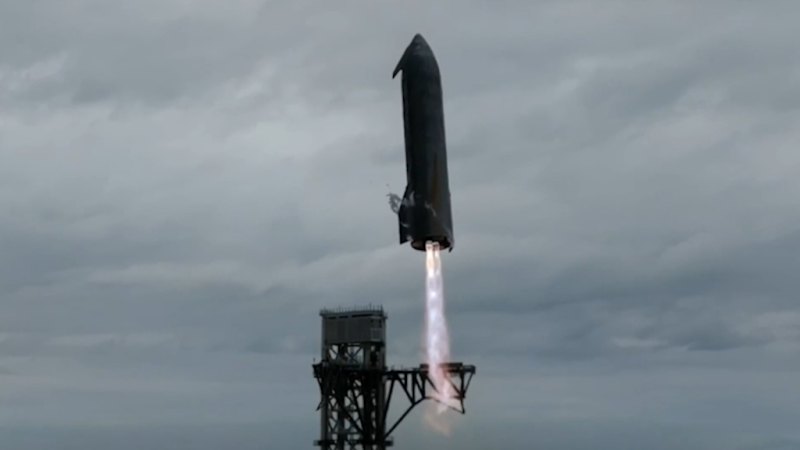
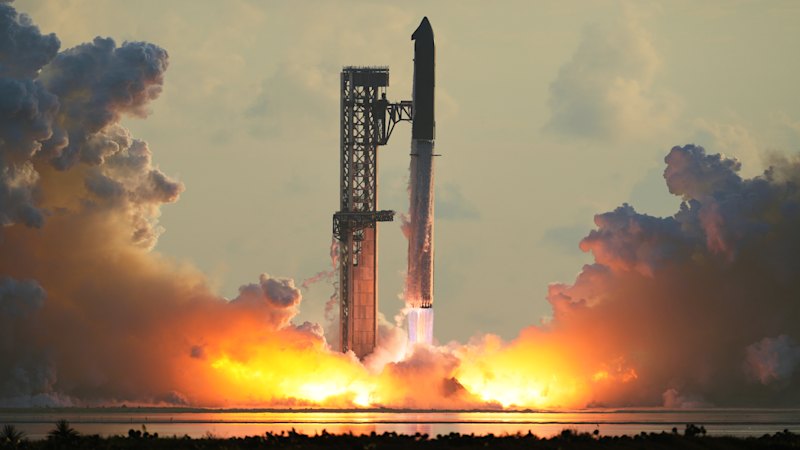
On October 13, 2024, SpaceX achieved an unprecedented engineering feat in Boca Chica, Texas, by catching the 232-foot Super Heavy rocket booster in midair using giant mechanical arms attached to its launch tower. Known as Mechazilla, the tower plucked the returning 250-ton stainless steel cylinder out of the sky just seven minutes after liftoff during Starship Flight 5. By eliminating heavy landing legs and returning the booster directly to its launch mount, SpaceX drastically cut the mass penalty of reusability and proved that rapid, airline-style turnaround for heavy-lift orbital rockets is physically possible.
Most spaceflight coverage treated the event as a visually stunning spectacle—a sci-fi movie brought to life on the Texas Gulf Coast. That framing misses the real story. The catch was not a stunt for cameras; it was a brutal, high-stakes balance-sheet maneuver designed to solve the single greatest bottleneck in human spaceflight: the crushing tyranny of the rocket equation.
The Brutal Math Behind Catching a Falling Skyscraper
To understand why engineers risked destroying a $100 million launch tower to catch a falling rocket, you have to look at mass fraction. Every kilogram of structural hardware added to a rocket subtracts directly from the payload it can carry to orbit.
When SpaceX pioneered propulsive landings with the Falcon 9 a decade ago, it accepted a steep penalty. Falcon 9 boosters carry four heavy carbon-fiber and aluminum landing legs, hydraulic deployment systems, and reinforced lower bulkheads to absorb the shock of touching down on concrete pads or ocean drone ships. Those legs are dead weight during ascent. They serve zero purpose while the rocket fights Earth's gravity on the way up, yet the engines must burn precious propellant to haul them toward space.
For Starship—a vehicle standing nearly 400 feet tall and designed to haul over 100 metric tons to Low Earth Orbit—scaling up Falcon 9 landing legs presented an engineering nightmare. Legs strong enough to support a 250-ton booster slamming down at terminal velocity would weigh tens of tons. Worse, landing on a concrete pad miles away means you still have to bring in heavy cranes, detach the booster, haul it back to the launch site on multi-axle transporters, and lift it back onto the pad. That process takes days or weeks.
SpaceX's solution was radical. Strip the landing legs off the rocket entirely and put the landing gear on the ground.
By shifting the structural load to the Orbital Launch Integration Tower, SpaceX kept the Super Heavy booster remarkably light. Two small, reinforced lifting pins mounted near the top of the booster—just beneath the forward grid fins—take the entire weight of the vehicle. Everything else stays anchored in concrete and steel in South Texas.
Inside the Seven Minutes of Controlled Chaos
The physics of the Flight 5 catch read like a list of impossible constraints. At liftoff, 33 Raptor engines ignited simultaneously, generating roughly 16.7 million pounds of thrust—more than double the power of NASA's historic Saturn V moon rocket.
Two minutes and forty seconds into flight, at an altitude of roughly 40 miles and traveling at over 3,400 miles per hour, the upper stage Starship ignited its own engines and separated from the booster via hot-staging. Instead of separating cleanly in cold space before firing, Starship blasted its exhaust directly onto a vented steel interstage ring atop Super Heavy. The maneuver saved propellant and preserved momentum, though it subjected the top of the booster to extreme thermal shock.
Then came the fall.
Super Heavy flipped around, fired a subset of its Raptor engines for a boostback burn, and plunged back toward the Texas coast. As it dropped into the thickening lower atmosphere, aerodynamic forces heated the stainless steel skin until parts of the engine skirt glowed orange. Four large waffle-like grid fins carved through the supersonic airflow, steering the falling cylinder toward a microscopic target.
Notice the safety architecture built into that trajectory. Until the final seconds of descent, the booster is not actually aimed at the tower. Its flight computer guides it toward an empty patch of scrubland or the Gulf of Mexico. Only when thousands of telemetry channels confirm that engine thrust, guidance sensors, hydraulic actuators, and tower hydraulics are all healthy does the software command a final lateral sidestep toward the catch pins.
At roughly 3,000 feet above the ground, the booster relit 13 of its Raptor engines, rapidly decelerating from supersonic speeds. Moments later, it throttled down to just three center engines, hovering nearly motionless in a deafening column of fire and dust while sliding sideways between the open steel chopsticks of the launch tower.
The arms snapped shut. The pins settled onto cushioned rails. The engines cut out.
[Boostback Burn] ---> [Supersonic Atmospheric Entry] ---> [Landing Burn (13 -> 3 Engines)]
                                                                         |
                                                                         v
                                                      [Lateral Shift & Tower Catch]
It worked on the very first attempt.
What the Competitor Coverage Missed About the Damage
Watching the livestream, the catch looked effortless. Reading the post-flight engineering assessments tells a far messier, more honest story.
SpaceX CEO Elon Musk later revealed that the booster came dangerously close to aborting the entire maneuver. A misconfigured spin-start gas pressure parameter on one of the outer Raptor engines nearly triggered an automated divert command just seconds before contact. Had that sensor tripped a fraction of a second earlier, the booster would have intentionally steered itself away from the tower and crashed into the ground to protect the launch pad.
Furthermore, the booster did not emerge unscathed. Intense acoustic vibrations and extreme heat warped sections of the outer engine shielding—the metal cowlings designed to protect plumbing and wiring from exhaust plumes. A visible fire burned near the base of the vehicle for several seconds after the engines shut down, fueled by residual methane venting from the tanks.
This is the critical nuance lost in breathless headlines. Catching a rocket does not automatically make it reusable the next morning.
The Thermal Protection and Refurbishment Bottleneck
For decades, aerospace veterans have warned that the hardest part of reusability is not surviving the trip back—it is inspecting and certifying the hardware afterward. NASA learned this lesson the hard way with the Space Shuttle. Although the Shuttle orbiters returned intact, technicians spent months replacing thousands of fragile silica heat shield tiles and rebuilding main engines after every flight.
Super Heavy avoids the reentry heating faced by an orbital upper stage because it never reaches orbital velocity. It travels roughly a quarter as fast as Starship before turning around. Even so, 33 high-pressure full-flow staged combustion engines endure violent thermal cycles during ascent and descent.
If technicians have to spend three weeks crawling over the booster with ultrasonic scanners looking for hairline cracks in welds and turbine blades, the economic advantage of catching it on the tower shrinks dramatically. True rapid reusability requires proving that Raptor engines and stainless steel propellant tanks can endure dozens of flights with minimal human intervention. SpaceX has demonstrated remarkable speed with Falcon 9 refurbishment—turning around individual boosters in as little as three weeks—but scaling that reliability to a cluster of 33 complex engines remains an unproven operational hurdle.
Why Traditional Aerospace Cannot Easily Copy This
Competitors across the globe are scrambling to respond, yet almost none are pursuing a tower-catch architecture. Blue Origin's New Glenn rocket relies on massive deployable landing legs to touch down on an ocean platform. Rocket Lab's upcoming Neutron vehicle uses fixed landing legs integrated into its carbon-composite fairing structure. Chinese state contractors and private startups are largely replicating the Falcon 9 model with grid fins and fold-out legs.
Why is nobody else building a Mechazilla?
- Capital Risk Tolerance: If a Falcon 9 misses its drone ship, SpaceX loses a booster and patches a steel deck. If a Super Heavy booster loses control during a tower catch, it obliterates the Orbital Launch Mount, propellant tank farm, and catch tower in a single catastrophic fireball. Rebuilding that ground infrastructure would halt launches for up to a year and cost hundreds of millions of dollars. Publicly traded aerospace giants and government agencies answer to risk-averse boards and taxpayers who rarely tolerate fiery explosions at primary launch complexes.
- Hardware Iteration Velocity: SpaceX treats rockets like software prototypes rather than handcrafted monuments. The company builds boosters on an assembly line in Starbase, Texas, accepting the destruction of multiple vehicles during earlier test flights to gather real-world flight data. Traditional cost-plus contractors design rockets to succeed on Flight 1 through exhaustive computer simulation, making bold mechanical experiments like midair catches financially and politically untenable.
- Engine Throttling Precision: Catching a booster requires hovering—reducing thrust to match the exact declining weight of the rocket as fuel burns off. Liquid rocket engines struggle to throttle deeply without experiencing combustion instability, which can shake an engine apart in milliseconds. Raptor's ability to throttle down smoothly while maintaining precise gimbal control is a prerequisite for the maneuver.
The Regulatory Friction Nobody Wants to Talk About
While engineers celebrate physics breakthroughs, the biggest threat to Starship's cadence in Texas sits in Washington, D.C., not on the launch pad.
The Federal Aviation Administration (FAA), alongside the U.S. Fish and Wildlife Service and the Environmental Protection Agency, governs every launch license issued at Boca Chica. Flight 5 itself was delayed for months amid contentious disputes over sonic booms, water deluge runoff, and debris dispersion zones.
Catching a 23-story booster over land introduces a completely new regulatory headache. Unlike drone ship landings hundreds of miles out in the Atlantic Ocean, a tower catch brings a massive, pressurized explosive device screaming back over coastal wetlands and nearby communities at supersonic speeds. The sonic boom generated by Super Heavy's reentry shook windows across Brownsville and South Padre Island, prompting immediate scrutiny from environmental groups and local officials.
SpaceX is currently lobbying federal regulators to increase its annual launch cadence from Boca Chica to 25 flights per year while simultaneously constructing a second launch tower at the site and another at Kennedy Space Center in Florida. Every modification to the booster's flight profile—even minor software tweaks to trajectory or propellant venting—can trigger fresh environmental reviews and safety assessments. Engineering can move at the speed of welding torches; federal licensing moves at the speed of administrative law.
How This Reshapes the Global Launch Market
To grasp the commercial shockwave of the Flight 5 catch, consider the current cost per kilogram to reach orbit.
| Launch Vehicle | Operator | Payload to LEO (Metric Tons) | Reusability Status | Estimated Cost per kg to LEO |
|---|---|---|---|---|
| Saturn V (Retired) | NASA | 140 | Expendable | ~$10,000+ (inflation-adjusted) |
| SLS Block 1 | NASA | 95 | Expendable | ~$20,000+ |
| Ariane 6 | Arianespace | 21.6 | Expendable | ~$5,000 - $7,000 |
| Falcon 9 | SpaceX | 17.5 (Reusable) | First Stage Reusable | ~$2,700 |
| Falcon Heavy | SpaceX | 63.8 (Expendable) | Boosters Reusable | ~$1,500 |
| Starship (Target) | SpaceX | 100 - 150 | Fully Reusable | Less than $200 |
Even if SpaceX misses its aspirational target by an order of magnitude and only brings launch costs down to $500 per kilogram, the economic foundation of the entire space industry collapses and rebuilds around Starship.
Satellite manufacturers currently spend millions of dollars miniaturizing components, folding solar arrays into origami shapes, and shaving grams off aluminum frames just to squeeze onto expensive rockets. When launch mass becomes cheap and abundant, satellite design flips overnight. Companies can build heavy, rugged spacecraft using off-the-shelf industrial hardware rather than bespoke space-grade electronics.
More urgently, the Flight 5 catch unlocks two strategic architectures that depend entirely on high-cadence heavy lift:
- Next-Generation Starlink Deployment: SpaceX's V3 Starlink satellites are too large and heavy to launch efficiently on Falcon 9. Starship is the sole vehicle capable of deploying them at scale, cementing a global broadband monopoly that funds SpaceX's deeper space ambitions.
- Orbital Propellant Depots: NASA's Artemis lunar lander—a modified version of the Starship upper stage—cannot reach the Moon on a single launch. It requires launching a depot ship into Earth orbit and then flying ten to fifteen tanker Starships in rapid succession to transfer supercooled liquid methane and liquid oxygen before the lander departs for lunar orbit. Without a tower catch enabling rapid booster turnaround, the Artemis moon landing schedule remains mathematically impossible.
The Hard Road Left to Full Reusability
Catching the booster solved half of the equation. The upper stage—Ship itself—faces a far deadlier obstacle.
During Flight 5, the Starship upper stage survived reentry from orbital velocity and executed a controlled splashdown in the Indian Ocean, hitting its target buoy with remarkable accuracy. Yet camera footage showed plasma burning through the hinge of one of its forward flaps, melting steel structure beneath the ceramic heat shield tiles.
Unlike the booster, the upper stage slams into the upper atmosphere at roughly 17,000 miles per hour. No amount of engine thrust can slow it down before hitting the air; it must bleed off massive kinetic energy through aerodynamic friction, generating temperatures exceeding 2,600 degrees Fahrenheit. SpaceX is still searching for a thermal protection system that can survive those temperatures repeatedly without shedding tiles or requiring months of post-flight bodywork.
Until the upper stage can survive reentry intact, return to Texas, and be caught by the very same Mechazilla arms without needing a heat shield rebuild, Starship remains only partially reusable. SpaceX proved on October 13 that it can catch a falling skyscraper out of the sky—now it has to prove it can fly the whole stack back from orbit and launch it again before the sun sets.