SpaceX abandoned its second consecutive attempt to catch a Super Heavy booster with its launch tower arms, diverting the massive rocket stage to a controlled water splashdown in the Gulf of Mexico after automated telemetry checks flagged a system anomaly during the final minutes of flight. While casual observers saw a missed opportunity for another viral Mechazilla grab, the decision exposes the brutal engineering reality of SpaceX’s rapid-iteration model. The company will not risk a multi-billion-dollar launch mount for the sake of a spectacle when safety thresholds fail to clear.
The abort happened fast. During the sixth integrated flight test of Starship, known as Flight 6, Super Heavy lifted off cleanly from Starbase in Boca Chica, Texas, pushing the upper stage toward suborbital velocity before executing its hot-staging separation maneuver. Everything looked nominal on the surface. But as the 232-foot stainless steel booster began its boostback burn toward the Texas coast, flight computers ran thousands of automated health checks on both the vehicle and the ground support equipment. One of those checks failed. Within seconds, the autonomous flight safety and guidance software executed a pre-programmed abort criteria, shifting the booster’s trajectory away from the population and delicate infrastructure of Starbase and out over the open ocean. For an alternative look, see: this related article.
The Invisible Mechanics of a Launch Tower Abort
Most people watching a SpaceX webcast think a human flight director sits at a console with a big red button, making gut calls in real time. That is not how modern orbital rocketry works. By the time Super Heavy is falling back through the upper atmosphere at supersonic speeds, human reaction times are functionally useless. The commit-to-catch decision rests entirely with deterministic software evaluating hard telemetry limits.
To understand why the booster ended up in the water, you have to look at the commit criteria required for a tower catch. Unlike a Falcon 9 booster, which lands on a reinforced concrete pad or a flat-deck autonomous spaceport drone ship with wide margins for error, Super Heavy has to thread a needle. It must decelerate from supersonic speeds, relight a cluster of Raptor engines, hover in mid-air, and translate laterally until two small load-bearing pins on its forward section slot cleanly onto the chopstick arms of the orbital launch and integration tower. Further insight on the subject has been published by The Verge.
The margins are razor-thin. If the tower’s hydraulic actuators report a pressure dip, if a communications link between the ground station and the booster drops packets, or if one of the inner Raptor engines shows abnormal chamber pressure during the landing burn, the system defaults to safety.
A water landing destroys the booster, which SpaceX considers expendable hardware during developmental testing. A botched tower catch destroys Stage Zero, setting the entire Starship program back by six to twelve months.
In aerospace engineering, the ground infrastructure is known as Stage Zero. At Boca Chica, Stage Zero includes the orbital launch mount, the 480-foot integration tower, the massive liquid methane and liquid oxygen tank farms, and the complex network of cryogenic plumbing that feeds the rocket. Building another Super Heavy booster takes SpaceX weeks inside its Starbase mega-bays. Rebuilding a mangled launch tower after a 250-ton rocket slams into it at terminal velocity would trigger federal accident investigations, environmental reviews, and construction delays that could cripple the company’s manifest for years.
What Actually Went Wrong During the Descent
SpaceX has maintained its characteristic operational security regarding the exact sensor reading that triggered the Flight 6 abort, though post-flight data points directly to communications and ground-system synchronization. During the boostback and descent phase, the booster and the tower engage in a continuous, high-speed digital handshake. The tower needs to know the rocket’s exact velocity vector, mass distribution, and attitude down to the millimeter. Simultaneously, the booster needs confirmation that the chopsticks are unlocked, positioned at the exact capture height, and ready to absorb hundreds of tons of kinetic energy.
When a single data link experiences latency or a sensor returns an out-of-bounds value, the software does not guess. It immediately locks out the overland trajectory.
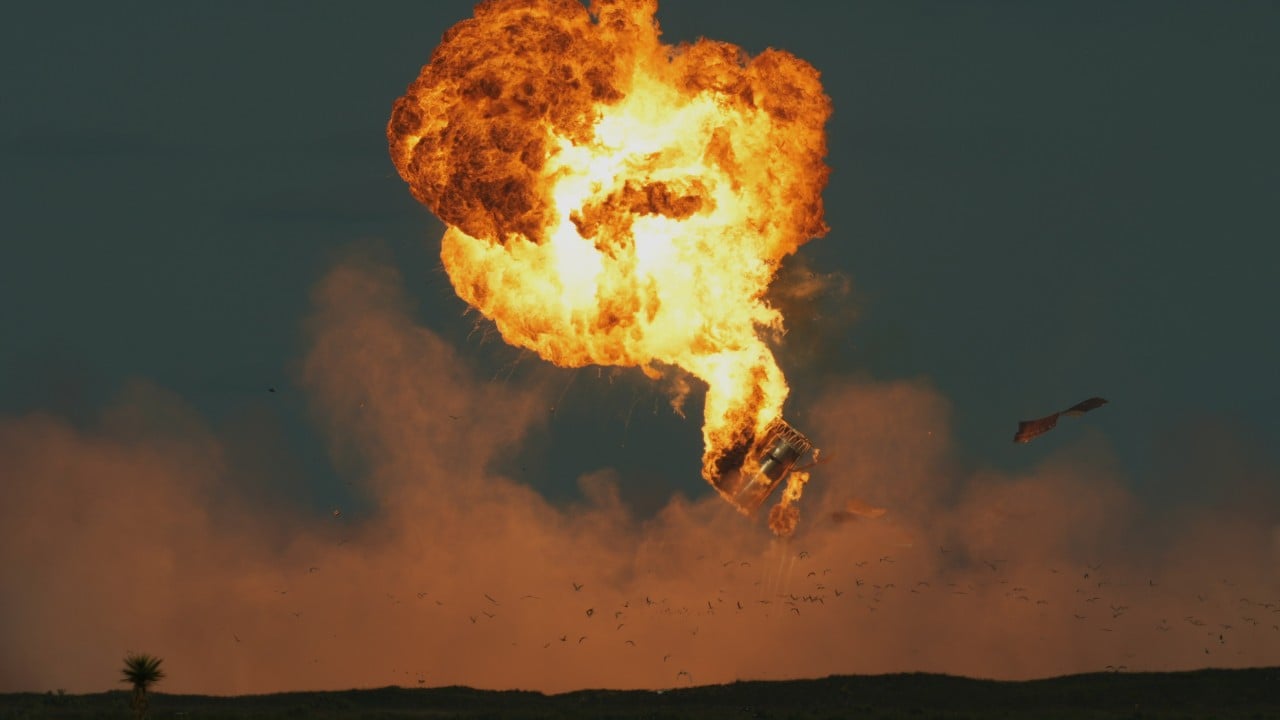
Notice how the booster behaved once the abort triggered. It did not tumble out of control or break up in the upper atmosphere. Instead, it executed a textbook descent profile over the Gulf of Mexico, firing its landing engines to slow down to a near-hover right above the waves before tipping over and breaking apart upon impact. That controlled splashdown is proof that the vehicle’s primary flight controls, grid fins, and Raptor engines were functioning properly. The rocket was healthy enough to land. The system simply decided it was not safe enough to land next to a billion dollars of irreplaceable steel and concrete.
The Physics of the Soft Water Splashdown
Executing a soft splashdown with a 23-story rocket booster is not an easy consolation prize. Even when aimed at the ocean, Super Heavy must survive peak heating during atmospheric reentry, where plasma builds up around its stainless steel skin and titanium grid fins.
As the booster drops into thicker air, the four massive grid fins—each weighing roughly three tons—bite into the atmosphere to steer the cylinder toward a precise set of offshore coordinates. In the final seconds, the rocket relights thirteen of its thirty-three Raptor engines to kill its vertical velocity, then throttles down to just three center gimbaled engines for the final hover. When the engines cut off at sea level, the empty tank structure drops into the water, rupturing its bulkheads from the sudden deceleration and hydrostatic pressure.
Why SpaceX Moves Fast and Breaks Boosters
To outside critics, watching a towering rocket explode in a fireball on the surface of the Gulf looks like failure. Wall Street analysts and legacy aerospace contractors often struggle to reconcile SpaceX’s visual explosions with actual engineering progress. Yet this exact methodology is how Elon Musk’s company captured over eighty percent of the global orbital launch mass market.
Legacy aerospace programs, such as NASA’s Space Launch System built by Boeing and Northrop Grumman, operate under a traditional waterfall development model. Every component is modeled, simulated, and tested on the ground for years before a single piece of flight hardware ever leaves the pad. The goal is zero failures. The consequence is astronomical cost overruns and multi-year delays.
SpaceX uses hardware-rich iterative testing. Because the company manufactures its own stainless steel airframes and 3D-prints major components of its Raptor engines in-house at Hawthorne, California, the marginal cost of building a test article is low enough that losing one in the ocean is treated as the cost of buying real-world flight data.
Consider what SpaceX actually accomplished on that flight despite missing the catch:
- Upper Stage In-Space Relight: For the first time, the Ship upper stage successfully reignited a single Raptor engine while coasting in space, a mandatory requirement for controlled deorbit burns and future orbital refueling missions.
- Thermal Protection Stress Testing: SpaceX deliberately stripped away thousands of heat shield tiles from the sides of the Ship to test the structural limits of the underlying stainless steel during hypersonic reentry, simulating future catch-hardware attachment points.
- Daylight Reentry Data: By launching in the late afternoon Texas time, SpaceX ensured the upper stage reentered over the Indian Ocean in broad daylight, giving onboard cameras and tracking aircraft unprecedented visual data on plasma flow and flap heating.
If the price of validating an orbital Raptor relight and gathering high-definition reentry telemetry is losing a booster that was already slated for retirement anyway, SpaceX takes that trade every single time.
The Myth of the Effortless Repeat
The frustration surrounding the aborted catch stems largely from the sheer perfection of Flight 5 just weeks earlier. When SpaceX caught Booster 12 on its very first try, it altered public perception overnight. Watching a 20-story skyscraper fall out of the sky and get plucked cleanly out of the air by two mechanical arms made the impossible look routine.
It was anything but routine. Post-flight inspections and subsequent engineering disclosures revealed that the Flight 5 catch came perilously close to disaster. During that descent, a misconfigured spin-start gas parameter on one of the Raptor engines nearly caused the landing burn to abort a second before the arms closed. Had that sensor tripped a fraction of a second earlier, Booster 12 would have slammed directly into the launch tower or cratered into the Boca Chica mudflats.
That near-miss is the exact reason Flight 6 aborted to the ocean. SpaceX engineers took the lessons from Flight 5 and tightened the software guardrails. They made the automated abort triggers more sensitive, refusing to let the rocket push through minor telemetry ambiguities just to repeat a historic milestone.
Comparing Recovery Architectures
To see why Super Heavy’s recovery is fundamentally harder than anything attempted in rocketry history, compare it directly to the Falcon 9 booster that revolutionized commercial spaceflight over the past decade.
| Engineering Metric | Falcon 9 First Stage | Starship Super Heavy |
|---|---|---|
| Height | 135 feet (41 meters) | 232 feet (71 meters) |
| Dry Mass | ~25 metric tons | ~200+ metric tons |
| Propellant | RP-1 (Kerosene) & LOX | Liquid Methane & LOX |
| Landing Gear | Four deployable carbon-fiber legs | None (caught by tower arms) |
| Landing Zone | Concrete pad or 300-ft drone ship | Sub-meter tolerance between tower arms |
| Engine Count | 9 Merlin engines | 33 Raptor engines |
Eliminating landing legs on Super Heavy was not a publicity stunt; it was an equation driven by the tyranny of the rocket equation. Supporting a 200-ton structure on deployable legs would require massive structural reinforcement at the base of the rocket, adding tens of tons of dead weight. Every kilogram of landing leg mass carried to stage separation is a kilogram of payload subtracted from low Earth orbit. By shifting the landing mechanism off the rocket and onto the ground tower, SpaceX keeps the booster light enough to meet its 100-ton-plus payload targets.
The Bottleneck Nobody Wants to Admit
While the public fixates on dramatic tower catches, a much quieter crisis threatens SpaceX’s long-term timeline. Catching the booster is only half of the rapid-reusability equation. Even if SpaceX nails every single Super Heavy catch from here on out, the current iteration of the Starship architecture faces severe structural and thermal bottlenecks that prevent true airline-style turnaround.
First, there is the heat shield problem on the upper stage. During reentry, the belly of Starship endures temperatures exceeding 2,600 degrees Fahrenheit. SpaceX uses roughly 18,000 hexagonal ceramic tiles to protect the steel hull. On every single flight to date, dozens of tiles have cracked, shaken loose, or ablated away, exposing the underlying metal to dangerous thermal loads. On Flight 6, intense heating visibly burned through sections of the forward steering flaps, leaving glowing holes in the steel skin as the ship descended toward the Indian Ocean.
You cannot refuel and relaunch a rocket in 24 hours if a crew has to spend three weeks inspecting, replacing, and gluing down thousands of fragile ceramic tiles after every mission.
Second, the current Block 1 and early Block 2 vehicles have lower payload margins than originally advertised. To fulfill its multi-billion-dollar Human Landing System (HLS) contract with NASA for the Artemis III moon mission, SpaceX must launch an orbital propellant depot and then execute anywhere from ten to twenty consecutive tanker flights to fill it with liquid methane and liquid oxygen before a single astronaut ever steps aboard.
If a tanker flight suffers a catch abort and drops its booster into the ocean, that booster is gone forever. SpaceX cannot afford to expend boosters during an orbital refueling campaign. The economics only work if the same booster flies, gets caught, gets restacked, and launches again within days, not months.
Regulatory Friction and the Boca Chica Ceiling
Technology is not the only force dictating when SpaceX tries its next catch. Every time a Starship or Super Heavy deviates from its nominal flight profile, the Federal Aviation Administration (FAA) takes notice.
Under federal commercial spaceflight regulations, any off-nominal event—even a planned, automated water abort—requires SpaceX to submit a formal anomaly report before the FAA will issue a license modification for the next launch. While the FAA has streamlined its review process for expected test-flight failures, shifting a 250-ton rocket’s trajectory over coastal waters triggers consultations with the U.S. Fish and Wildlife Service, the Coast Guard, and environmental watchdogs monitoring the protected wetlands surrounding Boca Chica.
SpaceX is currently pushing for approval to increase its annual launch cadence at Starbase from five launches per year to twenty-five. Every booster that ends up in the Gulf of Mexico gives environmental opponents and regulatory skeptics fresh ammunition to argue that the technology is not mature enough for high-frequency operations near a populated coastline.
The Road to Full Reusability Runs Through Failure
SpaceX is already transitioning away from the older hardware flown on these early tests, moving toward taller, heavier, and more capable Version 2 and Version 3 boosters equipped with upgraded Raptor 3 engines. These next-generation engines eliminate much of the external plumbing and heat shielding that plagued earlier designs, stripping out hundreds of potential sensor failure points that can trigger an automated catch abort.
Until those upgrades are proven in flight, the Gulf of Mexico will remain SpaceX’s ultimate safety net. Watching a towering stainless steel booster sink beneath the waves looks like a setback only if you misunderstand the objective of a test campaign. SpaceX is not trying to put on a flawless airshow for cameras on South Padre Island. It is trying to break the fundamental cost barrier of human spaceflight—and if saving the launch pad means sacrificing the rocket, the software will pull the trigger every single time.