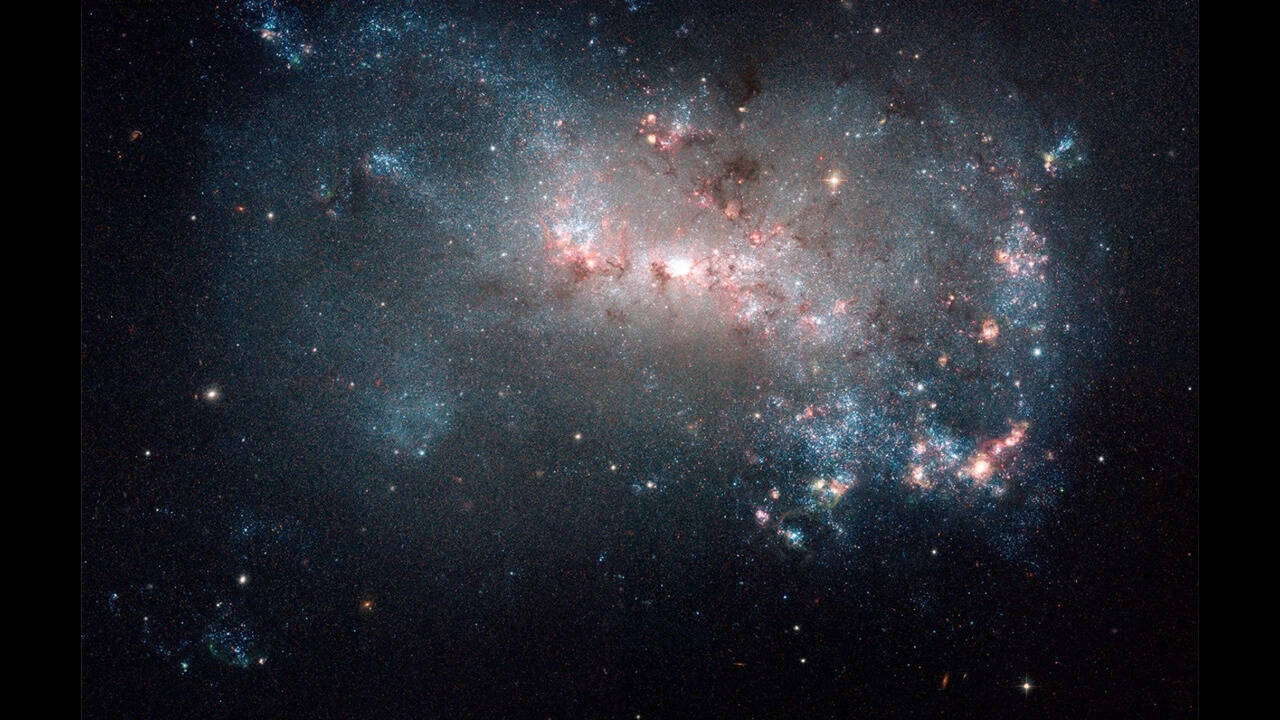
Astronomers spent years looking at dwarf galaxies as gentle nurseries of the universe. They were small, quiet, and seemingly simple. But when the Hubble Space Telescope turned its sensitive ultraviolet eye toward these tiny cosmic backwaters, it caught them in the middle of a quiet tragedy.
They were losing their breath.
Stars build the elements of life inside nuclear furnaces. They forge oxygen, carbon, and iron out of raw hydrogen. When massive stars reach the end of their brief, furious lives, they explode in violent supernovas, flinging those heavy elements into space. In larger galaxies like our own Milky Way, gravity is a iron grip. The galaxy holds onto that fresh oxygen, recycling it into new stars, new planets, and eventually, the air inside living lungs.
Dwarf galaxies fail at this basic survival task. Hubble’s high-resolution cosmic origins spectrograph revealed a staggering loss: dwarf galaxies retain just 11% of the oxygen their stars produce. Nearly nine out of every ten oxygen atoms forged inside their stellar engines simply vanish into intergalactic space.
Understanding why requires looking at how gravity behaves on a small scale.
The Great Escape
Imagine throwing a baseball into the air. Earth’s gravity pulls it back down every time. If you had a strong enough arm—or a rocket engine—you could throw that ball at 11.2 kilometers per second, reaching escape velocity. The ball would break free of Earth forever.
A dwarf galaxy is a city of stars with weak bones. Because it contains only a fraction of the mass of a major spiral galaxy, its gravitational pull is gentle. When a cluster of giant stars dies in a rapid chain of supernovas, the combined blast wave acts like a furious wind.
Instead of gently seeding the surrounding gas clouds, the explosions trigger cosmic superwinds. The heated oxygen gas rockets outward at hundreds of kilometers per second. The dwarf galaxy's escape velocity is too low to stop it. The oxygen shoots past the faint outer boundaries of the galaxy, blowing into the wide, cold emptiness between galaxies.
It leaves behind an impoverished landscape.
Why Missing Oxygen Changes Everything
This is not just a accounting curiosity for astrophysicists. It alters our understanding of how the universe grew up.
Early in cosmic history, the universe consisted almost entirely of dwarf galaxies. They were the primordial building blocks. If these small structures blew away 89% of their heavy elements, they fundamentally altered the space around them. The intergalactic medium—the vast, empty regions between stellar systems—was not empty at all. It was enriched early on by the frantic exhalations of dying dwarf galaxies.
Scientists long wondered why deep space contained trace signatures of heavy elements far from any known major galaxy. Hubble’s observation solved the riddle by turning dwarf galaxies into the primary suspects. They were the cosmic gardeners, tossing their most precious seeds over the fence into the deep night.
Consider the contrast between heavy systems and light ones:
- Spiral Galaxies (like the Milky Way): High gravity traps exploding stellar debris. Oxygen stays pooled inside dense gas disks, creating high metallicities capable of forming rocky, terrestrial worlds.
- Dwarf Galaxies: Low gravity lets supernovas punch holes through the galactic gas layer. Heavy elements blow completely out of the system, leaving remaining stars permanently poor in heavy elements.
The consequences for potential life inside dwarf galaxies are stark. Without retained oxygen and heavy elements, later generations of stars in these systems rarely form solid, rocky planets like Earth. Their worlds remain ghosts of gas and dust.
The Invisible Stakes
Sitting in a control room on Earth, staring at spectral lines plotted on a screen, it is easy to view these findings as pure mathematics. But spectrum lines are human signatures. Every atom of oxygen in every breath you take was forged inside a dying star billions of years ago.
Our solar system exists because an ancient parent galaxy was heavy enough to hoard its wealth. It kept its oxygen. It recycled its iron. It held onto its carbon long enough for a small blue world to coalesce around a yellow star.
When we look through Hubble at a dwarf galaxy bleeding its oxygen out into the dark, we are looking at an alternate history of what might have been. We are observing the limits of cosmic construction.
The supernovas keep firing in those small, dim galaxies. The stellar winds keep blowing. And into the endless cold, nine-tenths of the promise of life drifts away, lost between the stars.