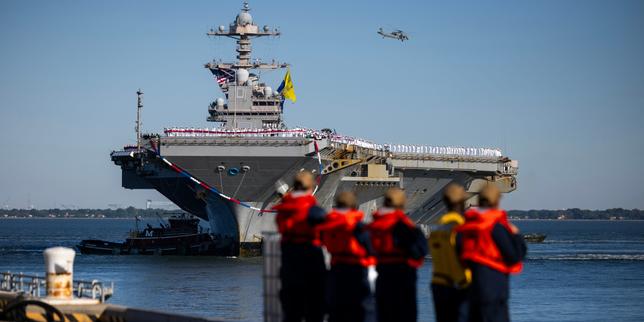
The sea does not care about geopolitics. It only understands weight, salt, and the relentless grinding of time. For nearly three months, the waters of the Eastern Mediterranean bore a weight unlike almost any other on Earth—one hundred thousand tons of nuclear-powered American steel, idling in the gray swells just off the coast of a region on fire.
When the USS Gerald R. Ford finally turned its bow toward the Atlantic, heading home to Norfolk, Virginia, it left a vacuum. Not just a tactical one, but a psychological one.
To understand the departure of the world’s largest warship from a combat zone, you have to understand what it feels like to live inside a pressure cooker. Think of a crowded room where everyone is shouting, fingers resting lightly on triggers. Suddenly, the biggest person in the room steps out the back door. The shouting doesn't stop, but the air changes. The temperature drops, then spikes. That is what happened when the Ford weighed anchor.
The Weight of Presence
For ninety days, the presence of that single ship was the central axis upon which a dozen delicate diplomatic calculations turned.
Step inside the skin of a radar operator on a commercial vessel navigating the Suez Canal during those weeks. Your screens are cluttered. The airwaves are thick with warnings. To your south, Houthi rebels in Yemen are launching drones at cargo ships. To your east, Gaza is a plume of smoke, and the northern border of Israel vibrates with the thrum of Hezbollah rocket fire. But on the horizon, or just beyond it, sits the Ford.
It was a floating city. Four thousand five hundred souls lived aboard her. They drank desalinated seawater, ate thousands of meals a day in fluorescent-lit mess halls, and worked twenty-hour shifts under the deafening roar of steam catapults launching F/A-18 Super Hornets into the night sky.
That ship was sent there for one specific reason. Deterrance. It was a visual sentence written in steel and aviation fuel, meant to read: Do not get involved. It was aimed squarely at Iran and its proxies, a promise of overwhelming violence if the localized nightmare in Gaza spilled over into a total regional war.
Then, the orders came. Go home.
The departure was not a sudden flight; it was a scheduled transition. Yet, in the theater of international relations, timing is everything. The Pentagon framed the move as a routine return to its home port to prepare for future deployments. But out here, where the water meets the sand, nothing feels routine.
The Invisible Stakes
When a superpower moves a piece that large off the board, the silence it leaves behind is deafening.
Consider what happens next on the ground. For months, regional actors had to calculate their movements based on the strike radius of the Ford’s air wing. Every rocket trajectory, every drone path, every troop movement was weighed against the terrifying possibility of American intervention. With the carrier group sailing west, past Gibraltar, those calculations change.
The risk is not that the United States has abandoned the region. Far from it. Other warships remain, including amphibious assault ships and guided-missile destroyers. But the Ford was the symbol. It was the heavy shield held aloft.
Its departure reveals a deeper, more uncomfortable truth about modern conflict. Power is no longer just about who has the biggest ship or the most advanced radar. It is about endurance. It is about how long a nation can maintain a posture of extreme readiness before the human and mechanical gears begin to grind down.
The sailors aboard the Ford had been extended at sea repeatedly. Their deployment was prolonged as the crisis deepened, pushing men and women far past their expected return dates. Families in Virginia watched the news, waiting for a headline that would send their husbands, wives, sons, and daughters back across the Atlantic.
That is the human cost of deterrence. It is measured in missed birthdays, cold dinners, and the quiet anxiety of watching a loved one disappear into a zone of maximum danger.
The Changing Face of Power
The Mediterranean is a graveyard of empires that forgot the limits of their own reach. From the Romans to the Ottomans, every great power has eventually found that holding the center of the world requires more energy than any single state can indefinitely sustain.
The Ford is a marvel of technological hubris. It features an electromagnetic aircraft launch system that replaces the traditional steam pistons used since World War II. It can generate more electrical power than some small nations. It is designed to survive the unsurvivable.
But as it sailed away, it highlighted a stark vulnerability. A hundred-thousand-ton carrier is an incredible tool for projecting power against a conventional enemy. Against asymmetrical threats—against cheap, mass-produced drones launched from a flatbed truck in the Yemeni desert—it is an incredibly expensive hammer looking for a very small, very fast nail.
The Pentagon’s decision to bring the Ford home suggests a quiet acknowledgment of this imbalance. You cannot keep your most expensive asset parked in a firing line indefinitely just to act as a cosmic stopgap.
The strategic focus must shift. The burden now falls on a patchwork of smaller vessels and international coalitions trying to keep the shipping lanes open in the Red Sea. It is less dramatic than a massive carrier strike group, but it is the reality of modern, fractured warfare.
The Restless Water
The ship is gone now. The wakes it carved into the Levantine Sea have flattened out, swallowed by the Mediterranean’s eternal blue.
But the tension remains, hovering just above the surface like humidity before a summer storm. The departure of the USS Gerald R. Ford did not solve the crisis, nor did it spark the explosion many feared. It simply stripped away the illusion of a permanent referee.
The nations of the Middle East, and the non-state actors operating within their borders, are left looking at an altered horizon. The heavy metal shield has been lowered, if only for a moment, to be replaced by different, less visible instruments of American power.
The water is quiet today where the giant used to sit. But beneath that quiet lies the cold, hard certainty that the forces which brought the ship there in the first place are nowhere near finished.
The sea remains. The fire remains. The steel has simply moved on.