The room smells like stale coffee and floor wax. It is 2:00 AM, and the florescent lights overhead buzz with a low, relentless hum. An emergency room physician leans against a pristine metal countertop, eyes burning from a twenty-hour shift, staring at a monitor that shows a heartbeat flickering like a dying candle.
In that sharp, fragile space between life and death, nobody asks about political parties.
Nobody asks if the doctor holding the defibrillator paddle voted blue or red. They just want to live.
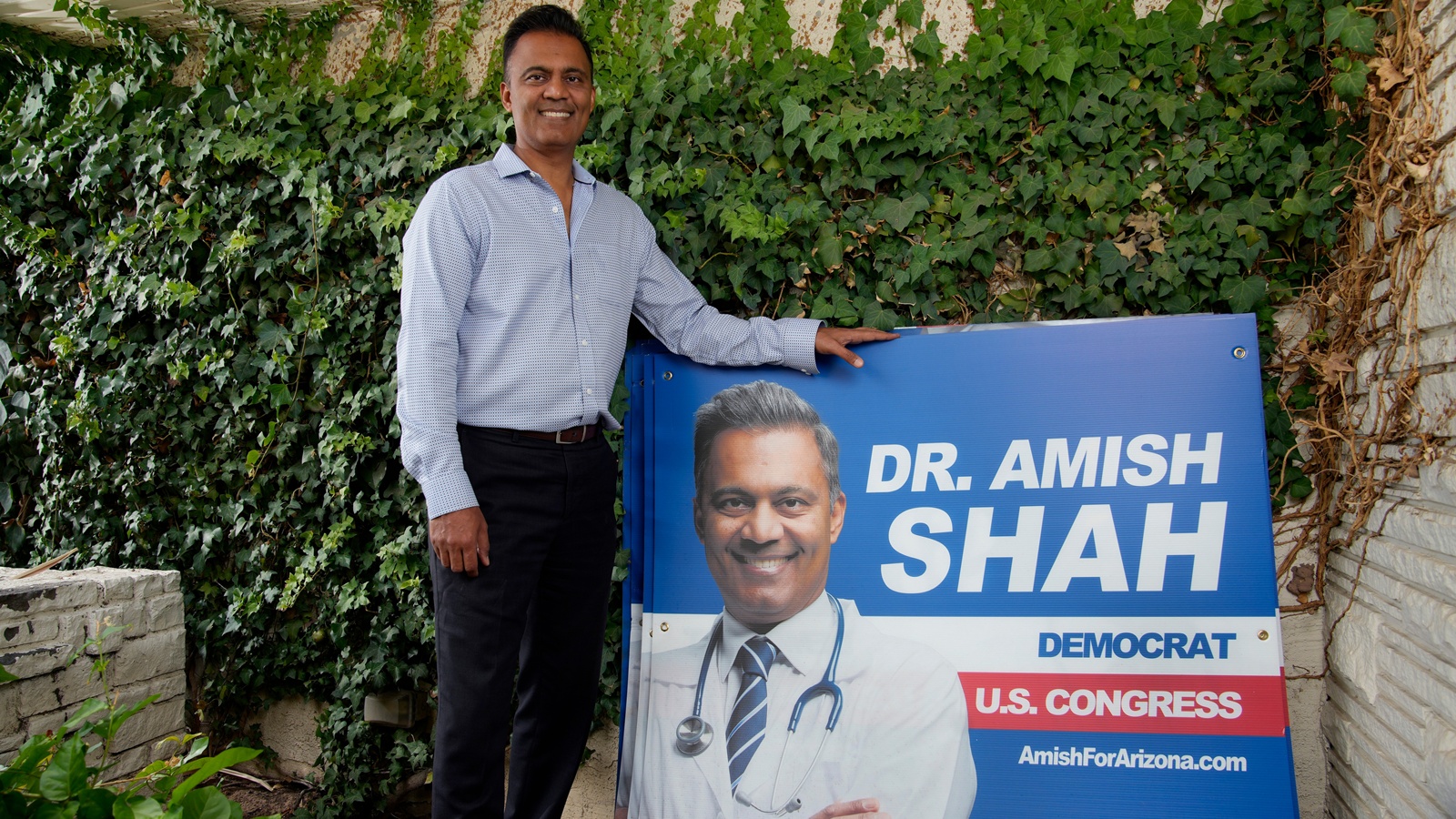
For years, Dr. Amish Shah lived inside that exact reality. He made rapid decisions under blinding pressure, treating thousands of patients across Phoenix emergency rooms. But on a muggy August night, Shah found himself standing in a very different kind of high-stakes room. The monitors didn't display heart rhythms; they displayed precinct percentages.
When the final tallies rolled in, the verdict was clear. Shah, an Indian-American emergency room physician and former state lawmaker, had survived a crowded, brutal primary to secure the Democratic nomination for Arizona’s 1st Congressional District.
Victory.
Briefly.
Because winning a primary is just stepping out of the waiting room into the operating theater. Waiting for him on the other side is David Schweikert, a seven-term Republican incumbent backed firmly by Donald Trump.
The Art of Knocking on Doors Until Your Shoes Bleed
Political analysts love charts. They love demographic overlays, fundraising totals, and voter registration margins. They look at Arizona’s 1st Congressional District—a crucial, affluent swath of suburban Phoenix, Scottsdale, and Paradise Valley—and see a puzzle box of independent voters.
They miss the human wear and tear.
To understand how a doctor end-runs political insiders, you have to look at his shoes. Years ago, when Shah first ran for the Arizona House of Representatives, political consultants told him he didn't fit the mold. He was an outsider. A physician, not a party operator. So Shah did the only logical thing a hyper-focused doctor could do: he began knocking on doors.
He didn't stop. Ten thousand doors. Then twenty thousand. By the time he transitioned his sight to Capitol Hill, his team had logged tens of thousands of direct, face-to-face interactions with real people on their doorsteps.
Consider a hypothetical resident—let's call her Sarah—standing on her porch in Scottsdale in the blistering 105-degree afternoon heat. She opens her front door expecting another glossy, junk-mail flyer or a scripted activist demanding money. Instead, she finds a guy in a plain polo shirt asking a simple, disarming question: What is breaking your heart about your community right now?
That isn't standard campaign strategy. It’s bedside manner.
Shah's primary victory was not a fluke of luck. It was the result of a calculated, relentless campaign of listening to voters who felt ignored by national soundbites. In a seven-candidate primary field crammed with well-funded rivals and party favorites, the physician walked away with the prize because he treated the campaign trail like a massive, sprawling triage unit.
The Friction of Two Worlds
Politics and medicine share a central core: both are fundamentally about triage. You assess the wound. You stop the bleeding. You treat the cause, not just the symptom.
Yet, the two fields collide in deeply uncomfortable ways.
Medicine demands evidence. If a clinical trial proves a drug fails, you discard it. Politics, conversely, often rewards the stubborn repetition of things that are demonstrably false. In an emergency department, if you stall an intervention to debate ideology, the patient dies. In Congress, stalling is practically a feature of the legislative architecture.
Shah's ascent highlights a growing, quiet movement across American politics: the entry of scientists, engineers, and healthcare workers into the halls of power. Voters are weary of professional talking heads who have spent their entire adult lives inside party apparatuses. There is an understated comfort in choosing a leader who has held a human heart in their hands.
It brings a raw, authentic authority. When a candidate talks about the skyrocketing cost of prescription medicine, it hits differently if they’ve had to look a senior citizen in the eye and explain why they can't afford the insulin keeping them alive.
The Wall Standing in November
The primary celebration was short-lived. The political reality waiting in the general election is formidable.
David Schweikert is a fixture of Arizona politics. He is a policy technician, a fiscal conservative with deep roots in the district, and a track record of holding off tough challengers. Moreover, Schweikert carries the powerful endorsement of Donald Trump—a factor that turns out conservative voters with ferocious reliability in suburban pockets of the Sun Belt.
Arizona’s 1st District is a quintessential political battlefield. It is wealthy, highly educated, and politically split down the middle. It represents the exact demographic that has drifted away from traditional conservatism in recent election cycles, yet remains deeply hesitant about national Democratic policy.
This is where the contrast becomes razor-sharp.
On one side stands an incumbent backed by the former president, relying on a coalition of loyal conservatives and economic traditionalists. On the other side stands an Indian-American ER doctor betting everything on the idea that swing voters care less about party loyalty and more about pragmatic, hands-on problem-solving.
It is a high-wire act without a net.
If Shah leans too far to the left, he alienates the crucial moderate Republicans and independents who decide elections in Scottsdale. If he plays it too safe, he risks dampening the enthusiasm of the progressive base he needs to drive turnout.
Beyond the Precinct Maps
Strip away the campaign finance reports, the television ads, and the strategic polling models. What remains is a story about the changing face of American representation.
For decades, the path to power was predictable. Law school, congressional staffer, state legislature, Congress. It was an insular pipeline that produced leaders who spoke the same hyper-polished, focus-grouped language.
When an immigrant's son steps out of a hospital trauma bay and onto a national campaign stage, the script breaks. It reminds us that governance is not meant to be a lifetime career for professional political strategists. It was designed as a temporary civic duty for people who know what it means to work a shift, pay a mortgage, and handle real human crises.
The sun sets over the McDowell Mountains, painting the Arizona sky in brilliant streaks of magenta and dust-orange. The primary ballots are packed away in cardboard boxes, certified and sealed.
Somewhere in the district, a porch light turns on. A door opens. A candidate steps up to the threshold, reaches out a hand, and prepares to listen once more. The real fight has just begun.