Silence.
In a federal courtroom, silence does not feel empty; it feels heavy, pressurized by the weight of thousands of pages of administrative law, environmental impact statements, and architectural blueprints that have suddenly lost their forward momentum. When a federal judge steps onto the bench and issues a procedural ruling that slows down a high-profile construction timeline, the headlines usually reduce the moment to dry bureaucratic friction. They speak of injunctions, zoning reviews, and docket schedules.
They rarely speak of the dust settling on an unpoured foundation.
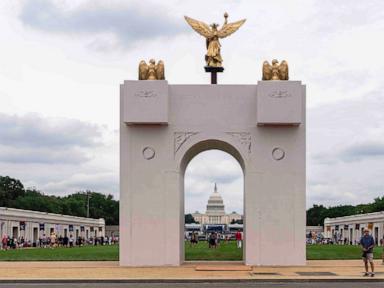
To understand what actually happens when a judge complicates the construction timeline on Donald Trump’s memorial arch project, you have to step away from the cable news chyrons and stand, metaphorically, on the contested ground itself. Imagine—as a purely hypothetical composite of the real tradespeople caught in these legal crosswinds—a structural ironworker named Marcus. For six months, Marcus has kept a rolled-up set of preliminary site drawings in the cab of his pickup truck, waiting for the green light to begin rigging the steel armature that will eventually support hundreds of tons of carved limestone. To politicians, a memorial arch is a legacy, a bold stroke of neoclassical permanence etched onto the American skyline. To commentators, it is a lightning rod for partisan debate over executive authority and public space. To Marcus, and to the civil engineers, quarry workers, and federal preservationists orbiting this project, the arch is a clock that just stopped ticking.
The friction between executive ambition and judicial oversight is as old as the republic, yet every time it plays out in concrete and marble, it feels remarkably personal. A monument is not a policy memo that can be rewritten with the stroke of a pen by the next administration. Once stone is quarried, dressed, and hoisted into place, it alters the physical horizon for centuries. That permanence is precisely why the law moves with such deliberate, maddening caution—and why a single judge’s intervention can send shockwaves through an entire construction timeline.
The Anatomy of a Delayed Foundation
When the plans for the Trump memorial arch first moved from conceptual sketches toward active procurement, the momentum seemed unstoppable. Proponents envisioned a grand, soaring tribute rendered in classic triumphal proportions—a physical anchor meant to commemorate a turbulent, transformative era in American political life. In the modern era of hyper-accelerated political branding, the goal was speed: secure the site, finalize the private and public funding mechanisms, clear the initial regulatory hurdles, and break ground before the political winds could shift.
Architecture, however, refuses to operate on a twenty-four-hour news cycle.
In Washington, D.C., and across federally managed parklands, building anything larger than a park bench requires navigating a labyrinth of statutory checkpoints designed specifically to prevent any single leader from reshaping the civic commons overnight. We are talking about the National Environmental Policy Act, the National Historic Preservation Act, and the oversight of bodies like the Commission of Fine Arts and the National Capital Planning Commission.
Think of these regulations not as red tape, but as the architectural equivalent of a structural load test. Before an engineer allows a crane to lift a fifty-ton lintel into the air, they calculate wind shear, soil compression, and seismic tolerance. Federal judges perform the exact same stress test on the legal foundation of a monument. When environmental groups, preservationists, or neighboring property stakeholders file suit arguing that an agency rushed an environmental assessment or bypassed mandatory public comment periods, the court does not weigh whether the arch is beautiful or politically popular. The court asks a much colder, sharper question: Did the builders follow the rules written by Congress before disturbing the earth?
In this case, the judge’s ruling did not necessarily kill the dream of the arch, nor did it permanently strip the project of its backers. Instead, it did something far more frustrating to project managers and contractors: it fractured the schedule. By requiring more rigorous administrative review—demanding clearer answers on site impact, traffic patterns, historical sightlines, and funding transparency before major excavation can proceed—the court effectively untethered the project from its target completion dates.
What Happens When the Cranes Stand Still
I have spent years watching major civic infrastructure projects stall in the purgatory between approval and groundbreaking, and the sensory reality of a delayed build is something you never forget. You walk past a chain-link perimeter fence where survey stakes—little wooden pegs wrapped in bright orange surveyor's tape—begin to fade in the sun and lean sideways in the mud. The grass grows tall around the temporary trailers.
Behind that quiet fence, money is bleeding out at an astonishing rate.
Construction timelines are not flexible rubber bands; they are interlocking chains of fragile commitments. When a judge introduces an indefinite pause or forces a multi-month supplemental review, three distinct dominoes fall immediately:
- Supply Chain Decoupling: Monumental stone cannot be ordered off a shelf. Quarries in Indiana, Vermont, or Georgia cut specific blocks from specific veins to ensure uniform color and grain. If a project’s timeline slips by nine months, the quarry cannot simply hold a cavern open; it moves on to other commercial contracts, pushing the memorial’s stone fabrication to the back of the line.
- Labor Reallocation: Specialized masons and heavy-rigging crews are scarce. A general contractor who loses a spring mobilization window cannot afford to pay forty union ironworkers to sit in a break trailer reading the paper. Those crews disperse to bridges, hospitals, and private skyscrapers across the region. Reassembling that exact team later carries massive remobilization surcharges.
- Escalating Capital Costs: Every month a major capital project sits in legal limbo, insurance premiums renew, architectural retainers tick upward, and the baseline cost of steel, concrete, and diesel drifts higher. A memorial budgeted at tens of millions of dollars can quietly gain another twenty percent in overhead without a single shovel touching dirt.
It is easy to look at a judicial delay as a clean, clinical victory or defeat in a political chess match. Yet on the ground, it creates a profound sense of vulnerability for everyone trying to build the thing. Even the most seasoned project directors will admit privately that navigating federal litigation is terrifying because you cannot engineer your way out of a court order. You can pour faster-curing concrete, and you can run double shifts under floodlights, but you cannot pour a single yard of footing over a stay issued from the federal bench.
The Echoes of Marble Past
If this bitter tug-of-war over scale, placement, and legality feels unprecedented, history suggests we have simply forgotten how loud the arguments were over the monuments we now treat as sacred, inevitable fixtures of the American landscape.
Consider the Lincoln Memorial. Today, visitors climb its marble steps in hushed reverence, looking out across the Reflecting Pool as if the structure had risen naturally out of the Potomac marsh. In the early twentieth century, however, the project was mired in fierce political and aesthetic warfare. Powerful figures in Congress thought the location—then a swampy, mosquito-infested wasteland—was an insult to Abraham Lincoln’s memory. Some demanded a grand highway to Gettysburg instead; others fought bitterly over whether a Greek temple was an appropriate form for a rugged frontier president. Delays piled upon delays.
Even more visceral was the battle over the Vietnam Veterans Memorial in the early 1980s. Maya Lin’s minimalist, V-shaped cut of black granite sparked outrage among prominent political donors and traditionalists who derided it as a "black gash of shame." Lawsuits were threatened, federal commissions deadlocked, and construction timelines buckled under the weight of emotional and legal intervention. A compromise statue had to be negotiated just to break the administrative logjam and allow the wall to be completed.
The pattern is unmistakable. America has never quietly agreed on how to cast its history in stone. Monuments are arguments made physical. When a president—especially one as polarizing and fiercely committed to visual branding as Donald Trump—seeks to erect a classical triumphal arch, that project inevitably inherits every unresolved tension in the national psyche. The courtroom simply becomes the arena where our collective hesitation meets executive urgency.
Reading the Legal Blueprint
For readers trying to separate political theater from genuine legal jeopardy, the mechanics of a judge complicating a construction timeline come down to a single concept: administrative regularity.
Think of federal agencies—like the National Park Service or the General Services Administration—as trustees managing a vast estate on behalf of 330 million co-owners. When an administration wants to carve out a piece of that estate for a new memorial, the law acts as a mandatory waiting period. If an agency takes shortcuts to please the White House—say, by issuing a "Finding of No Significant Impact" without genuinely studying how a massive stone arch will alter pedestrian flow, drainage, or historic vistas—a federal judge has the statutory duty to hit the brakes.
Does a judicial complication mean the arch will never be built? Not necessarily. Courts rarely issue permanent bans on projects that have lawful funding and congressional or executive authorization. Instead, judges remand the decisions back to the agencies. They hand the blueprints back across the bench and say, "Do the homework you skipped. Hold the public hearings. Answer the preservationists' objections on the record. Then come back."
In politics, however, time is the scarcest currency of all. A six-month delay can bleed into a year; a year can bleed into an election cycle; an election cycle can bring a new administration with entirely different priorities, or a shift in private donor enthusiasm as momentum cools. By complicating the timeline, the judge transforms a sprint into a marathon—and marathons test endurance in ways sprints never do.
Beyond the Scaffolding
Step back for a moment from the legal briefs and look at what is actually at stake in the dirt where this arch is meant to stand.
We live in an era of remarkable ephemerality. Our fiercest debates happen on glowing glass screens, vanish down algorithmic feeds in hours, and leave behind little more than digital ghosts. Perhaps that is why the urge to build in stone remains so intoxicating to leaders—and why the fight over who gets to build, and how fast, triggers such visceral resistance. Stone claims territory. Stone says, We were here, and our version of the story endures.
Yet the very system of laws slowing down the cranes and keeping Marcus’s blueprints rolled up on his dashboard is its own kind of monument. It is an invisible architecture of checks, balances, and forced patience, built specifically to ensure that nothing permanent rises on public ground without surviving the slow, grinding scrutiny of the rule of law.
Out at the proposed site, the wind still moves unimpeded across an empty patch of grass, passing right through the invisible outline of an arch that exists, for now, only on paper and in the quiet, unhurried prose of a federal court docket.



