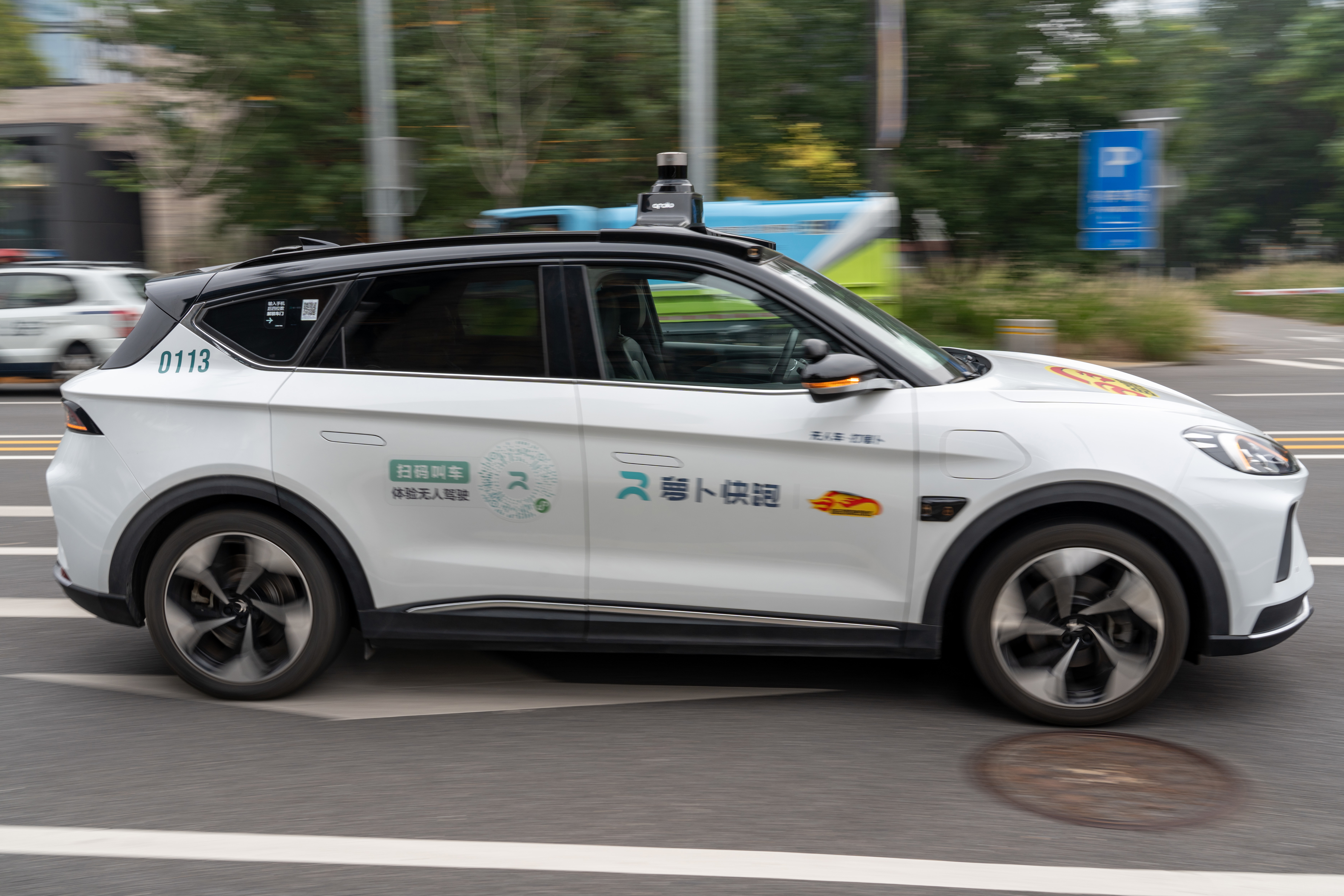
The media is addicted to a very specific kind of tech panic. You have seen the headlines. A fleet of autonomous vehicles suddenly stops in the middle of a busy downtown intersection. Horns blare. Commuters fume. Some local reporter stands in front of a line of stalled Chevy Bolts or Waymo Jaguars and talks about the "chaos" of driverless technology.
The competitor article above falls right into this trap. It looks at a temporary network outage that stranded a few dozen passengers and frames it as a fundamental indictment of autonomous transportation. They want you to believe that robotaxis are a dangerous, unproven threat to our cities. You might also find this similar coverage insightful: Meta Cannot Save Your Kids Because Safety Is Not A Software Patch.
They are dead wrong.
What that article calls a "failure of technology" is actually a triumph of safety protocol. The reporters are asking the wrong question. They are asking, "How do we stop robotaxis from freezing?" As highlighted in recent articles by The Verge, the implications are notable.
The question they should be asking is, "Why do we tolerate the millions of daily human errors that cause exponentially more damage?"
The "Lazy Consensus" of the Robotaxi Panic
Let's dismantle the mainstream narrative piece by piece.
The standard argument goes like this: Autonomous vehicles (AVs) are unpredictable. When they lose connection to the cloud or encounter an edge case they do not understand, they brick themselves. This creates massive traffic snarls and puts passengers at risk. Therefore, we should slow down deployment and keep human drivers behind the wheel.
This is a classic case of the availability heuristic. We notice the one time a robotaxi stops and blocks a lane because it is a novel, bizarre sight. We do not notice the 10,000 human-driven cars that caused fender benders, ran red lights, or blocked intersections that exact same day because that is just the background noise of modern life.
Here is the nuance the tech critics miss: The vehicle stopping is the feature, not the bug.
When an autonomous system detects a critical sensor failure, a loss of communication with central dispatch, or an environmental factor it cannot safely navigate, it is programmed to execute a Minimal Risk Maneuver (MRM). In many cases, that means coming to a controlled stop right where it is.
Is that annoying for the people behind it? Absolutely. Is it safer than the alternative? Invariably.
Compare this to a human driver who experiences a medical emergency, a sudden mechanical failure, or a moment of pure, unadulterated road rage. Humans do not execute a minimal risk maneuver. They plow into the vehicle in front of them. They veer into oncoming traffic. They kill people.
I have spent years looking at mobility data and consulting for municipal transit authorities. I have seen cities waste millions of dollars trying to optimize traffic light grids only to have all those gains wiped out by a single distracted driver looking at a text message. The double standard we apply to machines versus humans is not just illogical; it is actively costing lives.
The Brutal Math of Human Error
To understand why the competitor's outrage is misplaced, we need to look at the baseline we are comparing these machines against.
According to data from the National Highway Traffic Safety Administration (NHTSA), human error is a factor in roughly 94% of all motor vehicle crashes. We are talking about recognition errors, decision errors, and performance errors. Humans fall asleep. Humans drink. Humans get distracted by shiny billboards.
Let's look at the actual physics of a traffic jam caused by humans versus one caused by an AV outage.
A human traffic jam is a chaotic, unpredictable system. It is caused by the "phantom traffic jam" effect, where one driver brakes too hard, causing the driver behind them to brake harder, creating a shockwave that travels backward for miles. These are born purely from human reaction time delays and poor spatial awareness.
An AV outage, on the other hand, is a predictable, static event. A vehicle stops. It stays there until it is remotely reset or manually recovered. It does not cause a chain reaction of panic braking because the other AVs around it communicate its position and route around it.
Imagine a scenario where 100% of the vehicles on a highway are autonomous. There is a localized cellular network failure. Do the cars crash into each other? No. They decelerate simultaneously, maintaining their safe following distances, and come to a halt. The moment the network restores, they accelerate in perfect synchronization, like a train. No reaction time delays. No rubbernecking.
The competitor article treats a software glitch as a fatal flaw. In reality, it is a stepping stone to a system that will make human-caused gridlock a relic of history.
Addressing the "People Also Ask" Flaws
If you look at search trends around this topic, you see the same flawed premises repeated ad nauseam. Let's answer them honestly.
Question: Are robotaxis safer than human drivers?
Yes, and the gap is widening every day. Waymo published research comparing their collision data against human benchmarks over millions of miles. The results showed an 85% reduction in injury-causing crash rates compared to human drivers. Even if you account for underreported minor human crashes, the data is overwhelmingly in favor of the machines. They do not get tired, they do not get drunk, and they do not have road rage.
Question: What happens if a robotaxi gets hacked or loses signal?
If it loses signal, it stops safely. It does not go rogue and start hunting pedestrians like a sci-fi villain. Regarding hacking, the architecture of these systems uses heavily isolated hardware security modules. Is a fleet-wide breach theoretically possible? Yes. But the security protocols required to operate these fleets are orders of magnitude more strict than the security on the smartphone you are holding right now.
Question: Why can't they just pull over to the curb instead of stopping in the lane?
This is a legitimate technical challenge, and it is the one area where the critics have a sliver of a point. Executing a pull-over maneuver requires a high level of situational awareness. If a car has lost its primary sensor feed or its connection to the map, it cannot reliably see if there is a bicycle in the bike lane it needs to cross, or a high curb, or a fire hydrant. Stopping in place is the absolute lowest-risk action it can take. It is inconvenient, but it is the correct engineering decision.
The Real Problem: We Are Building the Wrong Infrastructure
The competitor article wants you to blame the tech companies. I blame the cities.
We are trying to insert 21st-century autonomous technology into early 20th-century road infrastructure. It is like trying to run high-speed fiber optic cables through a sewer system built in the 1800s. It works, but it is not optimal, and things are going to get messy.
If we want to stop seeing headlines about stranded passengers and blocked intersections, we need to stop trying to fix the cars. We need to fix the environment they operate in.
Here is the unconventional, actionable advice that municipal planners and tech leaders need to adopt right now:
1. Dedicated AV Loading Zones
We ban human drivers from parking in bus lanes and loading zones. Why are we not creating dedicated drop-off and physical recovery zones for autonomous vehicles? If an AV needs to execute a minimal risk maneuver, it should have a designated, geofenced area it can limp to so it does not block active traffic lanes.
2. Edge Computing at the Intersection
Relying on a centralized cloud to control a fleet of multi-ton kinetic objects is a recipe for the exact kind of outage the competitor article complained about. We need localized, mesh-networking at the intersection level. If a vehicle loses connection to the main AWS or Google Cloud server, it should immediately hand off control to the local intersection processor. This creates a fail-safe grid that does not rely on a single point of failure.
3. End the "Safety Driver" Theater
Many municipalities still require a human safety driver to sit in the vehicle during testing or certain operations. This creates a moral hazard and slows down the learning rate of the system. We need to push past the uncanny valley. The sooner we remove the human element entirely and let these systems learn from pure machine-to-machine interaction, the sooner they will become flawless.
The High Cost of the Status Quo
Let's talk about the downside of my approach.
If we push for rapid, aggressive deployment of fully autonomous networks, there will be more glitches. There will be more instances of cars stopping awkwardly. There might even be accidents. Tech skeptics will jump on every single incident as proof that the technology is not ready.
But we have to weigh that against the guaranteed, documented cost of doing nothing.
Every day we delay the transition to autonomous fleets is a day we accept tens of thousands of preventable human-caused accidents. We are choosing the devil we know (human incompetence) over the devil we do not (infrequent machine glitches). It is a coward's bargain.
I am tired of reading articles written by people who clearly do not understand how distributed systems or risk management work. They look at a minor, temporary inconvenience and call it a crisis.
It is not a crisis. It is the friction of progress.
If you are a passenger who got stuck in a robotaxi during that outage, I understand your frustration. It sucks to be late to dinner. But you were sitting in a vehicle that was actively prioritizing your survival over your schedule.
Stop asking tech companies to make their cars act more like humans. Humans are terrible drivers. Demand that your city build the infrastructure that lets the machines do their job.